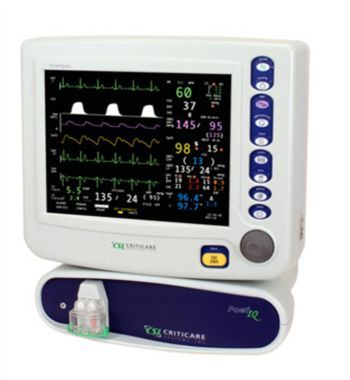
CritiCare Poet IQ 8500H
 CritiCare · Model Poet IQ 8500H
State-of-the-art non-dispersive infrared (NDIR) technology identifies and measures five anesthetic agent gases: Halothane, Enflurane, Isoflurane, Desflurane and Sevoflurane Automatic or manual modes for agent detection Breath-by-breath O2, CO2 and N2O monitoring Adjustable flow rates: 100, 150 and 200 ml/min Mixed agent identification Accuracy not affected by alcohol or ketones Fast warm-up time ensures full accuracy within minutes.
Key tips
- ·A failed daily leak test takes the machine out of service immediately - there is no acceptable workaround.
- ·Never run an agent-specific vaporizer with the wrong agent, even briefly, during testing.
- ·CO2-absorbent exhaustion mimics several unrelated fault symptoms - rule it out early.
Typical Failure Modes
Compiled for this model from its own documentation and established engineering knowledge for this equipment class - not from a verified service record. Confirm against the manufacturer's service manual.
Gas readings inaccurate or drifting
HighSymptoms: CO2 / agent / N2O / O2 values biased, will not calibrate, zero drift.
Root cause: Sample-cell / bench contamination, an aged O2 cell, or a calibration-gas / calibration issue.
Sample-line / water-trap occlusion
MediumSymptoms: "Occlusion" or "sample line blocked", low sample flow, no waveform.
Root cause: Blocked sampling line or a saturated / full water trap (Nafion / moisture trap).
Sample pump fault
MediumSymptoms: Low or no sample flow with a clear line, pump noisy or stopped.
Root cause: Worn sample pump.
O2 sensor fault (paramagnetic / galvanic)
MediumSymptoms: O2 reads wrong or will not calibrate.
Root cause: Aged galvanic O2 cell or a paramagnetic-sensor fault.
Module / host-communication fault
LowSymptoms: Host monitor does not see the gas module, intermittent dropout.
Root cause: Module connector / docking or an internal board fault.
Serviceable Parts & Consumables
Serviceable items for this model, compiled from its documentation and engineering knowledge for this equipment class. Service class and relative cost are estimates, not manufacturer figures; no part numbers are given. Confirm intervals and pricing against the manufacturer.
Water trap / moisture trap
Class ConsumableRel. cost $R&R Easy
Sampling line
Class ConsumableRel. cost $R&R Easy
Sample pump
Class Periodic replacementRel. cost $$R&R Moderate
O2 sensor / cell
Class Frequent wear itemRel. cost $$R&R Fairly easy
Gas bench / sample cell
Class Major service partRel. cost $$$R&R Difficult
| Part | Service class | Relative cost | R&R difficulty |
|---|---|---|---|
| Water trap / moisture trap | Consumable | $ | Easy |
| Sampling line | Consumable | $ | Easy |
| Sample pump | Periodic replacement | $$ | Moderate |
| O2 sensor / cell | Frequent wear item | $$ | Fairly easy |
| Gas bench / sample cell | Major service part | $$$ | Difficult |
Relative cost: $ lowest · $$$$ highest service-part cost for this equipment class. Not a price.
PM Checklist
Preventive-maintenance tasks typical of this equipment class. Perform to the manufacturer's procedure and your facility's policy - this is general reference, not a schedule for this specific unit.
- ·Daily pre-anesthesia machine check: leak test, O2 sensor calibration, per facility protocol
- ·Scheduled vaporizer calibration and agent-specific service
- ·Absorber / CO2 canister replacement
- ·Breathing circuit and hose inspection
- ·Annual full PM and electrical safety test
Troubleshooting Approach
A starting sequence for this model, compiled from its documentation and engineering knowledge for this equipment class. Follow the manufacturer's service documentation for the actual procedure.
Symptom: Occlusion / low sample flow
- Replace the water trap and the sampling line.
- Run the module's flow / leak check.
- Confirm the exhaust / scavenging return is not blocked.
- Replace the sample pump if flow is still low with a clear path.
- Verify the sample flow rate against the spec.
Symptom: Readings inaccurate or will not calibrate
- Run the span calibration with a certified calibration gas.
- Replace the O2 cell if the O2 channel will not calibrate.
- Check for water / contamination in the bench and dry / purge per the manual.
- Allow the full warm-up time before calibrating.
- Escalate a bench fault to the OEM if calibration still fails.
Technical Specs
- Height
- 4 in
- Length
- 10.8 in
- Weight
- 5.9 lbs
- Width
- 14 in
Typical Location
Where this class of equipment is typically deployed - general reference, not this unit's own placement record.
- Operating rooms
- Procedure / endoscopy suites requiring sedation
- Obstetric delivery rooms
Documents & Manuals
Troubleshoot this device with Bio
Describe a symptom or error code. Bio answers from this device's own documented error codes, failure modes, parts, and guides.
Ask Bio