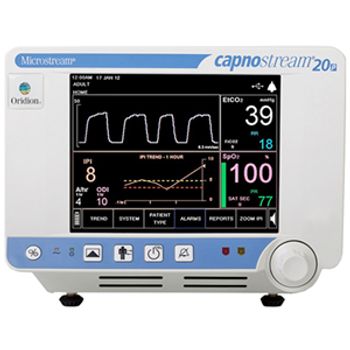
Covidien Capnostream 20P
 Covidien · Model Capnostream 20P
CO2 -specific emission source eliminates need to calibrate for presence of other gases. Accurate and reliable in the presence of various gases and for a wide range of temperature environments. No need for manual calibration and zeroing, water traps, or flushing monitor between patients. Flow rate of only 50 ml/min, especially suitable for neonatal sampling. Utilizes small sample cell (15 µl) for quick responsiveness and accurate monitoring, even with high respiratory rates. Shown in a clinical study to reduce clinically insignificant alarms* by 53% with the Oridion Smart Capnography SARA™ algorithm. Recognizes changes in ventilatory and oxygenation status with the Integrated Pulmonary Index™ (IPI), which combines etCO2, respiratory rate, SpO2, and pulse rate into a single, 1 to 10 index. Connectivity to nurse call, paging, and central monitoring systems including Bernoulli from Cardiopulmonary Corporation, Masimo Patient SafetyNet, and Philips systems using VueLink modules. Battery with two hours of power for patient transport. Choice of Masimo or Nellcor pulse oximetry technologies. Large, bright color display with an easy-to-use, knob-navigated, flat-menu structure. Data export capabilities through standard USB output.
Key tips
- ·A no-signal/flatline alarm gets checked on the patient first, not the monitor - rule out a real clinical event before troubleshooting.
- ·Recalibrate NIBP against a reference manometer, not just a self-test pass.
- ·Reused patient cables (SpO2, ECG leads) are a common source of intermittent-fault complaints - swap the cable before the module.
Typical Failure Modes
Compiled for this model from its own documentation and established engineering knowledge for this equipment class - not from a verified service record. Confirm against the manufacturer's service manual.
A parameter drops out or reads wrong
HighSymptoms: ECG, IBP, SpO2, temperature, CO2 or CO intermittently drops or is implausible.
Root cause: Worn patient cable / sensor, or a parameter-module / input-board fault.
NIBP will not measure or is inaccurate
MediumSymptoms: NIBP times out, cuff will not inflate / hold, readings implausible.
Root cause: Internal NIBP pump or valve, a cuff / hose leak, or a pressure-transducer fault.
Module / parameter not recognised
MediumSymptoms: The host does not display a plugged-in module or a built-in parameter.
Root cause: Docking / connector fault or an internal board fault.
Display / touchscreen fault
MediumSymptoms: Blank, dim or distorted display; unresponsive touchscreen.
Root cause: Display, backlight, or controller fault.
Battery / power fault
MediumSymptoms: Short battery run time, will not hold charge, will not power on.
Root cause: Aged battery pack or a power-supply fault.
Network / central-station connectivity fault
LowSymptoms: Monitor not shown at the central station, admit fails, intermittent drop.
Root cause: Wired / Wi-Fi network configuration or a communication board.
Serviceable Parts & Consumables
Serviceable items for this model, compiled from its documentation and engineering knowledge for this equipment class. Service class and relative cost are estimates, not manufacturer figures; no part numbers are given. Confirm intervals and pricing against the manufacturer.
Patient cable set (ECG / IBP / SpO2 / temp)
Class Frequent wear itemRel. cost $$R&R Easy
NIBP cuff and hose
Class Frequent wear itemRel. cost $R&R Easy
Internal NIBP pump / valve
Class Major service partRel. cost $$$R&R Difficult
Parameter module / input board
Class Major service partRel. cost $$$R&R Difficult
Battery pack
Class Periodic replacementRel. cost $$R&R Fairly easy
Display / touchscreen assembly
Class Major service partRel. cost $$$R&R Moderate
| Part | Service class | Relative cost | R&R difficulty |
|---|---|---|---|
| Patient cable set (ECG / IBP / SpO2 / temp) | Frequent wear item | $$ | Easy |
| NIBP cuff and hose | Frequent wear item | $ | Easy |
| Internal NIBP pump / valve | Major service part | $$$ | Difficult |
| Parameter module / input board | Major service part | $$$ | Difficult |
| Battery pack | Periodic replacement | $$ | Fairly easy |
| Display / touchscreen assembly | Major service part | $$$ | Moderate |
Relative cost: $ lowest · $$$$ highest service-part cost for this equipment class. Not a price.
PM Checklist
Preventive-maintenance tasks typical of this equipment class. Perform to the manufacturer's procedure and your facility's policy - this is general reference, not a schedule for this specific unit.
- ·Routine cable and lead-wire inspection for fraying/wear
- ·Battery conditioning cycle
- ·NIBP calibration check against a reference manometer
- ·ECG / SpO2 accuracy verification against a patient simulator
- ·Annual electrical safety test
Error Codes
Extracted directly from this unit's own service manual.
ETCO2 HIGH ALARMThe EtCO2 is above the upper alarm limit
Patient requires immediate medical attention.
ETCO2 LOW ALARMThe EtCO2 is below the lower alarm limit
Patient requires immediate medical attention.
RR HIGH ALARMThe RR is above the upper alarm limit
Patient requires immediate medical attention.
RR LOW ALARMThe RR is below the lower alarm limit
Patient requires immediate medical attention.
SPO2 HIGH ALARMThe SpO2 is above the upper alarm limit
Patient requires immediate medical attention.
SPO2 LOW ALARMThe SpO2 is below the upper lower limit
Patient requires immediate medical attention.
PULSE RATE HIGH ALARMThe pulse rate is above the upper alarm limit
Patient requires immediate medical attention.
PULSE RATE LOW ALARMThe pulse rate is below the lower alarm limit
Patient requires immediate medical attention.
FiCO2 RATE HIGH ALARMThe FiCO2 rate is above the upper alarm limit
Patient requires immediate medical attention.
CO2 ERRORFailure has occurred which prohibits the operation of the CO2 function.
Contact Oridion authorized personnel.
SPO2 ERRORFailure has occurred which prohibits the operation of the SpO2 function.
Contact Oridion authorized personnel.
PULSE NOT FOUNDNo detectable pulse. Patient requires immediate medical attention.
Reposition sensor on patient.
SPO2 SENSOR NOT ON PATIENTSensor is off patient. Place sensor properly on patient.
Place sensor properly on patient.
FILTERLINE BLOCKAGEFilterLine is kinked or clogged.
Disconnect and reconnect the FilterLine. Check the airway adapter and if necessary, replace the FilterLine.
BATTERY LOWBattery charge level is low and monitor will shutdown soon.
Connect monitor to AC power.
CLEARING FILTERLINEFilterLine kinked or clogged with water. Appears during clearing time until FilterLine is unclogged, or a blockage state is determined.
PERFORMING AUTOZEROThe monitor automatically performs a zeropoint calibration.
NO USB DEVICE FOUNDAdvisory displayed if a USB operation is tried in the absence of a USB device.
USB DEVICE FAILEDDisplayed when the USB device has been detected, but the data transfer operation cannot be successfully completed.
USB FLASH FULLAdvisory displayed when data can no longer be downloaded into a USB memory stick due to the memory being full.
USB TIME OUTAdvisory displayed when monitor is unable to establish communication with USB device.
Troubleshooting Approach
A starting sequence for this model, compiled from its documentation and engineering knowledge for this equipment class. Follow the manufacturer's service documentation for the actual procedure.
Symptom: A parameter drops out or reads wrong (ECG / IBP / SpO2 / temp / CO2 / CO)
- Reseat the patient cable at the module and at the monitor.
- Swap in a known-good cable / sensor for that parameter and re-test.
- Move the module to another host or slot to tell module from host.
- Inspect the module docking connector for bent or recessed pins.
- Verify against a patient simulator; replace the cable, or refer the parameter module / input board if the fault stays with it.
Symptom: NIBP will not measure or is inaccurate
- Leak-test the cuff and hose (occlude and watch for pressure decay).
- Run the monitor's NIBP calibration-verification against a calibrated manometer.
- Confirm correct cuff size and placement and check for a kinked hose.
- Verify against a NIBP simulator at several pressures.
- Refer the monitor for internal pump / valve service if it still fails.
Symptom: Blank / dim / frozen display or unresponsive touchscreen
- Power-cycle the monitor fully (mains removed, battery out where possible).
- Check the display backlight and the display / touchscreen cable.
- Note any boot or self-test error code.
- Re-calibrate the touchscreen if the touch offset is the issue.
- Replace the display / touchscreen assembly or refer the main board.
Symptom: Not shown at the central station / network dropout
- Confirm the wired drop or Wi-Fi settings and that other monitors on that segment are online.
- Check the monitor's network address / unit-bed assignment and re-admit.
- Reseat the network card / cable.
- Restart the monitor's network interface.
- Escalate a whole-unit outage to the central-station server / IT.
Technical Specs
- Height
- 6.6 in
- Length
- 7.6 in
- Power Requirements
- 100-240 VAC
- Pulse Rate Range
- 20-250 BPM
- Weight
- 7.72 lbs
- Temperature Range
- 0 to 40 °C
- Width
- 8.7 in
Typical Location
Where this class of equipment is typically deployed - general reference, not this unit's own placement record.
- ICU / CCU
- Emergency Department
- OR / PACU
- General med-surg floors
- Step-down units
- Telemetry units
Documents & Manuals
Troubleshoot this device with Bio
Describe a symptom or error code. Bio answers from this device's own documented error codes, failure modes, parts, and guides.
Ask Bio