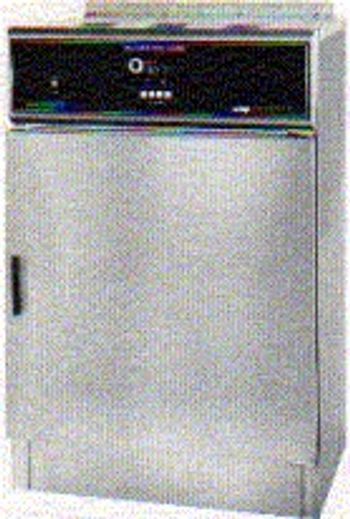
Continental Metal DSW1AE
 Continental Metal · Model DSW1AE
Features. Single or Double Compartment in Various Sizes. Stainless Steel Construction. Microprocessor Control System. Digital Display Indicators. Fahrenheit or Celsius Temperature Scale. U.L. Listed Construction CMP Digital Solution Warming Cabinets are constructed of No. 18 gauge Type 304 stainless steel with No. 4 finish. Compartments are 18" or 24" deep inside. Heating and Storage Compartments have insulated double-wall doors with magnetic catch and heat resistant gaskets. Heating Chamber The chambers are insulated and contain bottom and intermediate adjustable wire shelves. The warming cabinet is capable of heating a full load of solution flasks from 80 degrees F. to 180 degrees F. (27 degrees C. to 82 degrees C.) within 6 hours. Heating is by electric strip heater assemblies mounted on the rear wall of the cabinet, concealed behind a removable perforated guard. Separate temperature controls are available for dual compartment models. Service Requirements 120 VAC, 7 or 12.5 amps, 60 Hz, single phase electrical supply through a single connection to the integral circuit breaker panel. Other Models Available DSW1AE: Single Compartment, 30" wide X 45" high DSW2AE: Dual Compartment, 30" wide X 74" high DSW3AE: Single Compartment, 30" wide X 26" high SC5: Dual Compartment, 24" wide X 60" high Available Options 18" or 24" Compartment Depth Mounting may be Freestanding or Recessed Doors may be Hinged on the Right or Left Sides "Pass-Thru" Feature with Doors on the back of the unit enabling loading of solution warming cabinet from either side. Stainless Steel Base for floor mounting of models DSW3 and SC5 Caster Option Available.
Key tips
- ·Never skip temperature-accuracy verification to save time - it's the one check that directly prevents burns.
- ·Hose/blanket connector wear is the most common real fault and the easiest to miss on a quick visual check.
Typical Failure Modes
Compiled for this model from its own documentation and established engineering knowledge for this equipment class - not from a verified service record. Confirm against the manufacturer's service manual.
Cabinet not reaching / holding set temperature
HighSymptoms: Blanket / fluid cabinet below (or above) setpoint, temperature alarm.
Root cause: Heater element, a temperature sensor / controller fault, a door / gasket leak, or a circulation-fan fault.
Over-temperature safety trip
MediumSymptoms: Cabinet stops heating, over-temp alarm, will not restart.
Root cause: Controller / sensor fault driving the heater high, or a failed independent over-temp thermostat.
Door / gasket / hinge fault
MediumSymptoms: Door will not seal, heat loss, temperature swings when opened.
Root cause: Worn door gasket or a sagging hinge.
Circulation-fan fault
MediumSymptoms: Uneven temperature top to bottom, fan noise or stopped.
Root cause: Worn circulation fan.
Display / controller fault
LowSymptoms: Blank or frozen display, setpoint will not change.
Root cause: Controller or display fault.
Serviceable Parts & Consumables
Serviceable items for this model, compiled from its documentation and engineering knowledge for this equipment class. Service class and relative cost are estimates, not manufacturer figures; no part numbers are given. Confirm intervals and pricing against the manufacturer.
Heater element
Class Major service partRel. cost $$R&R Difficult
Temperature sensor / over-temp thermostat
Class Major service partRel. cost $$R&R Moderate
Door gasket
Class Periodic replacementRel. cost $$R&R Fairly easy
Circulation fan
Class Major service partRel. cost $$R&R Moderate
Controller / display
Class Major service partRel. cost $$R&R Moderate
| Part | Service class | Relative cost | R&R difficulty |
|---|---|---|---|
| Heater element | Major service part | $$ | Difficult |
| Temperature sensor / over-temp thermostat | Major service part | $$ | Moderate |
| Door gasket | Periodic replacement | $$ | Fairly easy |
| Circulation fan | Major service part | $$ | Moderate |
| Controller / display | Major service part | $$ | Moderate |
Relative cost: $ lowest · $$$$ highest service-part cost for this equipment class. Not a price.
PM Checklist
Preventive-maintenance tasks typical of this equipment class. Perform to the manufacturer's procedure and your facility's policy - this is general reference, not a schedule for this specific unit.
- ·Hose / blanket connector inspection
- ·Temperature-accuracy verification
- ·Annual electrical safety test
Troubleshooting Approach
A starting sequence for this model, compiled from its documentation and engineering knowledge for this equipment class. Follow the manufacturer's service documentation for the actual procedure.
Symptom: Not holding set temperature
- Compare the cabinet temperature to an independent calibrated thermometer at several shelf positions.
- Confirm the door seals and the gasket is intact.
- Check the circulation fan runs.
- Verify the heater draws current.
- Replace the sensor, controller or heater as isolated; confirm the max blanket / fluid temperature complies with policy.
Symptom: Over-temperature trip
- Let the cabinet cool.
- Compare the display to an independent reference.
- Replace the temperature sensor if it disagrees.
- Check the independent over-temp thermostat.
- Confirm stable control before returning to use.
Typical Location
Where this class of equipment is typically deployed - general reference, not this unit's own placement record.
- Operating Room
- PACU
- Emergency Department
- Labor & Delivery
- NICU
Documents & Manuals
No documents available for this device yet.
Troubleshoot this device with Bio
Describe a symptom or error code. Bio answers from this device's own documented error codes, failure modes, parts, and guides.
Ask Bio