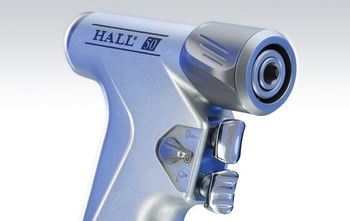
Conmed Hall 50
Conmed · Model Hall 50
The Hall 50 is a power instrument used for orthopedic procedures. Built upon 50 years of dependable power and engineering expertise, the Hall 50™ System combines precise performance, reliable power and convenient sterilization into one solution that delivers unmatched value for hospitals, surgeons and OR staff. Consistent, Long-Lasting Power: Hall 50™ handpieces with UL-approved autoclavable lithium batteries deliver twice the power, capacity and operating time of a standard battery * Improved Control: Hall 50™ handpieces feature variable speed triggers with 400 levels of speed controlled by how far you pull the trigger– providing more precise manipulation of blade and drill speed. The handpieces have also been engineered to produce less vibration and noise. One-Step Sterilization: The Hall 50™ System is the only powered instrument system that allows the batteries, handpieces and attachments to be sterilized together in the same tray at the same time. The Hall 50™ System is backward and forward compatible which means you can use it with both our old and future equipment – delivering better long term value and giving you more for your investment. Hall 50™ handpieces are engineered with TRI-SEAL™ Technology, an advanced triple-sealing which gives the handpieces superior resistance to moisture intrusion. Hall 50™ handpieces have ingress protection ratings of IPX6 and IPX8, indicating resistance to moisture intrusion in the presence of high pressure water jets and submersion. The Hall 50™ system has the highest IPX rating of any handpiece on the market.
Key tips
- ·Never defeat or bypass a return-electrode monitoring (REM) alarm to finish a case - it's a direct burn risk.
- ·Verify OR table battery backup - a table that loses power mid-procedure is a real, documented incident type.
- ·Track surgical light lamp-hours rather than waiting for failure - a sudden failure mid-case is avoidable.
Typical Failure Modes
Compiled for this model from its own documentation and established engineering knowledge for this equipment class - not from a verified service record. Confirm against the manufacturer's service manual.
Weak or no power / stalls under load
HighSymptoms: Handpiece runs slow, stalls when drilling / cutting, or does not run at all.
Root cause: Worn motor / turbine, worn gears / bearings, a low or aged battery, or (pneumatic) low supply pressure / a worn hose.
Overheats in use
MediumSymptoms: Handpiece or attachment gets hot quickly, burn / thermal-necrosis risk.
Root cause: Worn bearings / gears, a dry / seized attachment, or over-duty use.
Battery will not hold charge (battery tools)
HighSymptoms: Few cases per charge, will not reach full charge, sudden shutdown.
Root cause: Aged battery pack or a charger fault.
Chuck / coupling / attachment fault
MediumSymptoms: Bur / blade / pin slips or will not lock, attachment wobbles, quick-coupler worn.
Root cause: Worn chuck / collet or coupling.
Trigger / control fault
MediumSymptoms: Speed will not vary, forward/reverse or oscillate will not select, trigger sticks.
Root cause: Worn trigger / control mechanism or its seals.
Serviceable Parts & Consumables
Serviceable items for this model, compiled from its documentation and engineering knowledge for this equipment class. Service class and relative cost are estimates, not manufacturer figures; no part numbers are given. Confirm intervals and pricing against the manufacturer.
Motor / turbine assembly
Class Periodic replacementRel. cost $$$R&R Difficult
Gear / bearing service kit
Class Periodic replacementRel. cost $$R&R Difficult
Battery pack (battery tools)
Class Periodic replacementRel. cost $$$R&R Fairly easy
Chuck / collet / quick-coupler
Class Periodic replacementRel. cost $$R&R Moderate
Trigger / seal kit
Class Periodic replacementRel. cost $$R&R Moderate
| Part | Service class | Relative cost | R&R difficulty |
|---|---|---|---|
| Motor / turbine assembly | Periodic replacement | $$$ | Difficult |
| Gear / bearing service kit | Periodic replacement | $$ | Difficult |
| Battery pack (battery tools) | Periodic replacement | $$$ | Fairly easy |
| Chuck / collet / quick-coupler | Periodic replacement | $$ | Moderate |
| Trigger / seal kit | Periodic replacement | $$ | Moderate |
Relative cost: $ lowest · $$$$ highest service-part cost for this equipment class. Not a price.
PM Checklist
Preventive-maintenance tasks typical of this equipment class. Perform to the manufacturer's procedure and your facility's policy - this is general reference, not a schedule for this specific unit.
- ·Pre-case functional check
- ·Electrosurgical return-electrode cable inspection
- ·Table hydraulic / mechanical inspection
- ·Annual electrical safety test and full PM
Troubleshooting Approach
A starting sequence for this model, compiled from its documentation and engineering knowledge for this equipment class. Follow the manufacturer's service documentation for the actual procedure.
Symptom: Weak, stalling or no power
- Fit a fully charged battery (battery tools) or confirm the pneumatic supply pressure and hose.
- Fit a fresh, sharp attachment and confirm it seats and locks.
- Run the handpiece off the patient and listen / feel for bearing or gear roughness.
- Service the handpiece (bearings / gears / seals) or replace the motor.
- Confirm rated speed and torque and normal running temperature after service.
Symptom: Overheats
- Use sharp attachments and observe the duty cycle.
- Check the attachment / coupling is not dragging or dry.
- Feel for bearing roughness.
- Service the bearings / gears.
- Confirm the handpiece runs cool under a normal load.
Typical Location
Where this class of equipment is typically deployed - general reference, not this unit's own placement record.
- Operating rooms
- Procedure rooms
- Interventional suites
Documents & Manuals
Troubleshoot this device with Bio
Describe a symptom or error code. Bio answers from this device's own documented error codes, failure modes, parts, and guides.
Ask Bio