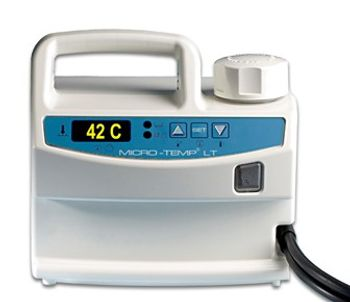
Cincinnati Sub-Zero Micro-Temp LT
 Cincinnati Sub-Zero · Model Micro-Temp LT
A variety of safety features are incorporated into the Micro-Temp® LT. These features include audible and visual alarms for patient and product protection. Additional protection includes an audible and visual alarm if temperature exceeds 1°C over setpoint ideal for neonatal applications. Will shut down in the event the unit tips over or when the water level is too low Easy to Use Self-calibrating microprocessor control also eliminates the need for costly manual calibration Lightweight Built-in handle, which allows the caregiver to easily place the unit on a table or stand near the patient's bed.
Key tips
- ·Never skip temperature-accuracy verification to save time - it's the one check that directly prevents burns.
- ·Hose/blanket connector wear is the most common real fault and the easiest to miss on a quick visual check.
Typical Failure Modes
Compiled for this model from its own documentation and established engineering knowledge for this equipment class - not from a verified service record. Confirm against the manufacturer's service manual.
Not delivering warm air / temperature fault
HighSymptoms: Air not warm, temperature alarm, over-temp shutdown, blows cold.
Root cause: Heater element, a temperature-sensor / thermal-cutout fault, or a control-board fault.
Low airflow / blower fault
MediumSymptoms: Weak airflow, blanket will not inflate, blower noisy.
Root cause: Worn blower, a blocked intake filter, or a kinked / disconnected hose.
Hose / adapter fault
LowSymptoms: Hose cracked, will not connect to the blanket, air leaks at the coupling.
Root cause: Worn hose or end fitting.
Filter overdue / dirty
LowSymptoms: Reduced airflow, longer warm-up.
Root cause: Clogged intake / HEPA filter.
Over-temperature safety fault
MediumSymptoms: Repeated over-temp alarms even with good airflow.
Root cause: Sensor or thermal-cutout fault.
Serviceable Parts & Consumables
Serviceable items for this model, compiled from its documentation and engineering knowledge for this equipment class. Service class and relative cost are estimates, not manufacturer figures; no part numbers are given. Confirm intervals and pricing against the manufacturer.
Heater element
Class Major service partRel. cost $$R&R Moderate
Blower / motor
Class Major service partRel. cost $$R&R Moderate
Temperature sensor / thermal cutout
Class Major service partRel. cost $$R&R Moderate
Intake / HEPA filter
Class Frequent wear itemRel. cost $R&R Easy
Delivery hose / adapter
Class Periodic replacementRel. cost $$R&R Easy
| Part | Service class | Relative cost | R&R difficulty |
|---|---|---|---|
| Heater element | Major service part | $$ | Moderate |
| Blower / motor | Major service part | $$ | Moderate |
| Temperature sensor / thermal cutout | Major service part | $$ | Moderate |
| Intake / HEPA filter | Frequent wear item | $ | Easy |
| Delivery hose / adapter | Periodic replacement | $$ | Easy |
Relative cost: $ lowest · $$$$ highest service-part cost for this equipment class. Not a price.
PM Checklist
Preventive-maintenance tasks typical of this equipment class. Perform to the manufacturer's procedure and your facility's policy - this is general reference, not a schedule for this specific unit.
- ·Hose / blanket connector inspection
- ·Temperature-accuracy verification
- ·Annual electrical safety test
Troubleshooting Approach
A starting sequence for this model, compiled from its documentation and engineering knowledge for this equipment class. Follow the manufacturer's service documentation for the actual procedure.
Symptom: Fluid / blood / blanket not reaching target temperature
- Confirm the correct programme / set for the fluid type and flow rate.
- Check both heater plates (or the water bath) warm evenly.
- Verify the output temperature against an independent reference at a representative flow.
- Replace the temperature sensor if it disagrees.
- Replace the heater plate / control assembly if output is still low.
Symptom: Over-temperature alarm / shutdown
- Let the unit cool and restart.
- Compare the displayed temperature to an independent reference.
- Check for an extreme flow-rate change during use (fluid warmers).
- Replace the temperature sensor / control board as isolated.
- Confirm stable control across the range before returning to service.
Symptom: Low airflow / blower fault (forced-air) or low water flow (water blanket)
- Replace the intake / HEPA filter (forced-air) or top up and de-air the reservoir (water).
- Check the hose for kinks or splits and confirm the correct blanket type.
- Inspect the blower / circulation pump and impeller.
- Replace the blower / pump if flow is still low.
- Confirm delivered air / water temperature and flow after repair.
Technical Specs
- Height
- 9.7 in
- Length
- 8.2 in
- Width
- 9.8 in
Typical Location
Where this class of equipment is typically deployed - general reference, not this unit's own placement record.
- Operating Room
- PACU
- Emergency Department
- Labor & Delivery
- NICU
Documents & Manuals
Safety & Recalls
Synced live from the FDA openFDA API.
- RECALL
Updated Manual-Warnigs have been added stating that exceeding 40'C for extended periods may cause tissue damage
- RECALL
The manual does not provide instruction stating that exceeding 40 Celsius for extended periods can cause tissue damage.
- RECALL
There is the potential that the power switch assembly can dislodge from the cabinet during use.
Troubleshoot this device with Bio
Describe a symptom or error code. Bio answers from this device's own documented error codes, failure modes, parts, and guides.
Ask Bio