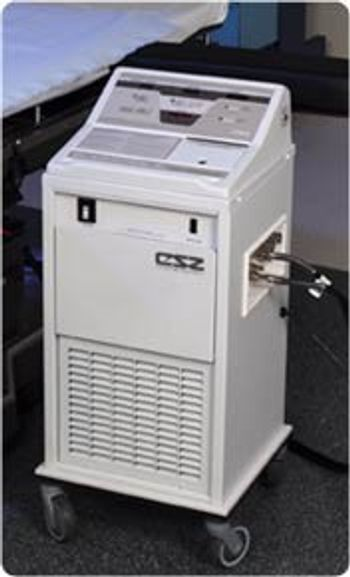
Cincinnati Sub-Zero Blanketrol II
 Cincinnati Sub-Zero · Model Blanketrol II
The unit’s compact size and built-in handle provide ease of use with swivel casters that provide mobility and prevent the unit from tipping. A built-in storage drawer is included in the unit for storage of instruction manuals, probes, connector cables, and hoses. The high water flow rate results in quicker heating or cooling for effective temperature therapy. Three independent safety limits combined with audible and visual alarms to protect your patient. Includes three blanket connections for user convenience. Three operation modes and swivel casters offer ease of use. Operation modes include automatic to control patient temperature, manual to control water temperature, and monitor mode to simply monitor the patient’s temperature. The Blanketrol II also includes pre-warming/cooling feature to simplify setup.
Key tips
- ·Never skip temperature-accuracy verification to save time - it's the one check that directly prevents burns.
- ·Hose/blanket connector wear is the most common real fault and the easiest to miss on a quick visual check.
Typical Failure Modes
Compiled for this model from its own documentation and established engineering knowledge for this equipment class - not from a verified service record. Confirm against the manufacturer's service manual.
Will not reach or hold set patient / water temperature
HighSymptoms: Water temperature drifts from setpoint, patient temperature not tracking, over/under-temp alarm.
Root cause: Heater / thermoelectric or refrigeration fault, a temperature-probe fault, or a circulation-pump / flow fault.
Circulation-pump / flow fault
MediumSymptoms: Low-flow alarm, blanket not filling, pump noisy.
Root cause: Worn pump, an air-locked circuit, or a kinked / disconnected hose.
Patient-probe fault
MediumSymptoms: Patient temperature implausible or open-probe alarm, auto-control will not regulate.
Root cause: Damaged patient temperature probe or its connector.
Leak / reservoir fault
MediumSymptoms: Low-water alarm, water on the floor, air in the lines.
Root cause: Reservoir low, a hose / fitting leak, or a blanket leak.
Refrigeration fault (cooling units)
MediumSymptoms: Cannot cool water, compressor not running.
Root cause: Compressor, condenser fan, or a sealed-system fault.
Serviceable Parts & Consumables
Serviceable items for this model, compiled from its documentation and engineering knowledge for this equipment class. Service class and relative cost are estimates, not manufacturer figures; no part numbers are given. Confirm intervals and pricing against the manufacturer.
Circulation pump
Class Periodic replacementRel. cost $$$R&R Difficult
Patient temperature probe
Class Frequent wear itemRel. cost $$R&R Easy
Heater / thermoelectric module
Class Major service partRel. cost $$$R&R Difficult
Hoses / quick-connectors
Class Periodic replacementRel. cost $$R&R Easy
Refrigeration components (cooling units)
Class Major service partRel. cost $$$R&R Difficult
| Part | Service class | Relative cost | R&R difficulty |
|---|---|---|---|
| Circulation pump | Periodic replacement | $$$ | Difficult |
| Patient temperature probe | Frequent wear item | $$ | Easy |
| Heater / thermoelectric module | Major service part | $$$ | Difficult |
| Hoses / quick-connectors | Periodic replacement | $$ | Easy |
| Refrigeration components (cooling units) | Major service part | $$$ | Difficult |
Relative cost: $ lowest · $$$$ highest service-part cost for this equipment class. Not a price.
PM Checklist
Preventive-maintenance tasks typical of this equipment class. Perform to the manufacturer's procedure and your facility's policy - this is general reference, not a schedule for this specific unit.
- ·Hose / blanket connector inspection
- ·Temperature-accuracy verification
- ·Annual electrical safety test
Troubleshooting Approach
A starting sequence for this model, compiled from its documentation and engineering knowledge for this equipment class. Follow the manufacturer's service documentation for the actual procedure.
Symptom: Will not hold set temperature
- Confirm the reservoir is filled and the blanket circuit is primed (no air).
- Verify the water temperature against an independent thermometer.
- Check the patient probe against a reference and swap it.
- Confirm the circulation pump delivers flow.
- Replace the probe, pump or heater / refrigeration components as isolated.
Symptom: Low-flow or leak alarm
- Check the hoses for kinks and confirm the quick-connectors are seated.
- Top up the reservoir and bleed air from the circuit.
- Inspect the blanket and hoses for leaks.
- Replace a leaking hose / blanket.
- Confirm the flow alarm clears and temperature control is stable.
Technical Specs
- Height
- 36 in
- Length
- 17 in
- Weight
- 131 lbs
- Width
- 17 in
Typical Location
Where this class of equipment is typically deployed - general reference, not this unit's own placement record.
- Operating Room
- PACU
- Emergency Department
- Labor & Delivery
- NICU
Documents & Manuals
Safety & Recalls
Synced live from the FDA openFDA API.
- RECALL
Warnings statements have been added- exceeding 40 degree C for extended periods may cause tissue damage. Additionally, a caution was added and clarifications were made regarding the use of the Automatic modes
- RECALL
The incorrect voltage component was placed into the device during manufacturing. This may make the device unable to maintain patient temperature during cooling mode. The device will continue to indicate that the unit is cooling because the compressor will continue to run, however water in the reservoir will begin to return to ambient temperature. The actual water temperature will be displayed but
- RECALL
During a label review it was discovered that both the Blanketrol III Operations (57201-N) & Operations & Technical (56201-Q) manuals had verbiage added back into the manual during ECN M111-4260 (released 12/29/2011) which was previously removed for clarification of the intended use and subsequent 501(K) approval.
- RECALL
During a customer inquiry regarding a beta version of the Bill Data Export Software, Model USB-127, it was discovered that the wrong software version was released to a customer.
- RECALL
The firm initiated this recall due to changes that have been made to the Blanketrol III Model 233 device's Operation and Operation/Technical Service Manuals, in order to stay in compliance with labeling regulations.
Troubleshoot this device with Bio
Describe a symptom or error code. Bio answers from this device's own documented error codes, failure modes, parts, and guides.
Ask Bio