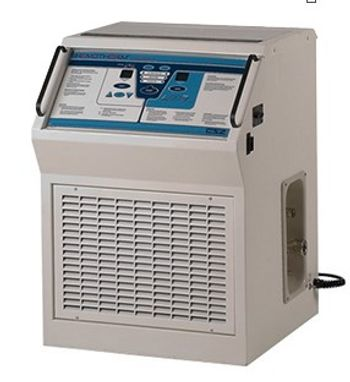
Cincinnati Sub-Zero 400 CE Hemotherm
 Cincinnati Sub-Zero · Model 400 CE Hemotherm
Mechanical refrigeration to replace messy, unmanageable ice Independent heating and cooling reservoirs each with its own controller and temperature display Self-checking microprocessor Supplies water to a blood temperature exchanger/oxygenator or hyper-hypothermia blanket Easy to use interface.
Key tips
- ·Never skip temperature-accuracy verification to save time - it's the one check that directly prevents burns.
- ·Hose/blanket connector wear is the most common real fault and the easiest to miss on a quick visual check.
Typical Failure Modes
Compiled for this model from its own documentation and established engineering knowledge for this equipment class - not from a verified service record. Confirm against the manufacturer's service manual.
Will not reach or hold set patient / water temperature
HighSymptoms: Water temperature drifts from setpoint, patient temperature not tracking, over/under-temp alarm.
Root cause: Heater / thermoelectric or refrigeration fault, a temperature-probe fault, or a circulation-pump / flow fault.
Circulation-pump / flow fault
MediumSymptoms: Low-flow alarm, blanket not filling, pump noisy.
Root cause: Worn pump, an air-locked circuit, or a kinked / disconnected hose.
Patient-probe fault
MediumSymptoms: Patient temperature implausible or open-probe alarm, auto-control will not regulate.
Root cause: Damaged patient temperature probe or its connector.
Leak / reservoir fault
MediumSymptoms: Low-water alarm, water on the floor, air in the lines.
Root cause: Reservoir low, a hose / fitting leak, or a blanket leak.
Refrigeration fault (cooling units)
MediumSymptoms: Cannot cool water, compressor not running.
Root cause: Compressor, condenser fan, or a sealed-system fault.
Serviceable Parts & Consumables
Serviceable items for this model, compiled from its documentation and engineering knowledge for this equipment class. Service class and relative cost are estimates, not manufacturer figures; no part numbers are given. Confirm intervals and pricing against the manufacturer.
Circulation pump
Class Periodic replacementRel. cost $$$R&R Difficult
Patient temperature probe
Class Frequent wear itemRel. cost $$R&R Easy
Heater / thermoelectric module
Class Major service partRel. cost $$$R&R Difficult
Hoses / quick-connectors
Class Periodic replacementRel. cost $$R&R Easy
Refrigeration components (cooling units)
Class Major service partRel. cost $$$R&R Difficult
| Part | Service class | Relative cost | R&R difficulty |
|---|---|---|---|
| Circulation pump | Periodic replacement | $$$ | Difficult |
| Patient temperature probe | Frequent wear item | $$ | Easy |
| Heater / thermoelectric module | Major service part | $$$ | Difficult |
| Hoses / quick-connectors | Periodic replacement | $$ | Easy |
| Refrigeration components (cooling units) | Major service part | $$$ | Difficult |
Relative cost: $ lowest · $$$$ highest service-part cost for this equipment class. Not a price.
PM Checklist
Preventive-maintenance tasks typical of this equipment class. Perform to the manufacturer's procedure and your facility's policy - this is general reference, not a schedule for this specific unit.
- ·Hose / blanket connector inspection
- ·Temperature-accuracy verification
- ·Annual electrical safety test
Troubleshooting Approach
A starting sequence for this model, compiled from its documentation and engineering knowledge for this equipment class. Follow the manufacturer's service documentation for the actual procedure.
Symptom: Fluid / blood / blanket not reaching target temperature
- Confirm the correct programme / set for the fluid type and flow rate.
- Check both heater plates (or the water bath) warm evenly.
- Verify the output temperature against an independent reference at a representative flow.
- Replace the temperature sensor if it disagrees.
- Replace the heater plate / control assembly if output is still low.
Symptom: Over-temperature alarm / shutdown
- Let the unit cool and restart.
- Compare the displayed temperature to an independent reference.
- Check for an extreme flow-rate change during use (fluid warmers).
- Replace the temperature sensor / control board as isolated.
- Confirm stable control across the range before returning to service.
Symptom: Low airflow / blower fault (forced-air) or low water flow (water blanket)
- Replace the intake / HEPA filter (forced-air) or top up and de-air the reservoir (water).
- Check the hose for kinks or splits and confirm the correct blanket type.
- Inspect the blower / circulation pump and impeller.
- Replace the blower / pump if flow is still low.
- Confirm delivered air / water temperature and flow after repair.
Technical Specs
- Height
- 32 in
- Length
- 22 in
- Width
- 22
Typical Location
Where this class of equipment is typically deployed - general reference, not this unit's own placement record.
- Operating Room
- PACU
- Emergency Department
- Labor & Delivery
- NICU
Documents & Manuals
Safety & Recalls
Synced live from the FDA openFDA API.
- RECALL
Due to FDA's safety communication relating to nontuberculous mycobacteria (NTM) infections related to heater/cooler devices, an updated Instructions For Use includes a more robust cleaning & disinfection procedure.
- RECALL
Improperly rated fuses were used in the manufacture of the device.
- RECALL
The device may not maintain water flow or temperature control.
- RECALL
Design error. The probe jack contacts (terminals on certain of the firm's ECMO Heater devices are located too close to the solid state relay contacts (terminals) which can lead to the terminals coming into contact with one another. If this situation occurs, a Service Technician, Operator/User, and/or Patient could be exposed to electric shock during device servicing or use. This situation was ori
Troubleshoot this device with Bio
Describe a symptom or error code. Bio answers from this device's own documented error codes, failure modes, parts, and guides.
Ask Bio