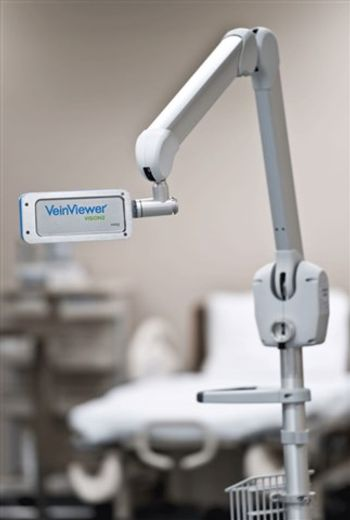
Christie Medical Holdings VeinViewer Vision2
 Christie Medical Holdings · Model VeinViewer Vision2
Universal - A benefit for all your patients. The brightest and most accurate direct-projection, baseline mode available. Ideal for minimizing surface structures such as hair and wrinkles. Fine Detail - Enhances finer structures, ideal for identifying small veins in pediatric or sclerotherapy patients. Inverse - Allows you to switch colors within the image window. This unique feature assists clinicians in customizing the projected image based on factors such as skin tone, density of hair follicles and room brightness. Resize - Allows you to choose one of three window sizes, a valuable feature for pediatric patients or when you need to focus on only one vessel. Image Capture - Allows the user to take and store up to 200 static images of patient vasculature on the device and transfer them to a PC for integration to HIS/RIS/PACS. No patient data is captured; HIPAA compliant. Excellent for documentation of vascular access site pre and post access, for setting expectations with aesthetics patients and demonstrating outcomes. Maximum Brightness - Increases our marketing leading image brightness by another 40% for scenarios where greater than standard ambient lighting. TriColor - Provides a choice of color for the projected image (green, yellow, white). Allows further customization for the clinician. Clinician can adjust image for varying skin tones and personal preference.
Key tips
- ·When no category-specific guidance fits, default to the manufacturer's own service manual and the general troubleshooting method in the Engineer's Guide.
- ·Run an incoming and annual electrical safety test regardless of how niche the device is.
Typical Failure Modes
Compiled for this model from its own documentation and established engineering knowledge for this equipment class - not from a verified service record. Confirm against the manufacturer's service manual.
Unit will not power on from AC (wall) power
HighSymptoms: No power on AC, no indicator lights, unit dead at the wall.
Root cause: Unplugged or unseated line cord, a damaged/failed-continuity AC cord, or a DC power-supply / charger-board fault.
Runs on AC but will not run on battery
HighSymptoms: Works plugged in, dies when unplugged, battery does not charge.
Root cause: Aged battery pack or a failed charger board.
Projected vein image dim, out of focus, or misaligned
MediumSymptoms: Weak projection, blurred image, image offset from the actual vasculature.
Root cause: Projector light source or NIR camera degradation, or an alignment/calibration drift.
Head / wrist-joint droop or binding
LowSymptoms: Projection head will not hold position, drifts, or is stiff to aim.
Root cause: Worn wrist-joint friction or a loose head mount.
Cart wheel / stability issue
MediumSymptoms: Wheels do not roll or lock, unit tips when moved incorrectly (per FDA notice).
Root cause: Worn casters/locks; centre of gravity when the head is extended.
Serviceable Parts & Consumables
Serviceable items for this model, compiled from its documentation and engineering knowledge for this equipment class. Service class and relative cost are estimates, not manufacturer figures; no part numbers are given. Confirm intervals and pricing against the manufacturer.
AC line cord
Class Periodic replacementRel. cost $R&R Easy
Rechargeable battery pack
Class Periodic replacementRel. cost $$R&R Fairly easy
Charger board
Class Major service partRel. cost $$$R&R Moderate
DC power supply (12 VDC)
Class Major service partRel. cost $$R&R Moderate
Wrist-joint friction / head-mount kit
Class Major service partRel. cost $R&R Moderate
Caster set with locks
Class Major service partRel. cost $R&R Fairly easy
| Part | Service class | Relative cost | R&R difficulty |
|---|---|---|---|
| AC line cord | Periodic replacement | $ | Easy |
| Rechargeable battery pack | Periodic replacement | $$ | Fairly easy |
| Charger board | Major service part | $$$ | Moderate |
| DC power supply (12 VDC) | Major service part | $$ | Moderate |
| Wrist-joint friction / head-mount kit | Major service part | $ | Moderate |
| Caster set with locks | Major service part | $ | Fairly easy |
Relative cost: $ lowest · $$$$ highest service-part cost for this equipment class. Not a price.
PM Checklist
Preventive-maintenance tasks typical of this equipment class. Perform to the manufacturer's procedure and your facility's policy - this is general reference, not a schedule for this specific unit.
- ·Follow the manufacturer's PM schedule
- ·Perform incoming and annual electrical safety testing per facility biomedical program
Troubleshooting Approach
A starting sequence for this model, compiled from its documentation and engineering knowledge for this equipment class. Follow the manufacturer's service documentation for the actual procedure.
Symptom: Vision2 will not power on using AC power
- Confirm the unit is plugged into a live wall outlet and the line cord is fully seated in the unit.
- Test the AC line cord for damage and continuity (Test one in the service guide); replace if it fails.
- Measure the DC power supply output - it should be 12 VDC (Test two).
- If the DC supply is correct, check the charger-board output.
- Replace the failed cord, DC supply or charger board and re-verify AC and battery operation.
Symptom: Works on AC but not on battery
- Fully charge on AC and note the run time on battery.
- If run time is very short, replace the battery pack.
- If the battery will not charge at all, check the charger board output.
- Replace the charger board if its output is absent or low.
- Verify the unit runs and charges normally after repair.
Technical Specs
- Height
- 69.8 in assembled
- Weight
- 54 lbs
Typical Location
Where this class of equipment is typically deployed - general reference, not this unit's own placement record.
- Varies by device - check the unit's own manual for facility placement guidance
Documents & Manuals
Safety & Recalls
Synced live from the FDA openFDA API.
- RECALL
Instrument may tip over if not moved correctly.
Troubleshoot this device with Bio
Describe a symptom or error code. Bio answers from this device's own documented error codes, failure modes, parts, and guides.
Ask Bio