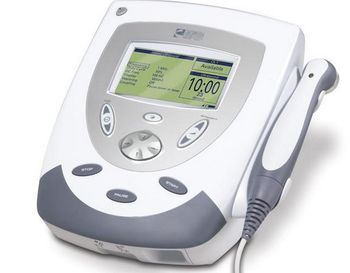
Chattanooga Intelect Transport Combo
 Chattanooga · Model Intelect Transport Combo
Fully functional 1 and 3.3 MHz ultrasound frequencies. Two channels of electrical stimulation output. Ten user-defined memory positions for User Protocols. Four standard waveforms on board: Interferential, Premodulated, High Volt, and Russian. Pulsed and continuous therapy operation (10%, 20%, 50% and 100%). Independent intensity and parameter controls for each channel. Ergonomically designed Sound Head Applicators in a variety of sizes (1 cm², 2 cm², 5 cm² and 10 cm²). All Sound Head Applicators are interchangeable with Electronic Signature™ residing on all transducers. Watertight sound heads for use in underwater therapy. Head-warming feature on all Sound Head Applicators. Unit uniquely designed for tabletop, wall mount, therapy cart or mobile use.
Key tips
- ·Most "no output" stim-unit complaints are cable-side - check electrode/lead continuity before assuming a unit fault.
- ·Frame and strap wear on mechanical rehab equipment is a real fall/injury risk - don't defer it as cosmetic.
Typical Failure Modes
Compiled for this model from its own documentation and established engineering knowledge for this equipment class - not from a verified service record. Confirm against the manufacturer's service manual.
No or low output on a modality / channel
HighSymptoms: Ultrasound, e-stim, shortwave or laser channel delivers no or weak output, error on that channel, patient feels nothing.
Root cause: Applicator / electrode / handpiece fault, a lead / cable fault, dried electrodes, or an output-stage fault on that module.
Therapeutic-ultrasound applicator fault
MediumSymptoms: Low or no ultrasound output, applicator-contact / BNR error, no warmth on a water-bath test.
Root cause: Worn or cracked applicator crystal, or a cable fault.
Electrode / lead-wire wear
MediumSymptoms: Intermittent stim, open-circuit error, uneven sensation.
Root cause: Worn lead wires or exhausted / dried self-adhesive electrodes.
Touchscreen / control fault
MediumSymptoms: Unresponsive or erratic touchscreen, parameters will not set.
Root cause: Touchscreen or controller fault.
Power / battery / cooling fault
LowSymptoms: Will not power on, short battery life, or shuts down on temperature.
Root cause: Power supply / fuse, an aged battery, or a cooling-fan fault.
Serviceable Parts & Consumables
Serviceable items for this model, compiled from its documentation and engineering knowledge for this equipment class. Service class and relative cost are estimates, not manufacturer figures; no part numbers are given. Confirm intervals and pricing against the manufacturer.
Therapeutic-ultrasound applicator
Class Periodic replacementRel. cost $$R&R Easy
Electrotherapy lead wires
Class Frequent wear itemRel. cost $R&R Easy
Self-adhesive / carbon electrodes
Class ConsumableRel. cost $R&R Easy
Output board / module
Class Major service partRel. cost $$$R&R Difficult
Touchscreen / control assembly
Class Major service partRel. cost $$R&R Moderate
| Part | Service class | Relative cost | R&R difficulty |
|---|---|---|---|
| Therapeutic-ultrasound applicator | Periodic replacement | $$ | Easy |
| Electrotherapy lead wires | Frequent wear item | $ | Easy |
| Self-adhesive / carbon electrodes | Consumable | $ | Easy |
| Output board / module | Major service part | $$$ | Difficult |
| Touchscreen / control assembly | Major service part | $$ | Moderate |
Relative cost: $ lowest · $$$$ highest service-part cost for this equipment class. Not a price.
PM Checklist
Preventive-maintenance tasks typical of this equipment class. Perform to the manufacturer's procedure and your facility's policy - this is general reference, not a schedule for this specific unit.
- ·Frame and strap wear inspection
- ·Electrode lead continuity check
- ·Annual electrical safety test
Error Codes
Extracted directly from this unit's own service manual.
100Ultrasound Applicator became unplugged
Plug Ultrasound Applicator into proper receptacle on unit making certain it is completely seated
101Ultrasound Applicator unplugged
User attempted to start an Ultrasound treatment, but no Ultrasound Applicator was plugged into unit. Plug Ultrasound Applicator into proper receptacle on unit making certain it is completely seated
102Ultrasound Applicator not calibrated
Contact dealer or Chattanooga Group for service.
103Ultrasound Channel not available
Wait until Ultrasound treatment is completed or stop Ultrasound treatment and try again
104Stim Channel not available
Wait until Ultrasound treatment is completed or stop Ultrasound treatment and try again
105Stim Channel not available
User attempted to select a two channel Electrotherapy treatment, but at least one of the two stim channels were already in use. Wait until Ultrasound treatment is completed or stop Ultrasound treatment and try again
106Over current Stim channel has exceeded allowed current level and the treatment has been stopped
Reset treatement parameters and attempt session again
107Bad Contact Quality Electrode contact is poor
Apply new electrodes to the treatment area
108Shortened Lead Wires Lead Wires are bad
Replace with new lead wires
109Power Supply current limit
User attempted to start two channels of Electrotherapy while running an Ultrasound treatment with a 10 cm2 Ultrasound Applicator and Ultrasound Output is currently set to greater than 15 Watts. Wait until Ultrasound treatment is completed or stop Ultrasound treatment and try again or decrease ultrasound output to less than 15 Watts
200Error while attempting to save Ultrasound Applicator Calibration Data. Could not save the Calibration Data to the Ultrasound Applicator
1. Replace the Ultrasound Applicator with a known good Ultrasound Applicator 2. Replace Ultrasound Board 3. Replace Control Board
201Error Applicator not calibrated OK. Could not calibrate Ultrasound Applicator
1. Attempt to calibrate again 2. Replace the Ultrasound Applicator with a known good Ultrasound Applicator 3. Replace Ultrasound Board 4. Replace Control Board
202Timed out while saving the Ultrasound Applicator Calibration Data. Could not save the Calibration Data to the Ultrasound Applicator
1. Replace the Ultrasound Applicator with a known good Ultrasound Applicator 2. Replace Ultrasound Board 3. Replace Control Board
203Error reading Protocol. Error reading a Protocol from the EEPROM
Restore Factory Settings, restore Factory Protocols and rebuild all User Protocols
204Main Software Flash Erase Error
1. Replace appropriate Stim Board 2. Replace Control Board
205Main Software Flash Echo
1. Replace appropriate Stim Board 2. Replace Control Board
206Main Software CRC Error
1. Replace appropriate Stim Board 2. Replace Control Board
207Main Software Program Flash Error
1. Replace appropriate Stim Board 2. Replace Control Board
208Main Software Acknowledge Error
1. Replace appropriate Stim Board 2. Replace Control Board
209Software CRC Acknowledge Error. Software upgrade Error
Replace Control Board
210Channel Software Flash Erase Error
1. Replace appropriate Stim Board 2. Replace Control Board
211Channel Software CRC Error
1. Replace appropriate Stim Board 2. Replace Control Board
212Channel Software Program Flash Error
1. Replace appropriate Stim Board 2. Replace Control Board
213Channel Software Acknowledge Error
1. Replace appropriate Stim Board 2. Replace Control Board
214Channel Software CRC Acknowledge Error
1. Replace appropriate Stim Board 2. Replace Control Board
300Unit CFG Critical Error Error communicating with Stim Board on Powerup
1. Replace appropriate Stim Board 2. Replace Control Board
301No Stim Board Critical Error Error detecting Stim Board on Powerup
1. Replace appropriate Stim Board 2. Replace Control Board
302No Ultrasound Board Critical Error Error detecting Ultrasound Board on Powerup
1. Replace Ultrasound Board 2. Replace Control Board
303EEPROM Critical Error Error reading EEPROM on Powerup.
Replace Control Board
304Ultrasound Board Critical Error Error communicating with the Ultrasound Board
305Ultrasound Board Critical Error Error communicating with the Ultrasound Board
306Ultrasound Board Critical Error Error communicating with the Ultrasound Board
307Ultrasound Board Critical Error Ultrasound Board Write Critical Error
308Ultrasound Board Critical Error Ultrasound Board Read_Write Critical Error
309Ultrasound Board Critical Error Ultrasound Board Reset Critical Error
310Ultrasound Board Critical Error Ultrasound Board Read Critical Error
314Ultrasound Board Critical Error Error communicating with the Ultrasound Board
Troubleshooting Approach
A starting sequence for this model, compiled from its documentation and engineering knowledge for this equipment class. Follow the manufacturer's service documentation for the actual procedure.
Symptom: Will not scan / inaccurate bladder volume
- Charge the device fully and retry.
- Confirm gel and probe placement over the bladder with the pubic bone below the probe.
- Verify against a bladder phantom if available.
- Swap the probe if the site has a spare.
- Return for calibration / probe service if volumes stay implausible.
Symptom: Battery will not hold charge / will not power on
- Charge for the full recommended time and check the cradle contacts.
- Run a battery capacity check if supported.
- Replace the battery.
- Confirm scan count per charge returns to normal.
- Clean and inspect the charging cradle.
Symptom: Image drops out when the probe cable is moved / probe not detected
- Flex the probe cable along its length and at both ends.
- Inspect and clean the connector.
- Try a known-good probe.
- Replace the probe cable or connector.
- Confirm a stable image.
Typical Location
Where this class of equipment is typically deployed - general reference, not this unit's own placement record.
- Physical therapy / rehab gym
- Outpatient rehab clinic
- Sports medicine
Documents & Manuals
Troubleshoot this device with Bio
Describe a symptom or error code. Bio answers from this device's own documented error codes, failure modes, parts, and guides.
Ask Bio