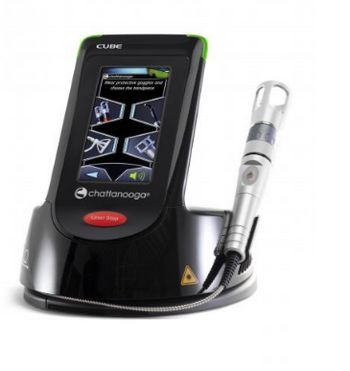
Chattanooga Cube
 Chattanooga · Model Cube
Biostimulation is the ability to stimulate and promote tissue growth and repair at the cellular level. The wavelengths of laser light are mainly absorbed by the chromophores, molecules located inside cells able to convert laser light. The products of this process are indispensable substances for the repair, growth and proliferation of cells. Using the appropriate wavelength, the maximum therapeutic effect on the target tissue can be achieved. Depending on the modulation of the wavelength and on the different parameters set, different effects can be achieved: Laser light is absorbed and partly scattered in the target tissue and thereby largely converted into heat. This thermal stimulus to the nociceptors of the skin affects the peripheral neurological tract and polarizes the neurons important for our pain perception. This polarization activates the neural and humoral endorphinergic pain inhibition system with immediate pain relief as a result.
Key tips
- ·Verify true laser output with an external power meter, not the console readout - the display drifts independently of real delivered energy.
- ·Never bypass a door interlock, key switch, or footswitch safety to finish a treatment - laser safety interlocks are not optional.
- ·Most low-output complaints trace to the delivery fiber or handpiece, not the laser source - inspect and swap those first.
- ·Intermittent mid-treatment shutdowns are usually cooling-related - check coolant level and flow before suspecting the diode or lamp.
Typical Failure Modes
Compiled for this model from its own documentation and established engineering knowledge for this equipment class - not from a verified service record. Confirm against the manufacturer's service manual.
No or low laser output
HighSymptoms: Weak or no output at the delivery device, treatment ineffective, power not reaching the set value.
Root cause: Laser module / lamp / diode-bar ageing, a damaged delivery fibre / handpiece / applicator, or a driver / power-supply fault.
Cooling / thermal shutdown
HighSymptoms: Unit shuts down after a period, over-temperature or low-flow alarm.
Root cause: Chiller / TEC fault, low or contaminated coolant, a failed pump, or blocked airflow.
Delivery fibre / handpiece / applicator fault
MediumSymptoms: Burn marks at the tip, high loss, intermittent output, applicator not recognised.
Root cause: Damaged or contaminated fibre / applicator / connector.
Skin-cooling / contact-cooling fault (aesthetic)
MediumSymptoms: Skin cooling not delivered, cooling / cryogen alarm.
Root cause: Contact-cooling / cryogen supply, a valve, or the tip.
Footswitch / interlock / key fault
MediumSymptoms: Laser will not fire, key / interlock / footswitch error.
Root cause: Footswitch, door interlock, or key-switch fault.
Serviceable Parts & Consumables
Serviceable items for this model, compiled from its documentation and engineering knowledge for this equipment class. Service class and relative cost are estimates, not manufacturer figures; no part numbers are given. Confirm intervals and pricing against the manufacturer.
Laser module / lamp / diode bar
Power re-calibration required after replacement.
Class Periodic replacementRel. cost $$$$R&R Expert-level
Delivery fibre / handpiece / applicator
Class Frequent wear itemRel. cost $$$R&R Fairly easy
Chiller / TEC components & coolant filter
Class Periodic replacementRel. cost $$$R&R Difficult
Contact-cooling tip / cryogen valve (aesthetic)
Class Periodic replacementRel. cost $$R&R Moderate
Footswitch
Class Periodic replacementRel. cost $$R&R Fairly easy
| Part | Service class | Relative cost | R&R difficulty |
|---|---|---|---|
| Laser module / lamp / diode bar Power re-calibration required after replacement. | Periodic replacement | $$$$ | Expert-level |
| Delivery fibre / handpiece / applicator | Frequent wear item | $$$ | Fairly easy |
| Chiller / TEC components & coolant filter | Periodic replacement | $$$ | Difficult |
| Contact-cooling tip / cryogen valve (aesthetic) | Periodic replacement | $$ | Moderate |
| Footswitch | Periodic replacement | $$ | Fairly easy |
Relative cost: $ lowest · $$$$ highest service-part cost for this equipment class. Not a price.
PM Checklist
Preventive-maintenance tasks typical of this equipment class. Perform to the manufacturer's procedure and your facility's policy - this is general reference, not a schedule for this specific unit.
- ·Laser output power verification against a calibrated external power meter
- ·Cooling-system check: coolant level, flow rate, and filter / heat-exchanger condition
- ·Delivery-system inspection: handpiece, delivery fiber or articulated arm, and output optics
- ·Interlock, key-switch, emergency-stop, and footswitch function test
- ·Beam-alignment and optical-path check per the service manual
- ·Annual full PM and electrical safety test
Error Codes
Extracted directly from this unit's own service manual.
Laser StopThe laser has been deactivated by pressing “Laser Stop” button. Interlock open
Please wait until the interlock is closed. Check interlock plug on back of machine. Wear protective goggles
Pin code not correctWrong pin code was entered. Please try again.
Delete treatment? Confirmation if the treatment shall be deleted.
Error. Wrong USB deviceSoftware update : The USB device was not accepted. Please plug it in again or try another USB device.
Insert USB
Software update procedureSoftware update procedure: before going on please plug the USB device into USB connector.
Battery low.Estimated power for 180 s. The battery level is very low (remaining power for 180 seconds) and needs to be charged.
Fan not working.Cooling fan is not working. To avoid damage please switch off the device and let it cool down for a while.
Switch off the device
Wait laser source coolingTo avoid damage of the laser source please wait and let the device cool down.
Missing finger switchThe fiber switch could not be detected. Please release the switch
Release the switch.
Connect plug to the DC-INConnect the DC-IN connector to the device.
Name already in useThe name is already present in the list.
ErrorA malfunction has occurred. Please contact an authorized service center.
Contact service
Troubleshooting Approach
A starting sequence for this model, compiled from its documentation and engineering knowledge for this equipment class. Follow the manufacturer's service documentation for the actual procedure.
Symptom: No or low laser output
- Measure output at the delivery device with a laser power meter against the setting.
- Fit a known-good delivery fibre / handpiece / applicator.
- Confirm the cooling system runs and the coolant is at level and clean.
- Check the key switch, door interlock and footswitch are satisfied.
- Escalate a confirmed laser-module / lamp / diode-bar or driver fault to the OEM; recalibrate power after any module work.
Symptom: Cooling / thermal shutdown
- Confirm the cooling fans / pump run and the airflow is clear.
- Check the coolant level and replace the coolant filter.
- Let the unit cool and restart.
- Clean the air filters / vents.
- Monitor for recurrence during a treatment.
Symptom: Burn marks at the fibre / handpiece tip / intermittent output
- Inspect the delivery fibre / applicator and its connector for damage or contamination.
- Re-cleave or replace the fibre.
- Clean the output optics per the manual.
- Confirm the applicator is recognised by the console.
- Re-measure output with a power meter.
Symptom: Will not fire / key, interlock or footswitch error
- Confirm the key switch is on and the door / remote interlock loop is closed.
- Test the footswitch and its cable.
- Check the aiming beam is present.
- Clear any standby / safety timeout.
- Replace the footswitch or refer the interlock circuit.
Typical Location
Where this class of equipment is typically deployed - general reference, not this unit's own placement record.
- Operating rooms and surgical procedure suites
- Dermatology and medical-aesthetic clinics
- ENT, gynecology, and specialty procedure rooms
- Outpatient surgical centers
Documents & Manuals
Troubleshoot this device with Bio
Describe a symptom or error code. Bio answers from this device's own documented error codes, failure modes, parts, and guides.
Ask Bio