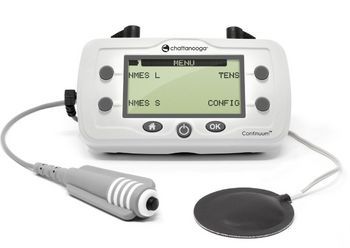
Chattanooga Continuum
 Chattanooga · Model Continuum
1+1 Function: Continuum features 2 separate channels that can be managed independently. Users can select either the same program on both channels, or 2 different programs to be used simultaneously Individually tailorable: Continuum has 13 preprogrammed and 2 custom regimens for NMES and TENS Generating a strong contraction: Continuum uses balanced waveforms that deliver muscle stimulation that is powerful whilst remaining comfortable Hand switch: The handheld remote trigger can be used to easily activate stimulation, either by the clinician at a distance, or by the patient Heel switch: When placed inside the user's shoe, this optional heel switch can be used to trigger muscle stimulation Battery powered: Continuum runs on a pair of standard AA batteries.
Key tips
- ·Most "no output" stim-unit complaints are cable-side - check electrode/lead continuity before assuming a unit fault.
- ·Frame and strap wear on mechanical rehab equipment is a real fall/injury risk - don't defer it as cosmetic.
Typical Failure Modes
Compiled for this model from its own documentation and established engineering knowledge for this equipment class - not from a verified service record. Confirm against the manufacturer's service manual.
No or low output on a modality / channel
HighSymptoms: Ultrasound, e-stim, shortwave or laser channel delivers no or weak output, error on that channel, patient feels nothing.
Root cause: Applicator / electrode / handpiece fault, a lead / cable fault, dried electrodes, or an output-stage fault on that module.
Therapeutic-ultrasound applicator fault
MediumSymptoms: Low or no ultrasound output, applicator-contact / BNR error, no warmth on a water-bath test.
Root cause: Worn or cracked applicator crystal, or a cable fault.
Electrode / lead-wire wear
MediumSymptoms: Intermittent stim, open-circuit error, uneven sensation.
Root cause: Worn lead wires or exhausted / dried self-adhesive electrodes.
Touchscreen / control fault
MediumSymptoms: Unresponsive or erratic touchscreen, parameters will not set.
Root cause: Touchscreen or controller fault.
Power / battery / cooling fault
LowSymptoms: Will not power on, short battery life, or shuts down on temperature.
Root cause: Power supply / fuse, an aged battery, or a cooling-fan fault.
Serviceable Parts & Consumables
Serviceable items for this model, compiled from its documentation and engineering knowledge for this equipment class. Service class and relative cost are estimates, not manufacturer figures; no part numbers are given. Confirm intervals and pricing against the manufacturer.
Therapeutic-ultrasound applicator
Class Periodic replacementRel. cost $$R&R Easy
Electrotherapy lead wires
Class Frequent wear itemRel. cost $R&R Easy
Self-adhesive / carbon electrodes
Class ConsumableRel. cost $R&R Easy
Output board / module
Class Major service partRel. cost $$$R&R Difficult
Touchscreen / control assembly
Class Major service partRel. cost $$R&R Moderate
| Part | Service class | Relative cost | R&R difficulty |
|---|---|---|---|
| Therapeutic-ultrasound applicator | Periodic replacement | $$ | Easy |
| Electrotherapy lead wires | Frequent wear item | $ | Easy |
| Self-adhesive / carbon electrodes | Consumable | $ | Easy |
| Output board / module | Major service part | $$$ | Difficult |
| Touchscreen / control assembly | Major service part | $$ | Moderate |
Relative cost: $ lowest · $$$$ highest service-part cost for this equipment class. Not a price.
PM Checklist
Preventive-maintenance tasks typical of this equipment class. Perform to the manufacturer's procedure and your facility's policy - this is general reference, not a schedule for this specific unit.
- ·Frame and strap wear inspection
- ·Electrode lead continuity check
- ·Annual electrical safety test
Troubleshooting Approach
A starting sequence for this model, compiled from its documentation and engineering knowledge for this equipment class. Follow the manufacturer's service documentation for the actual procedure.
Symptom: No or low output on a channel
- Fit a fresh applicator / handpiece / electrodes for that modality.
- Substitute a known-good lead / cable.
- Test ultrasound output into a water bath (visible cavitation / warmth) and run the applicator-contact / BNR self-test.
- Try the modality on another unit if available.
- Escalate a confirmed output-stage fault to the OEM.
Symptom: Touchscreen or power fault
- Power-cycle the unit.
- Check the mains fuse and power supply.
- Confirm the cooling fan runs and vents are clear.
- Recalibrate / re-seat the touchscreen if it is offset.
- Replace the touchscreen or power supply as isolated.
Technical Specs
- Transcutaneous electrical nerve stimulation (TENS)
- YES
- Neuromuscular Electrical Stimulation (NMES)
- YES
Typical Location
Where this class of equipment is typically deployed - general reference, not this unit's own placement record.
- Physical therapy / rehab gym
- Outpatient rehab clinic
- Sports medicine
Documents & Manuals
Troubleshoot this device with Bio
Describe a symptom or error code. Bio answers from this device's own documented error codes, failure modes, parts, and guides.
Ask Bio