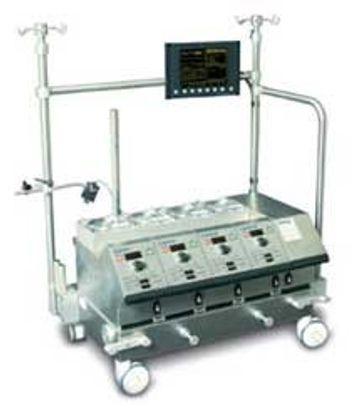
Century Heart & Lung Heart Lung Machine
 Century Heart & Lung · Model Heart Lung Machine
Heart-Lung Bypass Unit [b]Functional Advancements[/b] The Heart Lung Machine's minimal footprint takes up very little floor space while keeping components easily accessible. The pumps lift and lock securely in the upright position. Cable connections from the back of the system are located underneath, enabling easy access and fast troubleshooting during a case. Spill protection features make clean up easier. Cabling located under the pump is kept neatly organized and protected. Individual pump faces clean up fast because most knobs and crevices have been liminated from the design. Overhangs help direct spills away from the Heart Lung Machine and liquids that splash on the system are collected by a tray and drip gutters. [b]Precision Controls[/b] The roller pump display on the Century Heart Lung Machine is simple and easy to read. The system's computer will automatically calibrate for flow. Simply enter the tubing size, and it will perform the calculations even for dual-tube cardioplegia ratios or variable size tubing. The Century features exclusive rapid/fine flow control knobs. They ensure precise perfusion control in low flow conditions, important factors during cardioplegia and neonatal surgery. The computer's cardioplegia delivery system can track last volume delivered, total volume delivered, and time since last delivery. The Century's computer also has important built in safety features including the AEPS (Air Emboli Protection System); reservoir level sensor; and pressure regulation, which protects against accidental occlusion. [b]Built to Last[/b] The Century Heart Lung Machine has been built with the materials and craftsmanship that make this a durable and dependable piece of equipment. Solid construction makes the system easy to move and the rigid push bar doubles as a front mast for mounting a vaporizer or blender. Castersare protected from spills, roll easier and lock securely. Also exclusive to the Century Heart Lung Machine, is the 100% stainless steel chassis that will provide years of problem free performance. Also exclusive to the Century Heart Lung Machine, is the 100% stainless steel chassis that will provide years of problem free performance.
Key tips
- ·Never defeat or bypass a return-electrode monitoring (REM) alarm to finish a case - it's a direct burn risk.
- ·Verify OR table battery backup - a table that loses power mid-procedure is a real, documented incident type.
- ·Track surgical light lamp-hours rather than waiting for failure - a sudden failure mid-case is avoidable.
Typical Failure Modes
Compiled for this model from its own documentation and established engineering knowledge for this equipment class - not from a verified service record. Confirm against the manufacturer's service manual.
Roller / centrifugal pump fault
HighSymptoms: A pump will not run at set flow, speed unstable, occlusion out of adjustment, flow-probe error.
Root cause: Worn roller-pump raceway / rollers, a centrifugal drive-motor / coupling fault, or a flow-probe fault.
Console / control-module fault
HighSymptoms: A pump module unresponsive, display errors, module not recognised by the console.
Root cause: Module electronics or the console-to-module link.
Battery / UPS fault
HighSymptoms: Short back-up run time, will not transfer cleanly on a power interruption.
Root cause: Aged battery / UPS pack.
Pressure / level / bubble-monitoring fault
MediumSymptoms: Pressure, reservoir-level or bubble-detector alarms implausible or not triggering.
Root cause: Transducer, level-sensor, or bubble-detector fault.
Heater-cooler / temperature fault
MediumSymptoms: Blood / cardioplegia temperature not tracking, heater-cooler alarm, flow fault.
Root cause: Heater-cooler pump / refrigeration or a temperature-probe fault.
Serviceable Parts & Consumables
Serviceable items for this model, compiled from its documentation and engineering knowledge for this equipment class. Service class and relative cost are estimates, not manufacturer figures; no part numbers are given. Confirm intervals and pricing against the manufacturer.
Roller-pump raceway / roller kit
Class Periodic replacementRel. cost $$$R&R Difficult
Centrifugal drive motor / coupling
Class Major service partRel. cost $$$R&R Difficult
Battery / UPS pack
Class Periodic replacementRel. cost $$$R&R Moderate
Pressure / level / bubble sensors
Class Periodic replacementRel. cost $$R&R Moderate
Flow probe
Class Periodic replacementRel. cost $$R&R Fairly easy
| Part | Service class | Relative cost | R&R difficulty |
|---|---|---|---|
| Roller-pump raceway / roller kit | Periodic replacement | $$$ | Difficult |
| Centrifugal drive motor / coupling | Major service part | $$$ | Difficult |
| Battery / UPS pack | Periodic replacement | $$$ | Moderate |
| Pressure / level / bubble sensors | Periodic replacement | $$ | Moderate |
| Flow probe | Periodic replacement | $$ | Fairly easy |
Relative cost: $ lowest · $$$$ highest service-part cost for this equipment class. Not a price.
PM Checklist
Preventive-maintenance tasks typical of this equipment class. Perform to the manufacturer's procedure and your facility's policy - this is general reference, not a schedule for this specific unit.
- ·Pre-case functional check
- ·Electrosurgical return-electrode cable inspection
- ·Table hydraulic / mechanical inspection
- ·Annual electrical safety test and full PM
Troubleshooting Approach
A starting sequence for this model, compiled from its documentation and engineering knowledge for this equipment class. Follow the manufacturer's service documentation for the actual procedure.
Symptom: A pump will not run correctly
- Move the function to a spare pump module / mast position to isolate module vs console.
- Check the roller occlusion setting and inspect the raceway / rollers (roller pumps).
- Check the centrifugal drive coupling and flow probe.
- Verify flow against an independent flow probe.
- Replace the roller kit or drive components as isolated; a CPB console must pass a full functional check before clinical use.
Symptom: Monitoring alarm implausible or not triggering
- Verify each pressure channel against a reference.
- Test the level and bubble detectors per the service procedure.
- Reseat the sensor connectors.
- Calibrate the pressure channels.
- Replace a sensor that fails its functional test - these are safety systems.
Typical Location
Where this class of equipment is typically deployed - general reference, not this unit's own placement record.
- Operating rooms
- Procedure rooms
- Interventional suites
Documents & Manuals
No documents available for this device yet.
Troubleshoot this device with Bio
Describe a symptom or error code. Bio answers from this device's own documented error codes, failure modes, parts, and guides.
Ask Bio