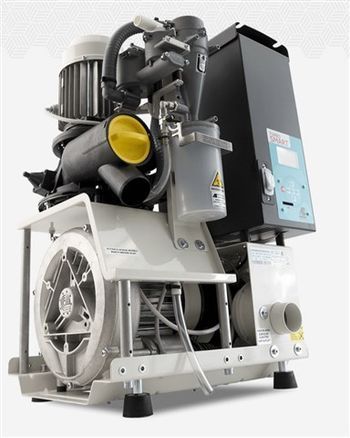
Cattani Turbo Smart
 Cattani · Model Turbo Smart
Consistent high performance - The inverter monitors and senses changes in number of users, size of the suction tips being used, the amount of fluid being aspirated, etc., and instantly adapts to the output to ensure that high airflow performance is constantly maintained. Energy efficient - With a traditional non-inverter on/off system, when there are a lower number of simultaneous users, the suction pump does not realise this condition and continues to produce performance to cater for the maximu number of users. What happens to the airflow performance that is not required? It is wasted energy in the form of extra power consumption and heat, not to mention unwanted spikes with excessive air flow performance. As an inverter monitors and adjusts accordingly i.e. slows the speed of the suction pump, energy consumption drops significantly. Simple capacity expansion - Connecting a number of suction systems together in parallel to increase the overall capacity of the suction system is a ‘plug and play’ exercise with inverter control. With the inverters all monitoring the same system and working together in harmony, there is no need for any additional expensive, complex, electrical equipment, which is a requirement with traditional non-inverter on/off systems.
Key tips
- ·A no-signal/flatline alarm gets checked on the patient first, not the monitor - rule out a real clinical event before troubleshooting.
- ·Recalibrate NIBP against a reference manometer, not just a self-test pass.
- ·Reused patient cables (SpO2, ECG leads) are a common source of intermittent-fault complaints - swap the cable before the module.
Typical Failure Modes
Compiled for this model from its own documentation and established engineering knowledge for this equipment class - not from a verified service record. Confirm against the manufacturer's service manual.
Low or no suction at the operatories
HighSymptoms: Weak or no aspiration at the dental units, low vacuum on the gauge.
Root cause: Worn suction motor / impeller (or ring / claw on liquid-ring units), an air leak in the distribution, or a blocked filter / amalgam separator.
Motor overheating / thermal trip
MediumSymptoms: Motor stops after a period, hot, restarts after cooling.
Root cause: Blocked cooling, a worn motor, or running dry (liquid-ring).
Amalgam separator / filter fault
MediumSymptoms: Separator-full alarm, reduced flow, drainage backing up.
Root cause: Full amalgam separator or a clogged central filter.
Excess noise / vibration
LowSymptoms: Loud operation, rattling.
Root cause: Worn bearings or loose mounts.
Will not start / no power
MediumSymptoms: Dead unit, contactor not pulling in.
Root cause: Power / fuse, the contactor / relay, or the demand-control / pressure switch.
Serviceable Parts & Consumables
Serviceable items for this model, compiled from its documentation and engineering knowledge for this equipment class. Service class and relative cost are estimates, not manufacturer figures; no part numbers are given. Confirm intervals and pricing against the manufacturer.
Suction motor / impeller (or ring & claw)
Class Major service partRel. cost $$$R&R Difficult
Central filter / amalgam separator
Class Frequent wear itemRel. cost $$R&R Fairly easy
Motor bearings / mounts
Class Major service partRel. cost $$R&R Moderate
Contactor / relay
Class Major service partRel. cost $R&R Moderate
Demand / pressure switch
Class Major service partRel. cost $R&R Moderate
| Part | Service class | Relative cost | R&R difficulty |
|---|---|---|---|
| Suction motor / impeller (or ring & claw) | Major service part | $$$ | Difficult |
| Central filter / amalgam separator | Frequent wear item | $$ | Fairly easy |
| Motor bearings / mounts | Major service part | $$ | Moderate |
| Contactor / relay | Major service part | $ | Moderate |
| Demand / pressure switch | Major service part | $ | Moderate |
Relative cost: $ lowest · $$$$ highest service-part cost for this equipment class. Not a price.
PM Checklist
Preventive-maintenance tasks typical of this equipment class. Perform to the manufacturer's procedure and your facility's policy - this is general reference, not a schedule for this specific unit.
- ·Routine cable and lead-wire inspection for fraying/wear
- ·Battery conditioning cycle
- ·NIBP calibration check against a reference manometer
- ·ECG / SpO2 accuracy verification against a patient simulator
- ·Annual electrical safety test
Troubleshooting Approach
A starting sequence for this model, compiled from its documentation and engineering knowledge for this equipment class. Follow the manufacturer's service documentation for the actual procedure.
Symptom: Low or no suction
- Check and empty the amalgam separator and clean the central filter.
- Leak-test the distribution and the operatory hoses / valves.
- Confirm the motor runs at full speed and (liquid-ring) has its water supply.
- Measure the vacuum at the pump vs at the units.
- Rebuild or replace the pump if vacuum is weak with a sealed, clean system.
Symptom: Motor overheats / will not start
- Clear the cooling airflow and let it cool.
- Check the contactor / relay pulls in and the demand switch operates.
- Check the mains fuse.
- Confirm the water supply (liquid-ring).
- Rebuild or replace the motor if it keeps tripping.
Typical Location
Where this class of equipment is typically deployed - general reference, not this unit's own placement record.
- ICU / CCU
- Emergency Department
- OR / PACU
- General med-surg floors
- Step-down units
- Telemetry units
Documents & Manuals
Troubleshoot this device with Bio
Describe a symptom or error code. Bio answers from this device's own documented error codes, failure modes, parts, and guides.
Ask Bio