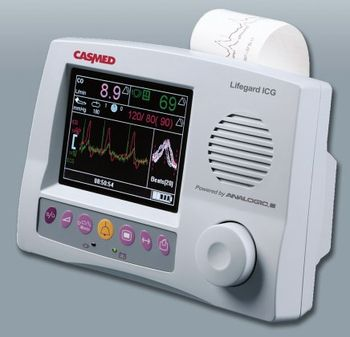
CAS Medical LIFEGARD ICG
 CAS Medical · Model LIFEGARD ICG
Key Features Unique Signal Quality Indicator (SQI) provides visual confirmation of signal integrity Multiple display modes, including Main Display, All Data, Tabular Trend, and Graphical Trend Color-coded tabular and graphical trends for quick parameter identification Three blood pressure measurement modes: Manual, Automatic, and STAT Elapsed time indicator displays the time since the last blood pressure measurement Continuous, non-invasive cardiac output monitoring with 12 additional hemodynamic parameters Integrated printer for fast and convenient data recording User-selectable display screens with waveforms, tabular trends, all-data views, and graphical trends Featured Technologies Thoracic Electrical Bioimpedance (TEB) and ECG for continuous, non-invasive cardiac output monitoring and single-lead ECG heart rate measurement Manual and automatic interval non-invasive blood pressure (NIBP) monitoring Measured & Derived Parameters Heart Rate (HR) Blood Pressure (Systolic/Diastolic) Mean Arterial Pressure (MAP) Cardiac Output/Cardiac Index (CO/CI) Stroke Volume/Stroke Volume Index (SV/SI) Systemic Vascular Resistance/Systemic Vascular Resistance Index (SVR/SVRI) Systolic Time Ratio (STR) Pre-Ejection Period (PEP) Left Ventricular Ejection Time (LVET) Velocity Index/Ejection Velocity Index (VI/EVI) Acceleration Index (ACI) Left Cardiac Work Index (LCWI) Thoracic Fluid Content (TFC)
Key tips
- ·A no-signal/flatline alarm gets checked on the patient first, not the monitor - rule out a real clinical event before troubleshooting.
- ·Recalibrate NIBP against a reference manometer, not just a self-test pass.
- ·Reused patient cables (SpO2, ECG leads) are a common source of intermittent-fault complaints - swap the cable before the module.
Typical Failure Modes
Compiled for this model from its own documentation and established engineering knowledge for this equipment class - not from a verified service record. Confirm against the manufacturer's service manual.
Will not power on or unexpected shutdown
HighSymptoms: The patient monitoring is dead, reboots, or shuts down mid-use.
Root cause: Mains lead / fuse, an aged battery, or a power-supply board fault.
Battery will not hold charge
MediumSymptoms: Short run time on battery; low-battery alarm soon after a full charge.
Root cause: Aged rechargeable battery pack or a charger fault.
Display / control-panel fault
MediumSymptoms: Blank, dim or distorted display; unresponsive keys or touchscreen.
Root cause: Display, backlight, or control-board fault.
Fails self-test or calibration
MediumSymptoms: Power-on self-test or the scheduled performance check fails or is out of tolerance.
Root cause: Sensor drift or an internal board fault; recalibration or repair needed.
Serviceable Parts & Consumables
Serviceable items for this model, compiled from its documentation and engineering knowledge for this equipment class. Service class and relative cost are estimates, not manufacturer figures; no part numbers are given. Confirm intervals and pricing against the manufacturer.
Rechargeable battery pack
Class Periodic replacementRel. cost $$R&R Fairly easy
Power supply / mains board
Class Major service partRel. cost $$$R&R Difficult
Display / control-panel assembly
Class Major service partRel. cost $$$R&R Moderate
Cooling fan
Class Major service partRel. cost $R&R Moderate
| Part | Service class | Relative cost | R&R difficulty |
|---|---|---|---|
| Rechargeable battery pack | Periodic replacement | $$ | Fairly easy |
| Power supply / mains board | Major service part | $$$ | Difficult |
| Display / control-panel assembly | Major service part | $$$ | Moderate |
| Cooling fan | Major service part | $ | Moderate |
Relative cost: $ lowest · $$$$ highest service-part cost for this equipment class. Not a price.
PM Checklist
Preventive-maintenance tasks typical of this equipment class. Perform to the manufacturer's procedure and your facility's policy - this is general reference, not a schedule for this specific unit.
- ·Routine cable and lead-wire inspection for fraying/wear
- ·Battery conditioning cycle
- ·NIBP calibration check against a reference manometer
- ·ECG / SpO2 accuracy verification against a patient simulator
- ·Annual electrical safety test
Error Codes
Extracted directly from this unit's own service manual.
ICG Leads OffAppears only after a valid reading has been obtained
Low BatteryAppears at same time that alarm is initiated; indicates 15 minutes or less of battery-driven operation remaining at start of alarm
NIBP - No CuffNo pressure detected when air is pumped
NIBP - BlockedUsually a kink in hose
NIBP - ArtifactFailure to acquire a valid measurement
NIBP - Time-OutMode operation exceeds limit of 180 seconds without measurable result
NIBP OverpressurePressure not achieved in allowable time
Check PrinterDoor may be open; no paper available
Low ICG AmplitudeQuestionable computed result; value may not be reliable
ICG ArtifactCardiac output results are questionable because of inconsistencies in waveforms
Troubleshooting Approach
A starting sequence for this model, compiled from its documentation and engineering knowledge for this equipment class. Follow the manufacturer's service documentation for the actual procedure.
Symptom: Sensor / electrode fault or drift / QC failure
- Run the relevant calibration and check the sensor / electrode status screen.
- De-bubble / rinse the measuring path and check for protein deposits.
- Replace an electrode / membrane / sensor cassette at end of life or that fails calibration.
- Confirm the solution pack / reagent cartridge and calibration gas are in date and not empty.
- Re-run QC at the relevant levels before releasing results.
Symptom: Sample not aspirated / clot / inlet alarm
- Run the inlet / preheater clot-removal or rinse routine.
- Inspect the inlet probe and gasket.
- Replace the inlet gasket or probe.
- Confirm free sample aspiration with a QC sample.
- Replace worn peristaltic pump tubing if transport is still poor.
Symptom: Result flagged / questionable vs the clinical picture
- Repeat with a fresh sample / strip / cassette from correctly stored, in-date stock.
- Run the QC controls at each level.
- Confirm the meter / analyzer is coded / calibrated to the current lot.
- Clean the measurement chamber / strip port and the optics per the manual.
- Quarantine the lot if QC fails; refer the analyzer if QC passes but a result still looks wrong.
Symptom: Will not power on / short battery life / strip-port fault (handhelds)
- Fit fresh batteries or confirm the charger / dock.
- Clean the strip-port contacts / optics.
- Try several strips from a fresh vial.
- Replace the battery.
- Replace the meter if it will not read known-good strips.
Technical Specs
- Height
- 16.5 cm
- Length
- 16.5 cm
- Weight
- 4.9 lbs
- Width
- 23.6 cm
Typical Location
Where this class of equipment is typically deployed - general reference, not this unit's own placement record.
- ICU / CCU
- Emergency Department
- OR / PACU
- General med-surg floors
- Step-down units
- Telemetry units
Documents & Manuals
Troubleshoot this device with Bio
Describe a symptom or error code. Bio answers from this device's own documented error codes, failure modes, parts, and guides.
Ask Bio