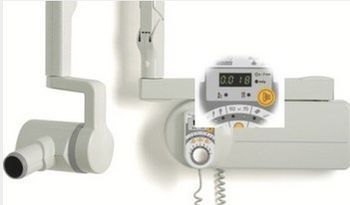
Carestream CS2200
 Carestream · Model CS2200
Optimize Diagnoses The CS 2200 System has an adjustable tube voltage (60 or 70 kV), so you can customize contrast or gray shading levels based on exam requirements - providing the control you need to support your diagnoses. Versatile Design Compatible with both film and digital imaging applications, the CS 2200 System works the way you do. Available in five available mounting options, two types of timers, and three arm lengths, the system can be easily adapted to match the configurations of your practice. Maximum Image Quality Our very high-frequency generator ensures superior image quality. Equipped with a focal spot of 0.7 mm, the CS 2200 System produces sharp, focused images each and every time. And the unit’s short exposure times make it an ideal product to use with our full range of dental digital radiography systems. Reduced Radiation Dose The CS 2200 System generates as much as 30% less radiation than traditional x-ray generators - thereby ensuring the safety of your patients and staff. In addition, the system’s electronic timer determines the optimal dose for patients based on exam settings, so you can work confidently with no worries of overexposure. And, after each exposure, the dose level is displayed for quick and simple dose monitoring. Usability at Its Best Compact and easy-to-use, the CS 2200 System’s handheld timer allows users to quickly select the right exposure settings. Pre-programmed to automatically calculate settings, the timer intuitively determines the appropriate exposure time based on anatomical region, patient bodyweight and detector type. Plus, the timer’s clear and easy-to-understand icons allow you to make your selections in less time than ever and help reduce the risk of mistakes.
Key tips
- ·Biological-indicator verification applies to dental sterilizers exactly the same as hospital CSSD - no exception for smaller units.
- ·"Sounds different" is often the first real report of handpiece bearing wear, not an outright failure - investigate early rather than waiting.
Typical Failure Modes
Compiled for this model from its own documentation and established engineering knowledge for this equipment class - not from a verified service record. Confirm against the manufacturer's service manual.
No or inconsistent exposure
HighSymptoms: No image, exposure will not trigger, images consistently under- or over-exposed, error code.
Root cause: Tube-head fault, an exposure-switch / timer fault, HV / generator fault, or a sensor / PSP-plate fault.
Sensor / imaging-plate fault (digital)
MediumSymptoms: Dead lines, artefacts, no image from the sensor, PSP plate scratched / fogged.
Root cause: Damaged intraoral sensor / cable, or worn PSP plates.
Pano / CBCT motion or reconstruction fault
MediumSymptoms: Blurred or distorted panoramic image, layer / focal-trough errors, reconstruction fails.
Root cause: Rotation drive / belt / encoder, patient-positioning error, or the reconstruction PC.
Tube-arm / balance fault
MediumSymptoms: Tube head drifts, will not stay positioned, arm joints loose.
Root cause: Worn arm springs / friction joints.
Software / acquisition fault
LowSymptoms: Images will not acquire, save or display in the practice-management software.
Root cause: TWAIN / driver, the acquisition PC, or the software.
Serviceable Parts & Consumables
Serviceable items for this model, compiled from its documentation and engineering knowledge for this equipment class. Service class and relative cost are estimates, not manufacturer figures; no part numbers are given. Confirm intervals and pricing against the manufacturer.
Intraoral sensor & cable / PSP plates
Class Periodic replacementRel. cost $$$R&R Fairly easy
Tube head / HV components
Class Major service partRel. cost $$$$R&R Difficult
Exposure switch / timer board
Class Major service partRel. cost $$R&R Moderate
Pano rotation drive / belt / encoder
Class Major service partRel. cost $$$R&R Difficult
Tube-arm spring / friction-joint kit
Class Major service partRel. cost $$R&R Moderate
| Part | Service class | Relative cost | R&R difficulty |
|---|---|---|---|
| Intraoral sensor & cable / PSP plates | Periodic replacement | $$$ | Fairly easy |
| Tube head / HV components | Major service part | $$$$ | Difficult |
| Exposure switch / timer board | Major service part | $$ | Moderate |
| Pano rotation drive / belt / encoder | Major service part | $$$ | Difficult |
| Tube-arm spring / friction-joint kit | Major service part | $$ | Moderate |
Relative cost: $ lowest · $$$$ highest service-part cost for this equipment class. Not a price.
PM Checklist
Preventive-maintenance tasks typical of this equipment class. Perform to the manufacturer's procedure and your facility's policy - this is general reference, not a schedule for this specific unit.
- ·Daily handpiece lubrication and autoclave cycle verification
- ·Compressor moisture-trap draining
- ·Annual full PM
Error Codes
Extracted directly from this unit's own service manual.
E50 to E54Problem with the IC bus, the connection between the control panel and the power board.
Troubleshooting Approach
A starting sequence for this model, compiled from its documentation and engineering knowledge for this equipment class. Follow the manufacturer's service documentation for the actual procedure.
Symptom: No or inconsistent exposure / generator or tube-head error
- Note the exact error code and whether it is a kV / mA / preheat / interface failure.
- Check the mains supply, the dedicated circuit and the fuses.
- Check the tube-head and detector / sensor interface cable connections.
- Confirm the exposure switch is held for the full exposure and the warning light works.
- Escalate a confirmed tube-head / HV / generator fault; verify output with a dental X-ray meter after any repair.
Symptom: Blurred or distorted panoramic image / layer or focal-trough errors
- Confirm patient positioning (bite block, chin rest, light guides).
- Check the rotation drive belt, motor and encoder for wear or slip.
- Run any image-calibration / geometry routine.
- Verify the focal-trough / layer selection.
- Escalate a drive / reconstruction fault to the OEM.
Symptom: Sensor / CCD / CBCT detector fault (dead lines, artefacts, no image)
- Swap in a known-good sensor if available.
- Inspect the sensor cable for kinks or breaks.
- Run the detector calibration / dead-pixel map.
- Expose a phantom and check uniformity.
- Replace or refer the detector as isolated.
Symptom: Software / acquisition fault (image will not acquire, save or display)
- Check the TWAIN / driver and the acquisition PC.
- Restart the acquisition software and the unit.
- Confirm the practice-management link.
- Update to compatible driver / software versions.
- Escalate a persistent acquisition fault to the OEM.
Technical Specs
- X-ray Type
- Digital
Typical Location
Where this class of equipment is typically deployed - general reference, not this unit's own placement record.
- Dental operatory
- Oral surgery suite
- CSSD (dental sterilizers)
Documents & Manuals
Troubleshoot this device with Bio
Describe a symptom or error code. Bio answers from this device's own documented error codes, failure modes, parts, and guides.
Ask Bio