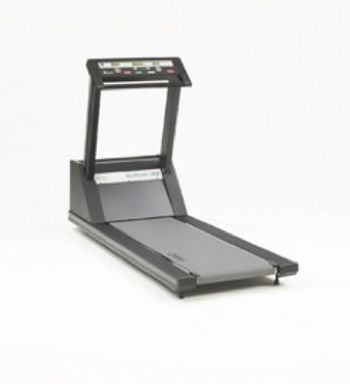
Cardiac Science Quinton CR60 Treadmill
 Cardiac Science · Model Quinton CR60 Treadmill
TripleFlex with two levels of shock-absorbing mounts and a flexible frame to provide ideal cushioning for walkers and runners. Two full speed ranges: 0.6 to 7.2 mph (0.9–11.5 km/h) or 1 to 12 mph (1.6–19.3 km/h). Easy-to-use control panel designed specifically for cardiac rehabilitation centers; includes METs, calorie counts, pre-set time limits, and top speed. Cool-down cycle to gradually reduce speed and lower the grade to zero. High torque for accurate speed control (patients enjoy a natural walking/running sensation with no lag when the foot strikes the belt – even at lower speeds). Ultradrive digitally-controlled AC-drive system for greater performance, improved accuracy, and increased reliability. Slow, gentle start and gradually increased speed features for patient safety and confidence. Warranty: 13-Month parts and labor. TripleFlex shock absorption provides ideal cushioning for walkers and runners up to 400 lbs (181 kg). The Ultradrive system provides exceptionally smooth power and accuracy even at the slowest speeds and the heaviest weights. The control panel is easy to use, and the Ultradrive is quiet and provides a nice, slow start. The CR60 medical treadmill provides two full speed ranges: 0.6 to 7.2 mph (0.9–11.5 km/h) or 1 to 12 mph (1.6–19.3 km/h). The machine has very few moving parts so there is minimal maintenance and less downtime. We provide excellent technical support and service, including a 13-month parts and labor warranty, direct service networks, and annual maintenance programs. International service is provided by factory-trained dealers.
Key tips
- ·Most "no output" stim-unit complaints are cable-side - check electrode/lead continuity before assuming a unit fault.
- ·Frame and strap wear on mechanical rehab equipment is a real fall/injury risk - don't defer it as cosmetic.
Typical Failure Modes
Compiled for this model from its own documentation and established engineering knowledge for this equipment class - not from a verified service record. Confirm against the manufacturer's service manual.
Treadmill does not start / no communication with the stress system
HighSymptoms: Belt will not run, no display, ECG / stress system cannot control it.
Root cause: Building or treadmill breaker / fuse, a cut power cord, a faulty control cable to the ECG unit, or a drive-controller fault.
Speed or grade error / inaccuracy
MediumSymptoms: Belt speed or incline does not match the protocol, error code, grade drifts.
Root cause: Grade motor / potentiometer needs calibration, a limit-switch fault, or a drive speed-feedback fault.
Walking belt / deck wear
MediumSymptoms: Belt slips, drifts off-centre, rough or noisy running.
Root cause: Worn or stretched belt, worn deck, or drive-belt tension loss.
Emergency stop / handrail fault
HighSymptoms: E-stop does not stop the belt, loose handrail.
Root cause: Failed e-stop switch/wiring or loosened handrail fasteners.
Serviceable Parts & Consumables
Serviceable items for this model, compiled from its documentation and engineering knowledge for this equipment class. Service class and relative cost are estimates, not manufacturer figures; no part numbers are given. Confirm intervals and pricing against the manufacturer.
Walking belt
Class Periodic replacementRel. cost $$R&R Moderate
Deck
Class Periodic replacementRel. cost $$R&R Moderate
Drive belt
Class Periodic replacementRel. cost $R&R Moderate
Grade motor / potentiometer
Class Major service partRel. cost $$R&R Moderate
Drive controller board
Class Major service partRel. cost $$$R&R Difficult
Roller / bearing set
Class Major service partRel. cost $$R&R Moderate
| Part | Service class | Relative cost | R&R difficulty |
|---|---|---|---|
| Walking belt | Periodic replacement | $$ | Moderate |
| Deck | Periodic replacement | $$ | Moderate |
| Drive belt | Periodic replacement | $ | Moderate |
| Grade motor / potentiometer | Major service part | $$ | Moderate |
| Drive controller board | Major service part | $$$ | Difficult |
| Roller / bearing set | Major service part | $$ | Moderate |
Relative cost: $ lowest · $$$$ highest service-part cost for this equipment class. Not a price.
PM Checklist
Preventive-maintenance tasks typical of this equipment class. Perform to the manufacturer's procedure and your facility's policy - this is general reference, not a schedule for this specific unit.
- ·Frame and strap wear inspection
- ·Electrode lead continuity check
- ·Annual electrical safety test
Error Codes
Extracted directly from this unit's own service manual.
E101Controller CPU chip failure
E102Controller CPU EPROM failure
E103Controller CPU stuck interrupt
E105Controller CPU NVRAM failure Code Explanation
E201Grade system error.
E202Speed check error.
Troubleshooting Approach
A starting sequence for this model, compiled from its documentation and engineering knowledge for this equipment class. Follow the manufacturer's service documentation for the actual procedure.
Symptom: Will not start / no comms
- De-energise and unplug before removing covers - residual voltage can persist.
- Check the breakers and any fuse.
- Inspect the power cord.
- Check the control cable between the treadmill and the ECG / stress system.
- If power is present and cabling is good, suspect the drive controller.
Symptom: Speed or grade inaccurate
- Verify belt speed with a tachometer against the protocol.
- Calibrate the grade potentiometer and check the limit switches.
- Inspect the drive speed-feedback path.
- Re-verify speed and grade.
- Centre and tension the belt and confirm the e-stop stops the belt.
Typical Location
Where this class of equipment is typically deployed - general reference, not this unit's own placement record.
- Physical therapy / rehab gym
- Outpatient rehab clinic
- Sports medicine
Documents & Manuals
Safety & Recalls
Synced live from the FDA openFDA API.
- RECALL
28 stress and rehab treadmills manufactured between September 2006 and January 2009 may not have received adequate electrical safety testing prior to being shipped from the factory. If these components break down in the field, a patient or operator could be exposed to excess touch currents on the surface of the product. Because safety testing may not have allowed for complete evaluation of the el
Troubleshoot this device with Bio
Describe a symptom or error code. Bio answers from this device's own documented error codes, failure modes, parts, and guides.
Ask Bio