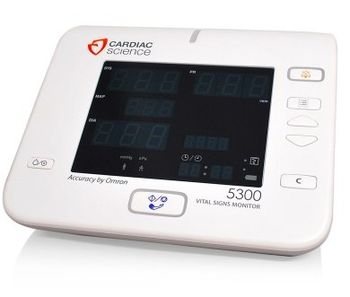
Cardiac Science 5300
 Cardiac Science · Model 5300
Smart features capture and distribute vital signs data accurately and efficiently [b]Bigger screen, better workflow[/b] With a screen that’s nearly 3x larger and noticeably brighter than the leading competitor’s1, slanted for optimal user viewability, and with large color-coded digits, Cardiac Science vital signs monitors enhance staff efficiency, improve accuracy, and increase patient throughput. [b]Rugged durability, easier clean-up, and infection control[/b] The Cardiac Science 5300 and 5350 vital signs monitors are built to last and give you maximum uptime. They withstand routine fluid contact so cleanup can be fast, easy, and thorough. [b]Enhanced patient comfort[/b] The Cardiac Science 5300 and 5350 vital signs monitors feature Smart Inflation™ and our dynamic linear deflation technology for greater patient comfort and accuracy. [b]Connectivity options[/b] For EMR integration, an optional connectivity kit enables you to download data in HL7 format or network service to a laptop. [b]Optional built-in printer for easy documentation[/b] The Cardiac Science 5300 and 5350 vital signs monitors offer an optional built-in printer so you can print out results immediately or later. Choose among three report styles: simple list, detail list, or measurement value.
Key tips
- ·A no-signal/flatline alarm gets checked on the patient first, not the monitor - rule out a real clinical event before troubleshooting.
- ·Recalibrate NIBP against a reference manometer, not just a self-test pass.
- ·Reused patient cables (SpO2, ECG leads) are a common source of intermittent-fault complaints - swap the cable before the module.
Typical Failure Modes
Compiled for this model from its own documentation and established engineering knowledge for this equipment class - not from a verified service record. Confirm against the manufacturer's service manual.
A parameter drops out or reads wrong
HighSymptoms: ECG, IBP, SpO2, temperature, CO2 or CO intermittently drops or is implausible.
Root cause: Worn patient cable / sensor, or a parameter-module / input-board fault.
NIBP will not measure or is inaccurate
MediumSymptoms: NIBP times out, cuff will not inflate / hold, readings implausible.
Root cause: Internal NIBP pump or valve, a cuff / hose leak, or a pressure-transducer fault.
Module / parameter not recognised
MediumSymptoms: The host does not display a plugged-in module or a built-in parameter.
Root cause: Docking / connector fault or an internal board fault.
Display / touchscreen fault
MediumSymptoms: Blank, dim or distorted display; unresponsive touchscreen.
Root cause: Display, backlight, or controller fault.
Battery / power fault
MediumSymptoms: Short battery run time, will not hold charge, will not power on.
Root cause: Aged battery pack or a power-supply fault.
Network / central-station connectivity fault
LowSymptoms: Monitor not shown at the central station, admit fails, intermittent drop.
Root cause: Wired / Wi-Fi network configuration or a communication board.
Serviceable Parts & Consumables
Serviceable items for this model, compiled from its documentation and engineering knowledge for this equipment class. Service class and relative cost are estimates, not manufacturer figures; no part numbers are given. Confirm intervals and pricing against the manufacturer.
Patient cable set (ECG / IBP / SpO2 / temp)
Class Frequent wear itemRel. cost $$R&R Easy
NIBP cuff and hose
Class Frequent wear itemRel. cost $R&R Easy
Internal NIBP pump / valve
Class Major service partRel. cost $$$R&R Difficult
Parameter module / input board
Class Major service partRel. cost $$$R&R Difficult
Battery pack
Class Periodic replacementRel. cost $$R&R Fairly easy
Display / touchscreen assembly
Class Major service partRel. cost $$$R&R Moderate
| Part | Service class | Relative cost | R&R difficulty |
|---|---|---|---|
| Patient cable set (ECG / IBP / SpO2 / temp) | Frequent wear item | $$ | Easy |
| NIBP cuff and hose | Frequent wear item | $ | Easy |
| Internal NIBP pump / valve | Major service part | $$$ | Difficult |
| Parameter module / input board | Major service part | $$$ | Difficult |
| Battery pack | Periodic replacement | $$ | Fairly easy |
| Display / touchscreen assembly | Major service part | $$$ | Moderate |
Relative cost: $ lowest · $$$$ highest service-part cost for this equipment class. Not a price.
PM Checklist
Preventive-maintenance tasks typical of this equipment class. Perform to the manufacturer's procedure and your facility's policy - this is general reference, not a schedule for this specific unit.
- ·Routine cable and lead-wire inspection for fraying/wear
- ·Battery conditioning cycle
- ·NIBP calibration check against a reference manometer
- ·ECG / SpO2 accuracy verification against a patient simulator
- ·Annual electrical safety test
Error Codes
Extracted directly from this unit's own service manual.
E01An error was detected in the main unit's internal ROM. Switch the power for the main unit OFF, then ON again. If this does not solve the problem, there is a possibility that the device is broken. Immediately stop using monitor and contact Cardiac Science Technical Support.
Switch the power for the main unit OFF, then ON again. If this does not solve the problem, there is a possibility that the device is broken. Immediately stop using monitor and contact Cardiac Science Technical Support.
E02An error was detected in the main unit's internal RAM. Switch the power for the main unit OFF, then ON again. If this does not solve the problem, immediately stop using monitor and contact Cardiac Science Technical Support.
Switch the power for the main unit OFF, then ON again. If this does not solve the problem, immediately stop using monitor and contact Cardiac Science Technical Support.
E81An error was detected. Charge the battery.
Charge the battery. If this does not solve the problem, immediately stop using monitor and contact Cardiac Science Technical Support.
E90Either no internal battery is mounted or it cannot be detected.
Check the internal battery cable connection.
E91An internal voltage error was detected. A device error was detected. Switch the power OFF, then ON again. If the error recurs repeatedly, stop using this device and contact Cardiac Science Technical Support.
Switch the power OFF, then ON again. If the error recurs repeatedly, stop using this device and contact Cardiac Science Technical Support.
E92The temperature in the device has risen. Check the ambient temperature. If the temperature has risen even though the device is being used within the usage temperature range, stop using this device and contact Cardiac Science Technical Support.
Check the ambient temperature. If the temperature has risen even though the device is being used within the usage temperature range, stop using this device and contact Cardiac Science Technical Support.
E93The backup memory was initialized. All data are erased and returned to factory defaults.
E94An error was detected in the main unit's internal clock IC. Switch the power for the main unit OFF, then ON again. If this does not solve the problem, immediately stop using it and contact Cardiac Science Technical Support.
Switch the power for the main unit OFF, then ON again. If this does not solve the problem, immediately stop using it and contact Cardiac Science Technical Support.
E95A sound function error was detected. Switch the power OFF, then ON again. If the error recurs repeatedly, stop using this device and contact Cardiac Science Technical Support.
Switch the power OFF, then ON again. If the error recurs repeatedly, stop using this device and contact Cardiac Science Technical Support.
E96An external communication function error was detected. Switch the power OFF, then ON again. If the error recurs repeatedly, stop using this device and contact Cardiac Science Technical Support.
Switch the power OFF, then ON again. If the error recurs repeatedly, stop using this device and contact Cardiac Science Technical Support.
E99A device error was detected. Switch the power OFF, then ON again. If the error recurs repeatedly, stop using this device and contact Cardiac Science Technical Support.
Switch the power OFF, then ON again. If the error recurs repeatedly, stop using this device and contact Cardiac Science Technical Support.
E03BPM pressure sensor fault. Pump operated for ten seconds, however pressure does not change.
Check the connection of the cuff hose. The problem may be due to a fault if no improvement is apparent. Cease use immediately in this case and contact Cardiac Science Technical Support.
E09A potentially dangerous situation was detected during measurement. It is possible that the situation was detected incorrectly due to vibration being applied to the cuff and cuff hose from an external source, or occurrence of a blockage.
Check the patient and conditions of measurement, and measure again with the cuff. Cease use immediately if the E09 error recurs and contact Cardiac Science Technical Support.
E10Readings outside NIBP range [Adult]: SYS < 60, SYS >250 MAP < 45, MAP >235 DIA < 40, DIA >200 [Neo]: SYS < 40, SYS >120 MAP < 30, MAP >100 DIA < 20, DIA >90
Check the condition of the patient.
E11Pressure rise not completed within required time. Required time: 60 seconds (adult), 20 seconds (neonate). The cuff pressure rise was not completed even though the pump was operated for longer than the usual time.
Check cuff and cuff hose. This error possibly occurs in the case of large cuffs that are applied loosely. When the error still occurs even after checking above, there is a possibility that the cuff is torn and air is leaking. Replace it with a new one.
E12Cannot compute a measured value despite cuff pressure being below specified pressure. Specified pressure: 10mmHg (adult), 5mmHg (neonate). Blood pressure could not be measured even after cuff pressure decreased.
Check
Troubleshooting Approach
A starting sequence for this model, compiled from its documentation and engineering knowledge for this equipment class. Follow the manufacturer's service documentation for the actual procedure.
Symptom: A parameter drops out or reads wrong (ECG / IBP / SpO2 / temp / CO2 / CO)
- Reseat the patient cable at the module and at the monitor.
- Swap in a known-good cable / sensor for that parameter and re-test.
- Move the module to another host or slot to tell module from host.
- Inspect the module docking connector for bent or recessed pins.
- Verify against a patient simulator; replace the cable, or refer the parameter module / input board if the fault stays with it.
Symptom: NIBP will not measure or is inaccurate
- Leak-test the cuff and hose (occlude and watch for pressure decay).
- Run the monitor's NIBP calibration-verification against a calibrated manometer.
- Confirm correct cuff size and placement and check for a kinked hose.
- Verify against a NIBP simulator at several pressures.
- Refer the monitor for internal pump / valve service if it still fails.
Symptom: Blank / dim / frozen display or unresponsive touchscreen
- Power-cycle the monitor fully (mains removed, battery out where possible).
- Check the display backlight and the display / touchscreen cable.
- Note any boot or self-test error code.
- Re-calibrate the touchscreen if the touch offset is the issue.
- Replace the display / touchscreen assembly or refer the main board.
Symptom: Not shown at the central station / network dropout
- Confirm the wired drop or Wi-Fi settings and that other monitors on that segment are online.
- Check the monitor's network address / unit-bed assignment and re-admit.
- Reseat the network card / cable.
- Restart the monitor's network interface.
- Escalate a whole-unit outage to the central-station server / IT.
Typical Location
Where this class of equipment is typically deployed - general reference, not this unit's own placement record.
- ICU / CCU
- Emergency Department
- OR / PACU
- General med-surg floors
- Step-down units
- Telemetry units
Documents & Manuals
Troubleshoot this device with Bio
Describe a symptom or error code. Bio answers from this device's own documented error codes, failure modes, parts, and guides.
Ask Bio