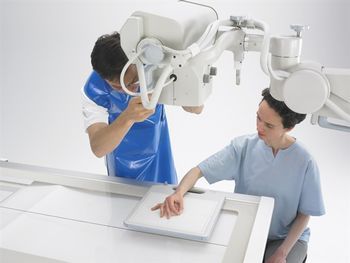
Canon CXDI-60G
 Canon · Model CXDI-60G
Outstanding Diagnostic Image Quality in a Convenient Size The 9 x 11 inch (23 x 28 cm) imaging area accommodates diverse applications, including examinations of the extremities, skull, shoulder, hip and cervical spine. Detailed x-ray images can be taken from almost any position and angle. The patient can comfortably hold the unit in place during capture when necessary. It’s the ideal size for orthopedic departments and mobile x-ray systems, plus general radiology applications that would benefit from easy handling and portability. Compact and Lightweight Weighing a mere 5.9 pounds (2.7 kg) and less than an inch thick (22.5 mm), the CXDI-60G offers true portability and versatility for use at diverse patient locations - both in and out of the x-ray room. The ergonomic detector is comfortable to hold and is as easy to position as a conventional film cassette or CR imaging plate. Its smooth, rounded edges allow it to easily slide under patients. Immediate Results Preview images are available after exposure and can be immediately transmitted over the hospital network to other workstations, printers, and archives for fast and easy data sharing. Canon Digital Radiography provides speed, efficiency, and a streamlined workflow to meet diverse needs, including support for off-site diagnosis and emergency care.
Key tips
- ·Never bypass a radiation interlock to "just get the image" - this is one of the few true zero-tolerance rules in BMET work.
- ·Trend image-quality phantom results over time - drift shows up before an outright failure does.
- ·Portable/mobile units take real physical abuse from transport - check wheel locks and cable strain reliefs more often than fixed units.
Typical Failure Modes
Compiled for this model from its own documentation and established engineering knowledge for this equipment class - not from a verified service record. Confirm against the manufacturer's service manual.
Detector not connecting / dropped images
HighSymptoms: Panel not detected, images not received, wireless / tethered link drops mid-exam.
Root cause: Detector battery (wireless), the Wi-Fi / tether cable, a docking / connector fault, or a detector electronics fault.
Image quality / calibration fault
MediumSymptoms: Fixed-pattern artefacts, non-uniform image, dead pixels / lines, calibration overdue or failing.
Root cause: Detector gain / offset calibration, a bad pixel map, or physical detector damage (drop).
Battery / charging fault (wireless)
MediumSymptoms: Short detector run time, will not charge in the cradle.
Root cause: Aged detector battery or a cradle / contact fault.
Acquisition-workstation / generator-sync fault
MediumSymptoms: Exposure not captured, timing / sync error, image not linked to the study.
Root cause: Generator-interface / AED trigger, or a workstation software / driver fault.
Detector housing / cable damage
LowSymptoms: Cracked housing, tether cable intermittent.
Root cause: Drop or crush damage.
Serviceable Parts & Consumables
Serviceable items for this model, compiled from its documentation and engineering knowledge for this equipment class. Service class and relative cost are estimates, not manufacturer figures; no part numbers are given. Confirm intervals and pricing against the manufacturer.
Detector battery (wireless)
Class Periodic replacementRel. cost $$R&R Easy
Tether cable / access point
Class Periodic replacementRel. cost $$R&R Fairly easy
Charging cradle
Class Periodic replacementRel. cost $$R&R Easy
Acquisition workstation PC
Class Major service partRel. cost $$$R&R Moderate
Flat-panel detector
Class Major service partRel. cost $$$$R&R Fairly easy
| Part | Service class | Relative cost | R&R difficulty |
|---|---|---|---|
| Detector battery (wireless) | Periodic replacement | $$ | Easy |
| Tether cable / access point | Periodic replacement | $$ | Fairly easy |
| Charging cradle | Periodic replacement | $$ | Easy |
| Acquisition workstation PC | Major service part | $$$ | Moderate |
| Flat-panel detector | Major service part | $$$$ | Fairly easy |
Relative cost: $ lowest · $$$$ highest service-part cost for this equipment class. Not a price.
PM Checklist
Preventive-maintenance tasks typical of this equipment class. Perform to the manufacturer's procedure and your facility's policy - this is general reference, not a schedule for this specific unit.
- ·Daily QC per modality: image-quality phantom test
- ·Tube and detector inspection
- ·Annual state-required radiation safety survey
- ·Vendor-scheduled preventive maintenance
Error Codes
Extracted directly from this unit's own service manual.
0x00Success Return value
No log output in this case.
0x00000001Invalid parameter exists
0x00180012CXDI description : DICOM connection error (CCRTRANS_ERR_NOT_CONNECT)
0x10CXDI description: DICOM response error (CCRTRANS_ERR_RESP)
0x18CXDI description : DICOM response warning (CCRTRANS_WRN_RESP)
The transfer process was successful, but a warning was returned from the server.
0x20CXDI description : DICOM printer status error (CCRTRANS_ERR_PRN_STATUS)
0x28CXDI description: DICOM printer status warning (CCRTRANS_WRN_PRN_STATUS)
The transfer process was successful, but a warning was returned as the printer status.
Values other than those aboveCXDI description : DICOM communications error (CCRTRANS_ERR_DICOM_TRANSE)
The log output in this case depends on the specific error. A typical example is shown below.
Troubleshooting Approach
A starting sequence for this model, compiled from its documentation and engineering knowledge for this equipment class. Follow the manufacturer's service documentation for the actual procedure.
Symptom: Detector not connecting / drops
- Confirm the detector battery charge (wireless) or reseat the tether.
- Check the Wi-Fi access point / channel and range.
- Reboot the detector and the acquisition workstation.
- Try a known-good detector if available.
- Escalate a confirmed detector electronics fault to Canon.
Symptom: Image quality / calibration fault
- Run the detector gain / offset calibration and dead-pixel map.
- Inspect the detector for drop damage.
- Compare against a phantom exposure for uniformity.
- Confirm generator sync / AED trigger settings.
- Replace or refer the detector if calibration will not hold.
Technical Specs
- Height
- 0.9 in
- Length
- 15 in
- Weight
- 5.9 lbs
- Detector Type
- Amorphous Silicon
- Pixel Matrix
- 1464 x 1776 pixels
- Width
- 14 in
Typical Location
Where this class of equipment is typically deployed - general reference, not this unit's own placement record.
- Radiology / Imaging department
- Emergency Department (portable units)
- Operating Room (C-arms)
- Cath lab
- Bedside ICU (portable X-ray)
Documents & Manuals
Troubleshoot this device with Bio
Describe a symptom or error code. Bio answers from this device's own documented error codes, failure modes, parts, and guides.
Ask Bio