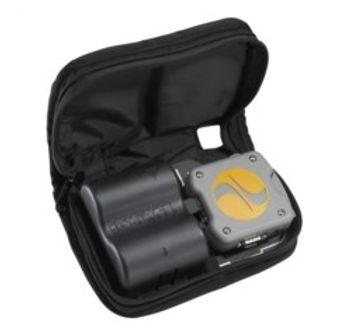
Cadwell Laboratories Easy Ambulatory
 Cadwell Laboratories · Model Easy Ambulatory
Easy Ambulatory EEG system is highly portable, provides great patient comfort and collects accurate, reliable EEG data. Q-Video® Mobile 2 synchronizes video recordings with EEG data and allows critical video recording in any monitoring environment: the home, the laboratory or the physician’s office. This data provides a clearer picture to the clinician about the events that occur during the study. The Q-Video Mobile 2 has built-in infrared lights to allow automatic recording of video at night. EasyNet® modules monitor oximetry, nasal pressure airflow, body position and limb movement. The EEG amplifier is completely self-contained, with all active components inside the amplifier case. Cadwell Ambulatory products use the same software and laboratory information management system as other Easy systems and data are downloaded to an Easy work station for analysis using a standard network connection.
Key tips
- ·Electrode impedance drives data quality more than almost any other single factor - check it before assuming an amplifier fault.
- ·Pre-case verification of intraoperative monitoring equipment isn't optional - a mid-case failure has direct surgical-decision consequences.
Typical Failure Modes
Compiled for this model from its own documentation and established engineering knowledge for this equipment class - not from a verified service record. Confirm against the manufacturer's service manual.
Noisy / high-impedance channels
HighSymptoms: Mains hum, drift or flat channels, persistently high electrode impedance, poor recording quality.
Root cause: Electrode / lead-wire wear, the electrode box (headbox) inputs, or poor skin prep / environment.
Headbox / amplifier fault
MediumSymptoms: A block of channels dead or saturated regardless of electrode, calibration / bio-cal fails.
Root cause: Headbox amplifier or its cable to the acquisition unit.
Amplifier-to-PC link / acquisition fault
MediumSymptoms: Recording drops, amplifier not detected, data gaps.
Root cause: USB / fibre / network link or a driver.
Photic stimulator / video / audio fault (diagnostic EEG/PSG)
LowSymptoms: Photic strobe not firing, no synchronised video, no audio.
Root cause: Photic lamp / trigger, the video camera, or the audio path.
PSG sensor fault (airflow / effort / SpO2 / limb)
LowSymptoms: A PSG channel (thermistor, pressure, RIP belt, SpO2, PLM) flat or noisy.
Root cause: Worn PSG sensor or its cable.
Serviceable Parts & Consumables
Serviceable items for this model, compiled from its documentation and engineering knowledge for this equipment class. Service class and relative cost are estimates, not manufacturer figures; no part numbers are given. Confirm intervals and pricing against the manufacturer.
Electrode lead set / headbox leads
Class Frequent wear itemRel. cost $$R&R Easy
Headbox / amplifier
Class Major service partRel. cost $$$R&R Moderate
Amplifier link cable / interface
Class Periodic replacementRel. cost $$R&R Fairly easy
Photic stimulator lamp (diagnostic)
Class Periodic replacementRel. cost $$R&R Fairly easy
PSG sensor set (airflow / effort / SpO2)
Class Frequent wear itemRel. cost $$R&R Easy
| Part | Service class | Relative cost | R&R difficulty |
|---|---|---|---|
| Electrode lead set / headbox leads | Frequent wear item | $$ | Easy |
| Headbox / amplifier | Major service part | $$$ | Moderate |
| Amplifier link cable / interface | Periodic replacement | $$ | Fairly easy |
| Photic stimulator lamp (diagnostic) | Periodic replacement | $$ | Fairly easy |
| PSG sensor set (airflow / effort / SpO2) | Frequent wear item | $$ | Easy |
Relative cost: $ lowest · $$$$ highest service-part cost for this equipment class. Not a price.
PM Checklist
Preventive-maintenance tasks typical of this equipment class. Perform to the manufacturer's procedure and your facility's policy - this is general reference, not a schedule for this specific unit.
- ·Electrode / lead impedance check
- ·Amplifier calibration
- ·Annual electrical safety test
Troubleshooting Approach
A starting sequence for this model, compiled from its documentation and engineering knowledge for this equipment class. Follow the manufacturer's service documentation for the actual procedure.
Symptom: Noisy or high-impedance channels
- Check and re-prep electrode sites; confirm impedances are balanced and low.
- Swap the affected leads and try different headbox inputs.
- Run the bio-calibration / calibration signal.
- Address mains interference (route cables, check the ground).
- Replace the lead set or headbox as isolated.
Symptom: Amplifier not detected / recording drops
- Reseat the amplifier-to-PC link at both ends.
- Restart the acquisition software and amplifier.
- Try a different port / cable.
- Update the driver / firmware if indicated.
- Replace the link cable or refer the amplifier.
Typical Location
Where this class of equipment is typically deployed - general reference, not this unit's own placement record.
- Neurology / EEG lab
- ICU (continuous EEG monitoring)
- Operating Room (intraoperative monitoring)
Documents & Manuals
Related calculators
From BioLab, for work done with this kind of equipment.
Troubleshoot this device with Bio
Describe a symptom or error code. Bio answers from this device's own documented error codes, failure modes, parts, and guides.
Ask Bio