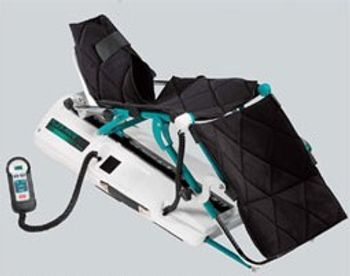
Breg Flexmate K500
 Breg · Model Flexmate K500
Anatomical Knee Continuous Passive Motion (CPM) device. The Flex-Mate K500 is an anatomical Knee Continuous Passive Motion (CPM) device that provides a full range of motion (ROM) of minus (-10°) in extension to (120°) of flexion designed to accommodate modern post-surgical protocols. No configuration change is needed for right or left applications. At only 26 pounds, the Flex-Mate K500 is a lightweight CPM device that is portable and ideal for both home and hospital use. The easy-to-use controls located on the handheld pendant allow the user to start or stop the unit, as well as, adjust for flexion, extension, speed, and pause settings. In addition, a lockout feature can be incorporated to prevent unintentional or unauthorized setting changes. The Flex-Mate K500 accommodates a wide range of patient sizes due to its ability to be easily converted for both adult and pediatric applications with no additional accessories required.
Key tips
- ·Most "no output" stim-unit complaints are cable-side - check electrode/lead continuity before assuming a unit fault.
- ·Frame and strap wear on mechanical rehab equipment is a real fall/injury risk - don't defer it as cosmetic.
Typical Failure Modes
Compiled for this model from its own documentation and established engineering knowledge for this equipment class - not from a verified service record. Confirm against the manufacturer's service manual.
Motor / actuator / drive will not run or is weak
HighSymptoms: Traction force not applied, CPM carriage will not move or stalls, drive assist weak, motion one direction only.
Root cause: Worn drive motor / leadscrew / actuator, a hand-control fault, or a control-board fault.
Force / range / position inaccuracy
MediumSymptoms: Set traction force or CPM angle not reached, load cell drifts, carriage overshoots or stalls short.
Root cause: Load-cell / position-sensor drift, a potentiometer fault, or a limit-switch fault.
Hand control / patient-control fault
MediumSymptoms: Hand control unresponsive, the patient stop / reverse button does not work.
Root cause: Worn hand control or a damaged cable.
Frame / bearing / cable wear
MediumSymptoms: Rough or noisy travel, play in the carriage, frayed traction cord or rope.
Root cause: Worn bearings / slides or a frayed cable / cord.
Power / battery fault
LowSymptoms: Will not power on, short battery run time.
Root cause: Power supply / fuse or an aged battery.
Serviceable Parts & Consumables
Serviceable items for this model, compiled from its documentation and engineering knowledge for this equipment class. Service class and relative cost are estimates, not manufacturer figures; no part numbers are given. Confirm intervals and pricing against the manufacturer.
Drive motor / leadscrew / actuator
Class Major service partRel. cost $$$R&R Difficult
Load cell / position sensor / potentiometer
Class Major service partRel. cost $$R&R Moderate
Hand control
Class Periodic replacementRel. cost $$R&R Fairly easy
Bearings / slides / traction cord
Class Periodic replacementRel. cost $$R&R Moderate
Power supply / fuse / battery
Class Major service partRel. cost $R&R Moderate
| Part | Service class | Relative cost | R&R difficulty |
|---|---|---|---|
| Drive motor / leadscrew / actuator | Major service part | $$$ | Difficult |
| Load cell / position sensor / potentiometer | Major service part | $$ | Moderate |
| Hand control | Periodic replacement | $$ | Fairly easy |
| Bearings / slides / traction cord | Periodic replacement | $$ | Moderate |
| Power supply / fuse / battery | Major service part | $ | Moderate |
Relative cost: $ lowest · $$$$ highest service-part cost for this equipment class. Not a price.
PM Checklist
Preventive-maintenance tasks typical of this equipment class. Perform to the manufacturer's procedure and your facility's policy - this is general reference, not a schedule for this specific unit.
- ·Frame and strap wear inspection
- ·Electrode lead continuity check
- ·Annual electrical safety test
Troubleshooting Approach
A starting sequence for this model, compiled from its documentation and engineering knowledge for this equipment class. Follow the manufacturer's service documentation for the actual procedure.
Symptom: No or low output on a modality / channel
- Fit a fresh applicator / handpiece / electrodes for that modality.
- Substitute a known-good lead / cable.
- Test therapeutic-ultrasound output into a water bath (visible cavitation / warmth) and run the applicator-contact / BNR self-test.
- Try the modality on another unit if available.
- Escalate a confirmed output-stage fault to the OEM.
Symptom: Patient feels nothing / open-circuit on an e-stim channel
- Fit fresh self-adhesive electrodes on well-prepped skin.
- Swap the lead wires.
- Confirm the current ramps and there is no open-electrode alarm.
- Test the channel into a resistive load per the manual.
- Refer the output stage if a good lead set still gives nothing.
Symptom: Unresponsive or erratic touchscreen / parameters will not set
- Power-cycle the unit.
- Recalibrate / re-seat the touchscreen if the touch is offset.
- Check the mains fuse and power supply.
- Confirm the cooling fan runs and the vents are clear.
- Replace the touchscreen or power supply as isolated.
Typical Location
Where this class of equipment is typically deployed - general reference, not this unit's own placement record.
- Physical therapy / rehab gym
- Outpatient rehab clinic
- Sports medicine
Documents & Manuals
Troubleshoot this device with Bio
Describe a symptom or error code. Bio answers from this device's own documented error codes, failure modes, parts, and guides.
Ask Bio