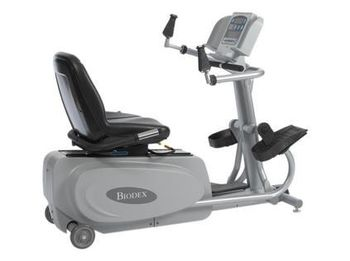
Biodex BioStep 2
 Biodex · Model BioStep 2
Elliptical motion - provides smooth continuous “zero joint impact” exercise. Self-powered, self-charging, cordless capability. 1:1 arm to leg motion - for natural arm swing rhythm. Pivoting handgrips – provide comfort for patients with forearm or wrist impingements. Rotating seat to 90° on either side and step-through design - for easy and safe entry and exit. Optimized seat height - for wheelchair transfers and controlled hip flexion. Up to 600 watts - to accommodate a wide spectrum of users. Constant resistance with 20 effort levels - provides greater program options. Heart Rate Monitoring - Polar® contact handgrips (telemetry compatible) to ensure proper training intensity. Sturdy, well-placed grab handles to facilitate patient transfer. Large easy-to-use “Quick Start” display - features time, RPM, watts, calories, METs, distance, total steps, heart rate. Large utility holder - provides a convenient storage place for water bottles and allows for hands-free reading. Robust design - for heavy institutional use. Optional Stabilization Packages - Standard and Advanced.
Key tips
- ·A no-signal/flatline alarm gets checked on the patient first, not the monitor - rule out a real clinical event before troubleshooting.
- ·Recalibrate NIBP against a reference manometer, not just a self-test pass.
- ·Reused patient cables (SpO2, ECG leads) are a common source of intermittent-fault complaints - swap the cable before the module.
Typical Failure Modes
Compiled for this model from its own documentation and established engineering knowledge for this equipment class - not from a verified service record. Confirm against the manufacturer's service manual.
Resistance / brake fault
HighSymptoms: Resistance will not change, feels wrong, or is uneven through the stroke.
Root cause: Eddy-current brake / magnet assembly, a resistance-motor fault, or a control fault.
Console dead / no data
MediumSymptoms: Console will not power on, no speed / cadence / power / HR data.
Root cause: Console battery / power, a sensor-cable fault, or the console board.
Pedal / crank / drive fault
MediumSymptoms: Play or knocking in the cranks, freewheel slips, drive belt / chain noise.
Root cause: Worn bottom-bracket bearings, pedals, or drive belt / chain.
Speed / cadence sensor fault
MediumSymptoms: Cadence or speed reads zero or erratically.
Root cause: Reed / optical sensor or its cable / magnet.
Seat / adjustment mechanism fault
LowSymptoms: Seat post or backrest will not adjust or lock, wear in the slider.
Root cause: Worn adjustment latch / slider.
Serviceable Parts & Consumables
Serviceable items for this model, compiled from its documentation and engineering knowledge for this equipment class. Service class and relative cost are estimates, not manufacturer figures; no part numbers are given. Confirm intervals and pricing against the manufacturer.
Eddy-current brake / resistance motor
Class Major service partRel. cost $$$R&R Difficult
Console board / power
Class Major service partRel. cost $$R&R Moderate
Bottom-bracket bearings / pedals
Class Periodic replacementRel. cost $$R&R Moderate
Drive belt / chain
Class Periodic replacementRel. cost $R&R Moderate
Speed / cadence sensor
Class Periodic replacementRel. cost $R&R Fairly easy
| Part | Service class | Relative cost | R&R difficulty |
|---|---|---|---|
| Eddy-current brake / resistance motor | Major service part | $$$ | Difficult |
| Console board / power | Major service part | $$ | Moderate |
| Bottom-bracket bearings / pedals | Periodic replacement | $$ | Moderate |
| Drive belt / chain | Periodic replacement | $ | Moderate |
| Speed / cadence sensor | Periodic replacement | $ | Fairly easy |
Relative cost: $ lowest · $$$$ highest service-part cost for this equipment class. Not a price.
PM Checklist
Preventive-maintenance tasks typical of this equipment class. Perform to the manufacturer's procedure and your facility's policy - this is general reference, not a schedule for this specific unit.
- ·Routine cable and lead-wire inspection for fraying/wear
- ·Battery conditioning cycle
- ·NIBP calibration check against a reference manometer
- ·ECG / SpO2 accuracy verification against a patient simulator
- ·Annual electrical safety test
Troubleshooting Approach
A starting sequence for this model, compiled from its documentation and engineering knowledge for this equipment class. Follow the manufacturer's service documentation for the actual procedure.
Symptom: Resistance will not change
- Confirm the console powers the brake (battery / mains).
- Check the sensor / brake cable connections.
- Feel the resistance through a full range setting.
- Test or replace the resistance motor / brake assembly.
- Verify resistance against known power targets if the unit supports it.
Symptom: Console dead or no data
- Replace the console batteries / check the power feed.
- Reseat the sensor and generator cables.
- Confirm the cadence sensor and magnet alignment.
- Try the console on another base if possible.
- Replace the console board if it stays dead.
Technical Specs
- Height
- 44 in
- Length
- 54 in
- Weight
- 202.5 lbs
- Width
- 28 in
Typical Location
Where this class of equipment is typically deployed - general reference, not this unit's own placement record.
- ICU / CCU
- Emergency Department
- OR / PACU
- General med-surg floors
- Step-down units
- Telemetry units
Documents & Manuals
Troubleshoot this device with Bio
Describe a symptom or error code. Bio answers from this device's own documented error codes, failure modes, parts, and guides.
Ask Bio