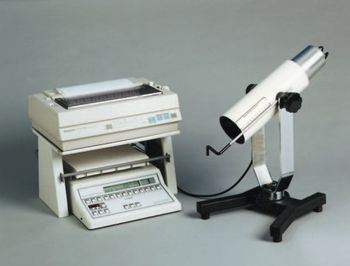
Biodex Atomlab 930
 Biodex · Model Atomlab 930
Thyroid Uptake System The Atomlab 930 is a versatile and cost-effective spectrum analysis system for performing uptake studies, bioassays, Schilling tests, wipe tests, and other user-defined tasks in the nuclear medicine environment. Engineered for mobility, durability, and efficiency, the 930 handles an array of clinical tests, safety compliance tasks, and system administration/QA procedures. A powerful microprocessor guides the user through procedures, automatically performs necessary calculations, and outputs clear, concise reports. The systems internal memory stores results on up to 25 patients (up to four studies per patient). The self-contained 930 system is configured on a mobile platform with locking casters and a base that measures only 30" by 31.5" (76 x 80 cm). A two-tiered shelf supports the microprocessor/keyboard and printer. The base of the stand has a special shelf to hold an optional well counter. A 2" x2" NaI(Tl) detector with collimator articulates on a counterbalanced arm. Twenty-two inches (56 cm) of vertical travel allows the probe to be positioned up to 55" (140 cm) from the floor to accommodate seated or supine patients.
Key tips
- ·Mounting and securement hardware takes real fatigue from vibration and road shock - inspect it as carefully as the device itself.
- ·Post-call battery and function checks catch transport-induced faults that a scheduled PM would miss for months.
Typical Failure Modes
Compiled for this model from its own documentation and established engineering knowledge for this equipment class - not from a verified service record. Confirm against the manufacturer's service manual.
Will not power on or unexpected shutdown
HighSymptoms: The ems & transport is dead, reboots, or shuts down mid-use.
Root cause: Mains lead / fuse, an aged battery, or a power-supply board fault.
Battery will not hold charge
MediumSymptoms: Short run time on battery; low-battery alarm soon after a full charge.
Root cause: Aged rechargeable battery pack or a charger fault.
Display / control-panel fault
MediumSymptoms: Blank, dim or distorted display; unresponsive keys or touchscreen.
Root cause: Display, backlight, or control-board fault.
Fails self-test or calibration
MediumSymptoms: Power-on self-test or the scheduled performance check fails or is out of tolerance.
Root cause: Sensor drift or an internal board fault; recalibration or repair needed.
Serviceable Parts & Consumables
Serviceable items for this model, compiled from its documentation and engineering knowledge for this equipment class. Service class and relative cost are estimates, not manufacturer figures; no part numbers are given. Confirm intervals and pricing against the manufacturer.
Rechargeable battery pack
Class Periodic replacementRel. cost $$R&R Fairly easy
Power supply / mains board
Class Major service partRel. cost $$$R&R Difficult
Display / control-panel assembly
Class Major service partRel. cost $$$R&R Moderate
Cooling fan
Class Major service partRel. cost $R&R Moderate
| Part | Service class | Relative cost | R&R difficulty |
|---|---|---|---|
| Rechargeable battery pack | Periodic replacement | $$ | Fairly easy |
| Power supply / mains board | Major service part | $$$ | Difficult |
| Display / control-panel assembly | Major service part | $$$ | Moderate |
| Cooling fan | Major service part | $ | Moderate |
Relative cost: $ lowest · $$$$ highest service-part cost for this equipment class. Not a price.
PM Checklist
Preventive-maintenance tasks typical of this equipment class. Perform to the manufacturer's procedure and your facility's policy - this is general reference, not a schedule for this specific unit.
- ·Post-call function and battery check
- ·Mounting / securement inspection
- ·Annual full PM and vibration-tolerance check
Error Codes
Extracted directly from this unit's own service manual.
01Battery voltage is low
02Display unit checksum failed
03Display RAM failure
04MCA critical value checksum failure
05Setmca () isotope record is invalid
09ROI is narrow
10Count rate is <10,000 cpm
11Count rate is >600,000 cpm
12No peak in ROI
13Communication failure
15MCA clock failure
20High energy peak
21Low energy peak
22Cs-137 Upper ROI is out of range
23Cs-137 Lower ROI is out of range
24High count rate. No correction factor
25Schilling background > standard
26EEPROM contains bad information
102General failure
no #Error: Byte #___ did NOT verify!
Troubleshooting Approach
A starting sequence for this model, compiled from its documentation and engineering knowledge for this equipment class. Follow the manufacturer's service documentation for the actual procedure.
Symptom: Hydraulic height / Trendelenburg will not lift or holds poorly
- Check the hydraulic fluid level.
- Pump the deck up under load and time how fast it settles.
- Inspect the pump and cylinder for external leaks.
- Rebuild the pump with the seal kit or bleed the system per the manual.
- Confirm it holds at full height under the rated load.
Symptom: Brake / steer castor will not hold / castor shimmy
- Inspect the brake linkage and each castor.
- Adjust the central-brake linkage.
- Replace worn castors and the fifth-wheel components.
- Confirm the brake holds on an incline and the steer-lock engages.
- Check all four corners brake evenly.
Symptom: Backrest / Fowler will not raise or hold
- Check the gas spring / strut and the release mechanism.
- Confirm the pneumatic assist (where fitted) holds.
- Replace a weak gas strut.
- Confirm the backrest holds at several angles under load.
- Inspect the pivot hardware for wear.
Symptom: Siderails / IV pole / accessories loose or will not latch
- Inspect the latches, detents and accessory sockets for wear.
- Adjust or replace worn latch hardware.
- Confirm the siderails lock up and drop cleanly.
- Check the IV pole and litter attachments are secure.
- Load-test any patient-support accessory.
Typical Location
Where this class of equipment is typically deployed - general reference, not this unit's own placement record.
- Ambulance / transport vehicles
- Emergency Department
- Inter-facility transport teams
Documents & Manuals
Safety & Recalls
Synced live from the FDA openFDA API.
- RECALL
When deleting a previously entered custom isotope, the software deletes the isotope, but not the associated dial setting. Possible other stored custom isotopes may then have incorrect dial settings and may lead to an incorrect dose measurement and/or misadministration
Troubleshoot this device with Bio
Describe a symptom or error code. Bio answers from this device's own documented error codes, failure modes, parts, and guides.
Ask Bio