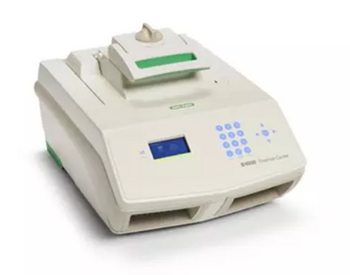
Bio-Rad Laboratories, Inc. S1000
 Bio-Rad Laboratories, Inc. · Model S1000
Flexible platform - choice of 4 interchangeable reaction modules; change throughput capability by linking up to 3 S1000 cyclers to a C1000 Touch cycler or adding PC control for up to 32 cyclers Exceptional thermal performance - the patented* reduced-mass honeycomb sample block delivers fast ramping and settling times for reliable results and reduced run times Optimal sealing - the fully adjustable heated lid accommodates a wide range of reaction vessels Thermal gradient - quickly and easily identify optimal annealing temperatures by using the programmable temperature gradient Applications and uses: Amplification/PCR Cloning Cycle sequencing Gene expression studies Mutagenesis.
Key tips
- ·Run QC controls before trusting any repair - an analyzer that passes self-test can still report clinically wrong results.
- ·Rule out a reagent lot change before opening the instrument - it can look exactly like a hardware fault.
- ·Centrifuge rotors have a hard retirement age/cycle limit regardless of visible condition - don't eyeball it.
Typical Failure Modes
Compiled for this model from its own documentation and established engineering knowledge for this equipment class - not from a verified service record. Confirm against the manufacturer's service manual.
Thermal / block uniformity fault
HighSymptoms: Wells at the edge vs centre give different Ct, failed thermal verification, ramp errors.
Root cause: Peltier block ageing / a failed Peltier zone, a heated-lid fault, or a fan / heatsink fault.
Optical / calibration fault (real-time)
HighSymptoms: High background, low signal, dye / ROI or pure-dye calibration fails, poor amplification curves.
Root cause: Excitation LED / lamp ageing, optics contamination, or an out-of-date calibration.
Heated lid / seal fault
MediumSymptoms: Evaporation, condensation on the seal, inconsistent replicates, lid-pressure error.
Root cause: Heated-lid heater or the lid-pressure mechanism / seal.
Software / instrument-comms fault
MediumSymptoms: Instrument not detected, runs will not start or export, firmware mismatch.
Root cause: USB / network link, driver, or the control PC.
Fan / cooling fault
LowSymptoms: Slow ramp-down, over-temperature warning, loud fan.
Root cause: Failed or clogged cooling fan.
Serviceable Parts & Consumables
Serviceable items for this model, compiled from its documentation and engineering knowledge for this equipment class. Service class and relative cost are estimates, not manufacturer figures; no part numbers are given. Confirm intervals and pricing against the manufacturer.
Peltier sample block
Class Major service partRel. cost $$$$R&R Difficult
Excitation LED / lamp module
Class Periodic replacementRel. cost $$$R&R Moderate
Heated-lid heater / seal
Class Major service partRel. cost $$R&R Moderate
Cooling fan
Class Periodic replacementRel. cost $R&R Fairly easy
Dye calibration kit
Class Frequent wear itemRel. cost $$R&R Easy
| Part | Service class | Relative cost | R&R difficulty |
|---|---|---|---|
| Peltier sample block | Major service part | $$$$ | Difficult |
| Excitation LED / lamp module | Periodic replacement | $$$ | Moderate |
| Heated-lid heater / seal | Major service part | $$ | Moderate |
| Cooling fan | Periodic replacement | $ | Fairly easy |
| Dye calibration kit | Frequent wear item | $$ | Easy |
Relative cost: $ lowest · $$$$ highest service-part cost for this equipment class. Not a price.
PM Checklist
Preventive-maintenance tasks typical of this equipment class. Perform to the manufacturer's procedure and your facility's policy - this is general reference, not a schedule for this specific unit.
- ·Daily QC controls run and reviewed
- ·Calibration verification per assay
- ·Routine cleaning and decontamination
- ·Scheduled reagent-path and pump-tubing maintenance
Troubleshooting Approach
A starting sequence for this model, compiled from its documentation and engineering knowledge for this equipment class. Follow the manufacturer's service documentation for the actual procedure.
Symptom: QC / calibration failure across a channel or the whole system
- Run fresh controls at all levels and note which analytes fail.
- Confirm reagents are in date, correctly loaded, mixed and not bubbled.
- Run the photometer / lamp-energy check and replace the lamp if energy is low.
- Clean the sample and reagent probes, the mixers and the wash / cuvette-wash stations.
- Recalibrate the affected assay / ISE module and re-run QC.
Symptom: Sample or reagent probe clog / crash / short aspiration
- Inspect the probe for a bend or blockage and clear it (wire / sonicate per the manual).
- Run the fluidics prime and the probe-wash cycle.
- Check for a clot or fibrin in the sample and the liquid-level sensing.
- Verify probe positioning / alignment.
- Replace the probe if aspiration is still short.
Symptom: ISE electrolyte results biased or noisy / ISE calibration fails
- Run the ISE calibration and check the slope / drift against spec.
- Replace an ISE electrode or the reference that is at end of life.
- Check the ISE pinch valves and tubing for wear or air.
- Confirm the ISE standard packs are in date.
- Re-run ISE QC before releasing electrolyte results.
Symptom: High cuvette blanks / position-dependent results
- Run the cuvette blank / photometric check.
- Clean or replace worn / scratched cuvettes or the reaction segment.
- Check the cuvette-wash station nozzles and drying.
- Confirm the water / DI supply quality.
- Recalibrate and re-run QC.
Technical Specs
- Weight
- 23
Typical Location
Where this class of equipment is typically deployed - general reference, not this unit's own placement record.
- Central / core laboratory
- Point-of-care testing stations
- Blood bank
- Microbiology lab
Documents & Manuals
Safety & Recalls
Synced live from the FDA openFDA API.
- RECALL
Due to two issues: 1) Customer complaints associated with greater than expected Rapid Plasma Reagin (RPR) reactivity which does not confirm with treponemal antibody test which may be due to a positive correlation between the mass COVID vaccinations and false reactive RPR results, and 2) During routine stability monitoring, an increase in mean bias above specification was observed which can cause elevated RPR reactivity potentially due to early shelf-life failure.
- RECALL
On a rare occasion the D-10 software might generate an extra result by duplicating the result form the previous sample and the Sample ID/Injection number from the next sample.
- RECALL
A previous recall related to reports of calibration failure and late retention times using Elution Buffer led to an examination of other buffers manufactured during the same time period and a decision was made to field correct these products until a definitive root cause and corrective action have been found and implemented.
- RECALL
Test Cartridges may leak and have the potential to generate error messages and biased inaccurate results.
- RECALL
Product mislabeled-- the ANA cutoff Control and Prostiva controls were mislabeled. Use of the incorrect controls will cause run failure - patient results cannot be reported because controls will not pass..
- RECALL
The firm received customer complaints of increased positivity rates associated with the Anti-dsDNA test kits.
- RECALL
The ANA Screening kit generates a high percentage of false positive results, associated with a low check control reading.
- RECALL
Inaccurate results-- Consumer complaints of increased positivity rates with the ANA screening kit.
- RECALL
The firm received customer complaints of increased positivity rates associated with the ANA Screening kit due to a decline in stability.
- RECALL
False positive test results caused by decrease in the OD values of ANA Cutoff Controls and ANA Positive Controls. The increased positivity rates were associated with the Meridian ANA Screening kit. False positive ANA values could result in misdiagnosis or mistreatment .
- RECALL
Pressure contained within the Elution Buffer vial may expel the rubber stopper, causing the potential for injury.
- RECALL
Incorrect patient results are being generated from out-of-range samples tested withc ompetitive enzyme immunoassays on the PhD system with software version 2.1A.
- RECALL
The firm received customer complaints of microbial contamination in Positive Controls in its Anti-Cardiolipin IgM Test Kit Lot CL-863.
- RECALL
The product may produce a faint line which could be interpreted as a false negative test result .
- RECALL
The Diluent in the D-10 Dual Program Calibrator reorder packs is defective, and can cause early calibration failure or elevated control and sample recovery results.
- RECALL
New instructions to recommend against using samples with visibly high level of blood.
- RECALL
The device was producing false negative results for cocaine tests.
Related calculators
From BioLab, for work done with this kind of equipment.
Troubleshoot this device with Bio
Describe a symptom or error code. Bio answers from this device's own documented error codes, failure modes, parts, and guides.
Ask Bio