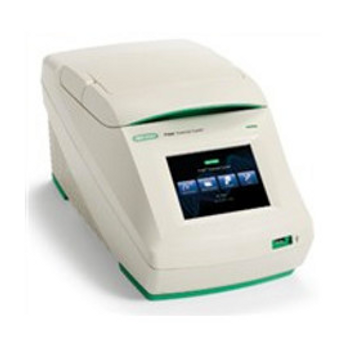
Bio-Rad Laboratories, Inc. Bio-Rad PTC-100
 Bio-Rad Laboratories, Inc. · Model Bio-Rad PTC-100
Thermal Cycler The Bio-Rad PTC-100 thermal cycler was designed by engineers and molecular biologists. It is sure to meet your need for a reliable, easy-to-use, programmable thermal cycler. T100 thermal cycler offers a user-friendly interface with the reliability and performance that you expect from Bio-Rad. Thermal gradient technology makes it easy to optimize the reactions in a single run. The 96-well sample block and self-adjusting heated lid accommodate standard tubes, tube strips, and plates.
Key tips
- ·Run QC controls before trusting any repair - an analyzer that passes self-test can still report clinically wrong results.
- ·Rule out a reagent lot change before opening the instrument - it can look exactly like a hardware fault.
- ·Centrifuge rotors have a hard retirement age/cycle limit regardless of visible condition - don't eyeball it.
Typical Failure Modes
Compiled for this model from its own documentation and established engineering knowledge for this equipment class - not from a verified service record. Confirm against the manufacturer's service manual.
Will not power on or unexpected shutdown
HighSymptoms: The laboratory & diagnostics is dead, reboots, or shuts down mid-use.
Root cause: Mains lead / fuse, an aged battery, or a power-supply board fault.
Battery will not hold charge
MediumSymptoms: Short run time on battery; low-battery alarm soon after a full charge.
Root cause: Aged rechargeable battery pack or a charger fault.
Display / control-panel fault
MediumSymptoms: Blank, dim or distorted display; unresponsive keys or touchscreen.
Root cause: Display, backlight, or control-board fault.
Fails self-test or calibration
MediumSymptoms: Power-on self-test or the scheduled performance check fails or is out of tolerance.
Root cause: Sensor drift or an internal board fault; recalibration or repair needed.
Serviceable Parts & Consumables
Serviceable items for this model, compiled from its documentation and engineering knowledge for this equipment class. Service class and relative cost are estimates, not manufacturer figures; no part numbers are given. Confirm intervals and pricing against the manufacturer.
Rechargeable battery pack
Class Periodic replacementRel. cost $$R&R Fairly easy
Power supply / mains board
Class Major service partRel. cost $$$R&R Difficult
Display / control-panel assembly
Class Major service partRel. cost $$$R&R Moderate
Cooling fan
Class Major service partRel. cost $R&R Moderate
| Part | Service class | Relative cost | R&R difficulty |
|---|---|---|---|
| Rechargeable battery pack | Periodic replacement | $$ | Fairly easy |
| Power supply / mains board | Major service part | $$$ | Difficult |
| Display / control-panel assembly | Major service part | $$$ | Moderate |
| Cooling fan | Major service part | $ | Moderate |
Relative cost: $ lowest · $$$$ highest service-part cost for this equipment class. Not a price.
PM Checklist
Preventive-maintenance tasks typical of this equipment class. Perform to the manufacturer's procedure and your facility's policy - this is general reference, not a schedule for this specific unit.
- ·Daily QC controls run and reviewed
- ·Calibration verification per assay
- ·Routine cleaning and decontamination
- ·Scheduled reagent-path and pump-tubing maintenance
Error Codes
Extracted directly from this unit's own service manual.
Instrument OverheatedInstrument is not getting enough air, or air being taken in is warmer than 31°C.
Correct air supply problems (see "Air Supply Requirements" in Chapter 3) and run protocol again. If error message persists, instrument may need servicing. Call 1-800-4BIORAD (in the US or Canada) , or your distributor.
Instrument OverheatingInstrument is not getting enough air, or air being taken in is warmer than 31°C.
Correct air supply problems (see "Air Supply Requirements" in Chapter 3) and run protocol again. If error message persists, instrument may need servicing. Call 1-800-4BIORAD (in the US or Canada) , or your distributor.
AC Power FailedDisplayed when a instrument running a protocol has been turned off, either intentionally or due to a power outage, and then turned on again.
No action is necessary. Protocol resumes running when power is restored Results may or may not be affected, depending on whether power failed in an early or a late cycle, and whether the power was restored before the sample cooled excessively.
Block Sensor FaultTemperature sensor is not working properly.
Instrument needs servicing. Call 1-800-4BIORAD (in the US or Canada) , or your distributor.
Lid Sensor FaultLid temperature sensor is not working properly. Protocols may still be run, but reactions may fail because of condensation in vessels.
Lid or instrument needs servicing soon. Call 1-800-4BIORAD (in the US or Canada) , or your distributor.
HtSink Sensor FaultThe heat sink sensor is not functioning properly.
Instrument needs servicing soon. Call 1-800-4BIORAD (in the US or Canada) , or your distributor.
PwrSup Sensor FaultPower supply sensor is not working properly. Protocols can still be run, but instrument should be serviced soon to repair sensor.
Instrument needs servicing soon. Call 1-800-4BIORAD (in the US or Canada) , or your distributor.
Lid Heat FailureLid temperature sensor failed during preheat.
Lid or instrument needs servicing. Call 1-800-4BIORAD (in the US or Canada) , or your distributor.
Heat Pump FailureHeat pump sensor is not working properly.
Instrument needs servicing. Call 1-800-4BIORAD (in the US or Canada) , or your distributor.
No ProgramsThere are no programs stored in the instrument.
Refer to Chapter 6, Creating Programs for instructions on creating and entering a new program.
Folder is EmptyThere are no programs stored in the folder.
Select a different folder or refer to Chapter 6, Creating Programs for instructions on creating and entering a new program.
Incorrect passwordThe password entered does not match the password assigned to the folder.
Enter the correct password for the folder.
Program/Folder name is takenA program/folder already exists with that name.
Enter a unique program/folder name.
Too many Folders12 folders already exist. Either use an existing folder, or first delete a folder and then create a new one.
Either use an existing folder, or first delete a folder and then create a new one.
Secure <Main>Cannot be secured The Main folder can not be password protected.
If password protection is desired, save the program to a folder other than <Main>.
Memory LowThere is not enough memory left for a maximal size program.
Delete unused programs to make more memory available.
Memory FullAll of the available memory has been filled.
Delete unused programs to make more memory available.
Too Many ProgramsThe number of stored programs exceeds the maximum allowed.
Delete any unused programs.
Program Too LongThe program size exceeds the maximum allowed.
Reduce the size of the program by using Goto steps and Inc and Ext options (see Chapter 6).
No reaction products obtained.Wrong protocol used. Protocol contains a wrong value. Reaction component omitted from mixture. Denaturation temperature too low. Annealing temperature too high for primers. Reaction mix contains an inhibitor. Reaction vessels not making good thermal contact with sample block.
Re-run reaction using correct protocol. Check protocol for correct temperature and times. Check reaction assembly protocol ensuring appropriate components in correct concentrations. Use 92°C for denaturation. Check for appropriate annealing temperatures of primers. Spike a complete reaction mix with a control template and primer set. Use only high-quality tubes/plates that fit block snugly. Ensure that wells are free of foreign materials.
Troubleshooting Approach
A starting sequence for this model, compiled from its documentation and engineering knowledge for this equipment class. Follow the manufacturer's service documentation for the actual procedure.
Symptom: QC / calibration failure across a channel or the whole system
- Run fresh controls at all levels and note which analytes fail.
- Confirm reagents are in date, correctly loaded, mixed and not bubbled.
- Run the photometer / lamp-energy check and replace the lamp if energy is low.
- Clean the sample and reagent probes, the mixers and the wash / cuvette-wash stations.
- Recalibrate the affected assay / ISE module and re-run QC.
Symptom: Sample or reagent probe clog / crash / short aspiration
- Inspect the probe for a bend or blockage and clear it (wire / sonicate per the manual).
- Run the fluidics prime and the probe-wash cycle.
- Check for a clot or fibrin in the sample and the liquid-level sensing.
- Verify probe positioning / alignment.
- Replace the probe if aspiration is still short.
Symptom: ISE electrolyte results biased or noisy / ISE calibration fails
- Run the ISE calibration and check the slope / drift against spec.
- Replace an ISE electrode or the reference that is at end of life.
- Check the ISE pinch valves and tubing for wear or air.
- Confirm the ISE standard packs are in date.
- Re-run ISE QC before releasing electrolyte results.
Symptom: High cuvette blanks / position-dependent results
- Run the cuvette blank / photometric check.
- Clean or replace worn / scratched cuvettes or the reaction segment.
- Check the cuvette-wash station nozzles and drying.
- Confirm the water / DI supply quality.
- Recalibrate and re-run QC.
Typical Location
Where this class of equipment is typically deployed - general reference, not this unit's own placement record.
- Central / core laboratory
- Point-of-care testing stations
- Blood bank
- Microbiology lab
Documents & Manuals
Safety & Recalls
Synced live from the FDA openFDA API.
- RECALL
Due to two issues: 1) Customer complaints associated with greater than expected Rapid Plasma Reagin (RPR) reactivity which does not confirm with treponemal antibody test which may be due to a positive correlation between the mass COVID vaccinations and false reactive RPR results, and 2) During routine stability monitoring, an increase in mean bias above specification was observed which can cause elevated RPR reactivity potentially due to early shelf-life failure.
- RECALL
There is an issue with the buffers which impacts the quantification of the Hemoglobin F peak. Calibration and Quality control are likely to fail if the affected lots are used.
- RECALL
On a rare occasion the D-10 software might generate an extra result by duplicating the result form the previous sample and the Sample ID/Injection number from the next sample.
- RECALL
It was discovered that the Variant II Turbo Link Calibrator Values card contains incorrect values for IFCC units. The numbers are missing a decimal point.
- RECALL
A previous recall related to reports of calibration failure and late retention times using Elution Buffer led to an examination of other buffers manufactured during the same time period and a decision was made to field correct these products until a definitive root cause and corrective action have been found and implemented.
- RECALL
Test Cartridges may leak and have the potential to generate error messages and biased inaccurate results.
- RECALL
Inaccurate results with high bias-- Inaccurate results may be read by the machine, creating the risk for untreated hypoglycemia at elevated altitudes.
- RECALL
Product mislabeled-- the ANA cutoff Control and Prostiva controls were mislabeled. Use of the incorrect controls will cause run failure - patient results cannot be reported because controls will not pass..
- RECALL
The firm received customer complaints associated with the Update Kit CD-ROM not being able to generate a valid calibration after being uploaded, resulting in patient results not being generated.
- RECALL
The firm received customer complaints of increased positivity rates associated with the Anti-dsDNA test kits.
- RECALL
The ANA Screening kit generates a high percentage of false positive results, associated with a low check control reading.
- RECALL
Inaccurate results-- Consumer complaints of increased positivity rates with the ANA screening kit.
- RECALL
The firm received customer complaints of increased positivity rates associated with the ANA Screening kit due to a decline in stability.
- RECALL
The value for the ANA Cutoff and ANA Positive Controls will decrease overtime resulting in an unusually elevated positivity rate for patient samples tested.
- RECALL
False positive test results caused by decrease in the OD values of ANA Cutoff Controls and ANA Positive Controls. The increased positivity rates were associated with the Meridian ANA Screening kit. False positive ANA values could result in misdiagnosis or mistreatment .
- RECALL
The results from the blood device had the occurrence of some ramping baselines on their chromatograms. The ramping baseline can affect quantitation of the blood results.
- RECALL
Pressure contained within the Elution Buffer vial may expel the rubber stopper, causing the potential for injury.
- RECALL
Wrong lot number was found on the Hemoglobin Cartridge Insert . The insert did not match the lot number to the device cartridge or the device cartridge label or on the Update Kit CD.
- RECALL
Some customers have reported the occurrence of some ramping baselines on the chromatograms. The ramping baseline can affect hemoglobin test results.
- RECALL
Product update kit CD rom will not upload. As a result, the device cannot be run.
- RECALL
Incorrect patient results are being generated from out-of-range samples tested withc ompetitive enzyme immunoassays on the PhD system with software version 2.1A.
- RECALL
The firm received customer complaints of microbial contamination in Positive Controls in its Anti-Cardiolipin IgM Test Kit Lot CL-863.
- RECALL
Calibration Failure-- due to high intercept values, the device fails calibration and users are unable to run samples.
- RECALL
The wrong barcode number and tube position number may be assigned to samples leading to discrepant sample results.
- RECALL
Sample results may be assigned to the wrong barcode number and tube position numbers, leading to discrepant sample results.
- RECALL
Incorrect values: An error was found in the BioPlex 2200 Software, Version 2.0 that results in assignment values being utilized for the BioPlex assay Calibrator Set that may be slightly different from those printed on the Value Assignment Data Sheet. Some values may be identical between the lot assignment combinations with the ANA Screen with MDSS kit.
- RECALL
The product may produce a faint line which could be interpreted as a false negative test result .
- RECALL
The Diluent in the D-10 Dual Program Calibrator reorder packs is defective, and can cause early calibration failure or elevated control and sample recovery results.
- RECALL
New instructions to recommend against using samples with visibly high level of blood.
- RECALL
The device was producing false negative results for cocaine tests.
Related calculators
From BioLab, for work done with this kind of equipment.
Troubleshoot this device with Bio
Describe a symptom or error code. Bio answers from this device's own documented error codes, failure modes, parts, and guides.
Ask Bio