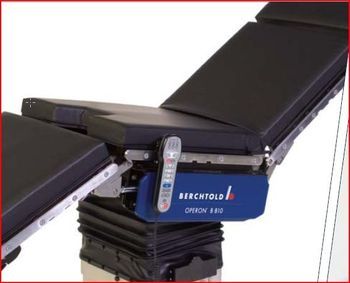
Berchtold OPERON B 810 Surgical
 Berchtold · Model OPERON B 810 Surgical
X-ray Cassette Channel: eliminates x-ray tops while maximizing patient safety and user convenience. Carbon Fiber Tabletop Construction: less x-ray attenuation improving image clarity while minimizing exposure to patients and OR staff. 12" Longitudinal Slide: Moves the tabletop longitudinally providing superior C-arm coverage without the need to physically reposition the patient. Imaging Window: A generous 21" wide tabletop and the OPERON B 810 frame design allows for maximum imaging capabilities.
Key tips
- ·Never defeat or bypass a return-electrode monitoring (REM) alarm to finish a case - it's a direct burn risk.
- ·Verify OR table battery backup - a table that loses power mid-procedure is a real, documented incident type.
- ·Track surgical light lamp-hours rather than waiting for failure - a sudden failure mid-case is avoidable.
Typical Failure Modes
Compiled for this model from its own documentation and established engineering knowledge for this equipment class - not from a verified service record. Confirm against the manufacturer's service manual.
A powered function will not run
HighSymptoms: Height, tilt, Trendelenburg, back or leg section does not respond to the hand control / pendant.
Root cause: Hand control fault, an electro-hydraulic actuator, a control-board fault, or a low battery (mobile column).
Section drifts or will not hold
MediumSymptoms: Table settles under load after positioning.
Root cause: Hydraulic valve internal leak or an actuator backdrive.
Battery will not hold charge (mobile column)
MediumSymptoms: Short run time, table dies mid-procedure, battery alarm.
Root cause: Aged battery pack or a charger fault.
Hand control / pendant / cable fault
MediumSymptoms: Intermittent or dead hand control.
Root cause: Worn hand control or a damaged cable.
Table-top segment / rail / pad fault
LowSymptoms: Segments loose, accessory rails will not clamp, pads torn, radiolucent top damaged.
Root cause: Worn segment latches, rail clamps, or upholstery.
Serviceable Parts & Consumables
Serviceable items for this model, compiled from its documentation and engineering knowledge for this equipment class. Service class and relative cost are estimates, not manufacturer figures; no part numbers are given. Confirm intervals and pricing against the manufacturer.
Electro-hydraulic actuator
Class Major service partRel. cost $$$R&R Difficult
Hydraulic control valve block
Class Major service partRel. cost $$$R&R Difficult
Battery pack (mobile column)
Class Periodic replacementRel. cost $$R&R Fairly easy
Hand control / pendant
Class Periodic replacementRel. cost $$R&R Fairly easy
Table-top segment pads / rail clamps
Class Major service partRel. cost $$R&R Fairly easy
| Part | Service class | Relative cost | R&R difficulty |
|---|---|---|---|
| Electro-hydraulic actuator | Major service part | $$$ | Difficult |
| Hydraulic control valve block | Major service part | $$$ | Difficult |
| Battery pack (mobile column) | Periodic replacement | $$ | Fairly easy |
| Hand control / pendant | Periodic replacement | $$ | Fairly easy |
| Table-top segment pads / rail clamps | Major service part | $$ | Fairly easy |
Relative cost: $ lowest · $$$$ highest service-part cost for this equipment class. Not a price.
PM Checklist
Preventive-maintenance tasks typical of this equipment class. Perform to the manufacturer's procedure and your facility's policy - this is general reference, not a schedule for this specific unit.
- ·Pre-case functional check
- ·Electrosurgical return-electrode cable inspection
- ·Table hydraulic / mechanical inspection
- ·Annual electrical safety test and full PM
Error Codes
Extracted directly from this unit's own service manual.
1Program Memory checksum error
• Return the CPU to the factory for reprogramming. • Replace the CPU.
2RAM memory fault
• Replace the CPU.
3EEPROM fault
• Return the CPU to the factory for reprogramming. • Replace the CPU.
4System Clock fault
• Non-critical error. • Run table through all functions to ensure proper operation. If functions fail to operate as expected, replace the CPU.
6Internal error 1
• Replace the CPU.
7Internal error 2
• Replace the CPU.
8Internal error 3
• Replace the CPU.
9Internal error 4
• Replace the CPU.
10Internal error 5
• Replace the CPU.
14ACCU fault
• Reconnect battery. • Replace battery
16Motor "voltage feedback" fault
• Check battery and the charging circuit connections. • Refer to Figure 5-2 and check circuits to and form J2 on the CPU board. Replace faulty harnesses or components.
17Motor "current feedback" fault
• Locate and eliminate short circuit. • Connect motor. • Replace broken wire(s).
1912 V fault
• Check battery and the charging circuit connections. • Refer to Figure 5-2 and check circuits to and form J2 on the CPU board. Replace faulty harnesses or components.
205 V fault
• Refer to Figure 5-2 and check the sensor circuits. Replace defective harnesses or components.
21Ground or ADC fault
• Check ground wiring continuity. • Replace CPU.
22Sensor-1 Fault (Tilt)
• Connect sensor. • Identify and replace broken wiring. • Locate and remove cause of short circuit.
23Sensor-2 Fault (Trend)
• Connect sensor. • Identify and replace broken wiring. • Locate and remove cause of short circuit.
24Sensor-3 Fault (Back)
• Connect sensor. • Identify and replace broken wiring. • Locate and remove cause of short circuit.
25Sensor-4 Fault (Legs)
• Connect sensor. • Identify and replace broken wiring. • Locate and remove cause of short circuit.
26Sensor-5 Fault (Lock)
• Connect sensor. • Identify and replace broken wiring. • Locate and remove cause of short circuit.
27Sensor-6 Fault (Kidney)
• Connect sensor. • Identify and replace broken wiring. • Locate and remove cause of short circuit.
28Sensor-7 Fault (Slide)
• Connect sensor. • Identify and replace broken wiring. • Locate and remove cause of short circuit.
37Valve-1 fault (LOCK)
• Connect valve. • Identify and replace broken wiring. • Locate and remove cause of short circuit. • Replace the Solenoid coil.
38Valve-2 fault (UNLOCK)
• Connect valve. • Identify and replace broken wiring. • Locate and remove cause of short circuit. • Replace the Solenoid coil.
39Valve-3 fault (HEIGHT DOWN)
• Connect valve. • Identify and replace broken wiring. • Locate and remove cause of short circuit. • Replace the Solenoid coil.
40Valve-4 fault (HIGHT UP)
• Connect valve. • Identify and replace broken wiring. • Locate and remove cause of short circuit. • Replace the Solenoid coil.
41Valve-5 fault (TILT LEFT)
• Connect valve. • Identify and replace broken wiring. • Locate and remove cause of short circuit. • Replace the Solenoid coil.
42Valve-6 fault (TILT RIGHT)
• Connect valve. • Identify and replace broken wiring. • Locate and remove cause of short circuit. • Replace the Solenoid coil.
43Valve-7 fault (TREND)
• Connect valve. • Identify and replace broken wiring. • Locate and remove cause of short circuit. • Replace t
Troubleshooting Approach
A starting sequence for this model, compiled from its documentation and engineering knowledge for this equipment class. Follow the manufacturer's service documentation for the actual procedure.
Symptom: A powered movement will not run (height / tilt / Trendelenburg / back / leg)
- Confirm the table is on mains or the mobile-column battery is charged, and no lock-out is set.
- Operate the function and listen for the electro-hydraulic pump / actuator.
- Substitute a known-good hand control / pendant.
- Check the control cable and connectors for damage.
- Replace the actuator, the hydraulic valve or the control board as isolated, then load-test.
Symptom: A section drifts down / will not hold position under load
- Note how fast it settles and under what load.
- Check the hydraulic control valve for internal leak-by and the actuator for backdrive.
- Bleed and top up the hydraulic system per the manual.
- Rebuild or replace the leaking valve / actuator.
- Confirm the section holds at several positions under the rated load.
Symptom: Battery will not hold charge (mobile column)
- Charge fully and check the charger.
- Run a battery test if supported.
- Replace the battery pack.
- Confirm a full set of movements on battery after replacement.
- Inspect the charge socket and cable.
Symptom: Hand control / pendant intermittent or dead
- Flex the cable along its length and at both ends while operating.
- Inspect the connector for bent pins or moisture.
- Substitute a known-good pendant.
- Replace the pendant or its cable.
- Confirm every function from the replacement.
Technical Specs
- Height
- 28 in to 48"
- Length
- 76 in
- Tredelenburg
- 30 degrees
- Lateral Tilt
- 30 degrees
- Patient Weight Capacity
- 600 lbs
- Width
- 21 in to 23"
Typical Location
Where this class of equipment is typically deployed - general reference, not this unit's own placement record.
- Operating rooms
- Procedure rooms
- Interventional suites
Documents & Manuals
Safety & Recalls
Synced live from the FDA openFDA API.
- RECALL
The Surgical Table Cushion (HybriGel Pads) could potentially contain staples that's secure two underlying fabrics, which would be captured on certain scans on patients, such as x-ray.
- RECALL
The firm received complaints for unintended movements.
- RECALL
Defective camera: There is a possibility that the connection of the wires to the connector may become loose, causing image distortion or loss.
- RECALL
Table was not lowering.
- RECALL
A mechanical failure of a welded joint within the spring Arm may result in the rapid drop of a monitor to the mechanical stop.
- RECALL
Difficulty in pressing the button needed to release a bed part resulted in an injury to a caregiver's finger which became stuck in metal latch under the gas cylinder of the bed piece.
Troubleshoot this device with Bio
Describe a symptom or error code. Bio answers from this device's own documented error codes, failure modes, parts, and guides.
Ask Bio