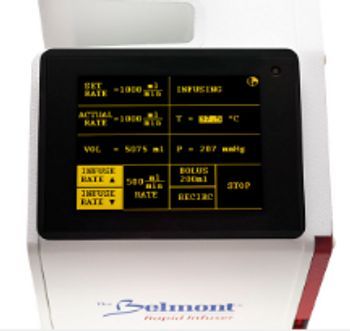
Belmont Rapid Infuser RI-2
 Belmont · Model Rapid Infuser RI-2
Provides instant heat No water baths or hot plates Automatic air removal Touch screen with step-by-step on screen instructions Simple set up Automatic priming in seconds Precise control of infusion - with settings from 2.5 ml/min to 1000 ml/min Operator controlled bolus infusion Automatic alarms - when the line becomes obstructed, fluids deplete or when other conditions requiring attention arise Recirculation mode Optional large reservoir Automatic line pressure monitoring Small and lightweight 15 ft. power cord with lock (USA only) RoHs compliant Aluminum-free disposables Medical grade stainless steel heat exchanger CE mark.
Key tips
- ·Never skip temperature-accuracy verification to save time - it's the one check that directly prevents burns.
- ·Hose/blanket connector wear is the most common real fault and the easiest to miss on a quick visual check.
Typical Failure Modes
Compiled for this model from its own documentation and established engineering knowledge for this equipment class - not from a verified service record. Confirm against the manufacturer's service manual.
Air-detection alarm
HighSymptoms: "Air Detection" alarm, pumping / heating stops and the revert valve goes to recirculate.
Root cause: Air in the disposable set, an improperly primed set, or an air-detector fault.
High-pressure alarm
MediumSymptoms: "High Pressure" alarm, delivery stops.
Root cause: Kinked or clamped line, a small-bore or clotted IV catheter, or a pressure-sensor fault.
Fluid-out alarm / will not prime
MediumSymptoms: "Fluid Out" alarm, set will not prime or maintain flow.
Root cause: Empty fluid bags, an air-locked or mis-loaded set, or a level / bubble-trap sensor fault.
Heating / temperature fault
MediumSymptoms: Delivered fluid not reaching the set temperature, heater alarm.
Root cause: Aluminium heat-exchanger plate contamination, the heater, or a temperature-sensor fault.
Battery / power fault
MediumSymptoms: "Low Battery" alarm, will not run on battery for the rated time.
Root cause: Aged battery pack.
Door-open alarm / door-latch fault
LowSymptoms: "Door Open" alarm with the door closed, or the door will not latch.
Root cause: Door switch or latch fault.
Serviceable Parts & Consumables
Serviceable items for this model, compiled from its documentation and engineering knowledge for this equipment class. Service class and relative cost are estimates, not manufacturer figures; no part numbers are given. Confirm intervals and pricing against the manufacturer.
Disposable infusion set (with heat exchanger)
Class ConsumableRel. cost $$R&R Easy
Battery pack
Class Periodic replacementRel. cost $$R&R Fairly easy
Air / bubble-trap detector
Class Major service partRel. cost $$R&R Moderate
Heater plate / temperature sensor
Class Major service partRel. cost $$$R&R Difficult
Door switch / latch
Class Major service partRel. cost $R&R Moderate
| Part | Service class | Relative cost | R&R difficulty |
|---|---|---|---|
| Disposable infusion set (with heat exchanger) | Consumable | $$ | Easy |
| Battery pack | Periodic replacement | $$ | Fairly easy |
| Air / bubble-trap detector | Major service part | $$ | Moderate |
| Heater plate / temperature sensor | Major service part | $$$ | Difficult |
| Door switch / latch | Major service part | $ | Moderate |
Relative cost: $ lowest · $$$$ highest service-part cost for this equipment class. Not a price.
PM Checklist
Preventive-maintenance tasks typical of this equipment class. Perform to the manufacturer's procedure and your facility's policy - this is general reference, not a schedule for this specific unit.
- ·Hose / blanket connector inspection
- ·Temperature-accuracy verification
- ·Annual electrical safety test
Troubleshooting Approach
A starting sequence for this model, compiled from its documentation and engineering knowledge for this equipment class. Follow the manufacturer's service documentation for the actual procedure.
Symptom: Air-detection alarm
- Follow the on-screen corrective instructions to silence and reset.
- Re-prime the disposable set, clearing all air from the bubble trap and lines.
- Confirm the set is loaded correctly around the air detector.
- Replace the set if air keeps being drawn in (loose spike / cracked bag).
- If it alarms with a correctly loaded, air-free set, refer the air detector for service.
Symptom: High-pressure or fluid-out alarm
- Check the line and IV catheter for kinks, clamps or a clot; use an adequate-bore catheter.
- Confirm the fluid bags are full and spiked, and the bubble trap is primed.
- Reload the set correctly.
- Clear the alarm and resume.
- Refer a persistent alarm with a good set for pressure-sensor / level-sensor service.
Technical Specs
- Height
- 7.5 in
- Length
- 13.5 in
- Weight
- 26
- Width
- 12 in
Typical Location
Where this class of equipment is typically deployed - general reference, not this unit's own placement record.
- Operating Room
- PACU
- Emergency Department
- Labor & Delivery
- NICU
Documents & Manuals
Safety & Recalls
Synced live from the FDA openFDA API.
- RECALL
Disposable set may leak during priming from a female quick connector due to a crack in the female quick connector, may lead to a potential delay in treatment since the set will need to be replaced by another set
- RECALL
Leak from a saline bag caused saline to drip along the back of the Rapid infuser close to the Power Entry Module causing an electrical flash at the power entry area.
Troubleshoot this device with Bio
Describe a symptom or error code. Bio answers from this device's own documented error codes, failure modes, parts, and guides.
Ask Bio