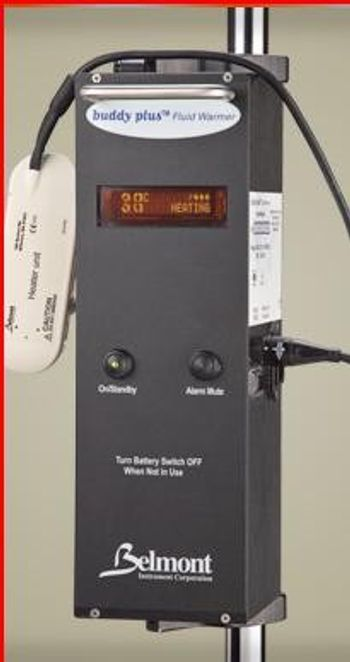
Belmont Buddy Plus Fluid Warmer
 Belmont · Model Buddy Plus Fluid Warmer
Power: Runs on AC line or from large capacity rechargeable battery built into the Power Module. Automatic switchover to battery at loss of power. Can be used where line power is unreliable. Self-contained: Battery, charger, and line power interface are all built-in and ready to go. High Capacity: Warms at least 5 liters of fluid to 38°C from 20°C infusate in a single battery cycle. Mounts to a litter or an IV pole. Display: Shows fluid temperature, battery charge status, and alarm messages.
Key tips
- ·Never skip temperature-accuracy verification to save time - it's the one check that directly prevents burns.
- ·Hose/blanket connector wear is the most common real fault and the easiest to miss on a quick visual check.
Typical Failure Modes
Compiled for this model from its own documentation and established engineering knowledge for this equipment class - not from a verified service record. Confirm against the manufacturer's service manual.
Fluid / blood not reaching target temperature
HighSymptoms: Output below target, low-temperature alarm, slow warm-up.
Root cause: Heater plate(s) or the heater-control circuit, or a temperature-sensor fault.
Over-temperature alarm / shutdown
HighSymptoms: The unit disables heating with an over-temperature condition (protects against haemolysis).
Root cause: Sensor or control fault driving the heater high, or an extreme flow-rate change.
Air-detector / bubble-trap alarm (rapid infusers)
MediumSymptoms: Air-in-line alarm, flow stops.
Root cause: Air in the set, an improperly primed set, or an air-detector fault.
Disposable-set detection / fitting fault
MediumSymptoms: Set not detected, will not clamp / seat, leaks at the warming chamber.
Root cause: Worn set-detection switch or chamber fitting.
Flow / pressure fault (rapid infusers)
MediumSymptoms: Cannot reach set flow, pressure alarm.
Root cause: Pump / roller fault or an occlusion.
Serviceable Parts & Consumables
Serviceable items for this model, compiled from its documentation and engineering knowledge for this equipment class. Service class and relative cost are estimates, not manufacturer figures; no part numbers are given. Confirm intervals and pricing against the manufacturer.
Heater plate(s) / heater-control assembly
Class Periodic replacementRel. cost $$$R&R Moderate
Temperature sensor
Class Major service partRel. cost $$R&R Moderate
Air-detector / bubble sensor
Class Major service partRel. cost $$R&R Moderate
Set-detection switch / chamber fitting
Class Periodic replacementRel. cost $$R&R Fairly easy
Disposable warming set
Class ConsumableRel. cost $R&R Easy
| Part | Service class | Relative cost | R&R difficulty |
|---|---|---|---|
| Heater plate(s) / heater-control assembly | Periodic replacement | $$$ | Moderate |
| Temperature sensor | Major service part | $$ | Moderate |
| Air-detector / bubble sensor | Major service part | $$ | Moderate |
| Set-detection switch / chamber fitting | Periodic replacement | $$ | Fairly easy |
| Disposable warming set | Consumable | $ | Easy |
Relative cost: $ lowest · $$$$ highest service-part cost for this equipment class. Not a price.
PM Checklist
Preventive-maintenance tasks typical of this equipment class. Perform to the manufacturer's procedure and your facility's policy - this is general reference, not a schedule for this specific unit.
- ·Hose / blanket connector inspection
- ·Temperature-accuracy verification
- ·Annual electrical safety test
Troubleshooting Approach
A starting sequence for this model, compiled from its documentation and engineering knowledge for this equipment class. Follow the manufacturer's service documentation for the actual procedure.
Symptom: Not reaching target temperature
- Confirm the correct programme / set for the fluid type and flow rate.
- Check both heater plates warm evenly.
- Verify the output temperature against an independent reference at a representative flow.
- Replace the temperature sensor if it disagrees.
- Replace the heater plate / control assembly if output is still low.
Symptom: Over-temperature alarm
- Let the unit cool and restart.
- Compare the displayed temperature to an independent reference.
- Check for an extreme flow-rate change during use.
- Replace the temperature sensor / control board as isolated.
- Confirm stable control across the flow range before returning to service.
Typical Location
Where this class of equipment is typically deployed - general reference, not this unit's own placement record.
- Operating Room
- PACU
- Emergency Department
- Labor & Delivery
- NICU
Documents & Manuals
No documents available for this device yet.
Safety & Recalls
Synced live from the FDA openFDA API.
- RECALL
Leak from a saline bag caused saline to drip along the back of the Rapid infuser close to the Power Entry Module causing an electrical flash at the power entry area.
Troubleshoot this device with Bio
Describe a symptom or error code. Bio answers from this device's own documented error codes, failure modes, parts, and guides.
Ask Bio