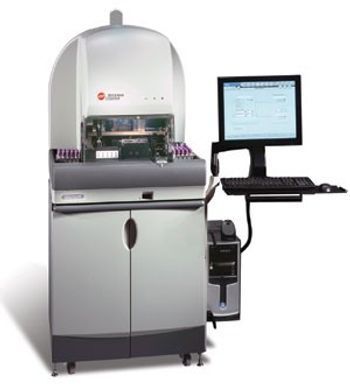
Beckman Coulter UniCel DxH 800 Coulter
 Beckman Coulter · Model UniCel DxH 800 Coulter
Single aspiration pathway simplifies calibration and quality control process while eliminating mode-to-mode issues. Sample Aspiration Module (SAM), with its unique design, reduces aspiration volume, especially benefiting pediatric samples. 2D-Digital Bar Code Technology maximizes reading capability, preventing errors and reducing misreads. Remote Management System (RMS) increases versatility by proactively performing diagnostics with real-time troubleshooting, leading to increased instrument uptime. Specimen Transport Module (STM) uses a unique, patented magnetic system for continuous loading of up to 20 cassettes, allowing “load 'n' go” capability. Intelligent workload distribution optimizes workflow by achieving rapid turnaround times, providing STAT and ER results quickly. Provides automation in a small footprint. On-board tracking, for optimal reagent management. With its future upgradability the UniCel DxH 800 can be converted to a full laboratory workcell, providing tomorrow’s platform today. High Definition Cellular Analysis on the UniCel DxH 800 provides four times greater resolution and achieves new levels of performance. Flow Cytometric Digital Morphology (FCDM) optimizes performance by providing 10 times more data per sample than existing technologies, allowing reduced review rates. With its multi-angle scatter technology, onboard reagents and new advanced algorithms, the UniCel DxH 800 provides an unrivaled NRBC, with no need for special or expensive stains. Using its data fusion capability, the system will correct for most of the common interferences in today’s laboratory, ensuring first-pass accuracy and efficiency.
Key tips
- ·Run QC controls before trusting any repair - an analyzer that passes self-test can still report clinically wrong results.
- ·Rule out a reagent lot change before opening the instrument - it can look exactly like a hardware fault.
- ·Centrifuge rotors have a hard retirement age/cycle limit regardless of visible condition - don't eyeball it.
Typical Failure Modes
Compiled for this model from its own documentation and established engineering knowledge for this equipment class - not from a verified service record. Confirm against the manufacturer's service manual.
Aperture blockage / partial obstruction
HighSymptoms: Flagged or implausible CBC counts, voteouts, aperture-clog alarms, poor precision.
Root cause: Debris or a clot partially blocking a counting aperture.
Sample probe / piercer / valve wear
MediumSymptoms: Short samples, aspiration errors, cap-piercing failures, carryover.
Root cause: Worn or bent sample probe / closed-vial piercer, or a worn segment / shear valve.
Reagent / lyse delivery fault
MediumSymptoms: WBC, HGB or diff results shifted, high background, reagent alarms.
Root cause: Reagent depleted or wrong lot, or a pinch-valve / tubing fault.
VCS / flow-cell / laser fault (diff)
MediumSymptoms: Diff scattergrams abnormal, missing populations, flow-cell or laser alarm.
Root cause: Contaminated or aged flow cell, or the laser / optics.
Autoloader / transport jam (DxH)
MediumSymptoms: Tubes not advancing, cassette / carousel error, mixing-station fault.
Root cause: Worn autoloader belt / gripper, a mis-loaded rack, or a mixing-station fault.
Vacuum / pressure out of range
MediumSymptoms: Multiple parameter errors, priming failures.
Root cause: Pump or regulator drift.
Serviceable Parts & Consumables
Serviceable items for this model, compiled from its documentation and engineering knowledge for this equipment class. Service class and relative cost are estimates, not manufacturer figures; no part numbers are given. Confirm intervals and pricing against the manufacturer.
Sample probe / closed-vial piercer
Class Periodic replacementRel. cost $$R&R Moderate
Segment / shear valve
Class Periodic replacementRel. cost $$$R&R Difficult
Pinch-valve / peristaltic tubing
Class Frequent wear itemRel. cost $R&R Moderate
VCS flow cell
Class Periodic replacementRel. cost $$$R&R Difficult
System reagents / controls
Class ConsumableRel. cost $$R&R Easy
Autoloader belt / gripper (DxH)
Class Periodic replacementRel. cost $$R&R Moderate
| Part | Service class | Relative cost | R&R difficulty |
|---|---|---|---|
| Sample probe / closed-vial piercer | Periodic replacement | $$ | Moderate |
| Segment / shear valve | Periodic replacement | $$$ | Difficult |
| Pinch-valve / peristaltic tubing | Frequent wear item | $ | Moderate |
| VCS flow cell | Periodic replacement | $$$ | Difficult |
| System reagents / controls | Consumable | $$ | Easy |
| Autoloader belt / gripper (DxH) | Periodic replacement | $$ | Moderate |
Relative cost: $ lowest · $$$$ highest service-part cost for this equipment class. Not a price.
PM Checklist
Preventive-maintenance tasks typical of this equipment class. Perform to the manufacturer's procedure and your facility's policy - this is general reference, not a schedule for this specific unit.
- ·Daily QC controls run and reviewed
- ·Calibration verification per assay
- ·Routine cleaning and decontamination
- ·Scheduled reagent-path and pump-tubing maintenance
Troubleshooting Approach
A starting sequence for this model, compiled from its documentation and engineering knowledge for this equipment class. Follow the manufacturer's service documentation for the actual procedure.
Symptom: Aperture-clog alarm / flagged counts
- Run the instrument's aperture-clear / burn and flush cycles.
- Run a background count and confirm it is within limits.
- Run controls at all levels.
- Clean or replace the aperture bath if clogs recur.
- Confirm precision on a replicate sample before releasing results.
Symptom: Short samples / aspiration errors
- Inspect the sample probe / piercer for wear or a bend.
- Check the segment / shear valve and tubing for leaks or wear.
- Verify vacuum and pressure against the service spec.
- Replace the probe / piercer, valve or tubing as found.
- Re-run controls.
Technical Specs
- Height
- 38 in
- Length
- 31 in
- Weight
- 260 lbs
- Width
- 30 in
Typical Location
Where this class of equipment is typically deployed - general reference, not this unit's own placement record.
- Central / core laboratory
- Point-of-care testing stations
- Blood bank
- Microbiology lab
Documents & Manuals
Safety & Recalls
Synced live from the FDA openFDA API.
- RECALL
Due to specific lots of diluents contributing to elevated platelet Daily Checks background counts cycle with use with analyzers.
- RECALL
Bicarbonate reagent may generate falsely high Bicarbonate results due to interference with Lactate Dehydrogenase (LDH) in the test sample.
- RECALL
Hematology analyzers configured with HGB photometers may result in erroneously high hemoglobin (HGB) results on samples with elevated white blood cell (WBC) counts.
- RECALL
Beckman Coulter has identified that the UniCel DxI 600/800 systems with linear slide PnP gantries running software versions 5.7 and up faced incorrect PnP X-motor current settings where the PnP X-motor current incorrectly resets to 1.5A (instead of the required 2.0A) because the software overwrites the factory setting during installs or upgrades. This anomaly causes increased PnP motion errors which could lead to delays in reporting patient sample results if unnoticed.
- RECALL
Beckman Coulter has become aware of an increase in customer complaints for intermittent IRISpec CB negative glucose control failure, resulting in false positive control results when used in conjunction with iChemVELOCITY Urine Chemistry Strips (PNs 800-7204 and 800-7212) on the iChemVELOCITY Analyzer. This issue may delay the reporting of patient results, with a worst-case scenario of a delay in diagnosis or treatment of metabolic disorders, kidney function abnormalities, urinary tract infections, and liver function.
- RECALL
LIH Influence check settings for Lipemia are incorrect which may result patient samples being reported as false low results or cause a high result to report as normal
- RECALL
Beckman Coulter has become aware that the cannula, which is found in the Flowcell and the iQClear Rinse Waste Well Assembly, may rust. Rust from the cannula has the potential to generate erroneous results.
- RECALL
Lipemic interference failed to meet the performance specification listed within the IFU.
- RECALL
A software defect in the DxA Automation System may cause tests to be run on patient samples in tube types not compatible with the requested test, leading to erroneous patient results
- RECALL
Specific diluent lot numbers showed that conductivity, osmolality, and pH were out of manufacturing specifications.
- RECALL
There is a potential for a decrease in calibration ODs for Bicarbonate reagent which could result in calibration failures and/or quality control failures.
- RECALL
The reagent lot produces elevated results (approximately >30%) in some (15-20%)patient samples that do not correlate with the results of other thyroid markers nor Free T3 results generated on other platforms. This introduces a risk of the positive bias not being detected by QC with the potential that clinical correlation with other thyroid function tests will be inconsistent requiring additional testing; however the clinical assessment and treatment decisions are not made in isolation on a single test result especially, in the setting of thyroid function testing. False positive test results could lead to a euthyroid patient being interpreted clinically as having elevated thyroid function (hyperthyroid) or a hypothyroid patient being within the normal range. Such misdiagnoses may lead to inappropriate treatment of a euthyroid patient with anti-thyroid medications or hypothyroid patient no
- RECALL
Beckman Coulter has become aware of an increase in customer complaints generated for intermittent IRISpec CB glucose control false positive results when used in conjunction with iChemVelocity Urine Chemistry Strips PN 800-7212
- RECALL
IRISpec CA failures for glucose.
- RECALL
Due to alkaline phosphatase (ALP) associated interference causing falsely elevated uE3 (Unconjugated Estriol assay) results.
- RECALL
Due to customer reports it has been determined that the inoculation system contains the incorrect prompt wands. Use of the incorrect wands could result in false -susceptible results, false-resistant results, possible misidentifications, or possible out-of-range Quality Control results.
- RECALL
When the UniCel DxH Slidemaker Stainer and UniCel DxH Slidemaker Stainer II dispense probe is slightly bent, there is a potential for cell carryover from the previous sample, and erroneous results could be reported from the slide review. Erroneous results may be reported from the laboratory which may trigger unnecessary or inappropriate patient treatment.
- RECALL
Potential exposure to biohazard. Software design problem causes excess speed and vibrations in the unload arm movement which causes caused sample splashing.
- RECALL
Falsely elevated (false positive) urobilinogen patient results due to an increase in the sensitivity of the urobilinogen reaction.
- RECALL
Compatibility issue between the software and Microsoft updates to Windows 7, 8, and 10. The compatibility issue causes the software to be unusable which could result in a delay of reporting results.
- RECALL
NAPQI, a metabolite of Acetaminophen, causes negative interference with the recalled product assays at levels present in the serum/plasma of overdose patients.
- RECALL
Complaints received of sporadic erroneously elevated platelet results without flags or system messages. Thrombocytopenia may go unrecognized.
- RECALL
Sorting-Drive software version 4.2 (released in October 2015) introduced a new option for iPAW and the Sorting-Drive Client that is used for manual printing of barcodes. Sorting Drive software version 4.2 was replaced by 4.2.1 (both versions contain the same option for manual barcode printing). When printing consecutively numbered tube labels using this optional Barcode Counter function, the system incorrectly converts numbers with consecutive multiple zeroes in the middle, potentially leading to wrong barcode IDs. The firm reports this does not affect automated label creation or reprinting of individual labels and that no other system functions are affected.
- RECALL
Beckman Coulter has received customer complaints of lowered minimum inhibitory concentration (MIC) for antimicrobial agents Cefaclor (Ctr) and Penicillin (P) with control organism Streptococcus pneumoniae (ATCC 49619) during quality control (QC) testing on MICroSTREP plus(R) Panel Type 1 hydrated with Mueller-Hinton Broth with 3% lysed horse blood part number B1015-25 lot number 1005986140.
- RECALL
Beckman Coulter has determined that there is a potential for incorrect settings to be installed on North American iChemVELOCITY Urine Chemistry Analyzers. 1. The installation of International settings can result in the generation of erroneous, false low results for some of the analytes at some concentrations. 2. The installation of colors different from those stated in the Instructions for Use (Colorless, Straw, Yellow, Amber, Red, Blue) for output settings will result in incorrect reporting of colors. For example, if Green is the color choice for the output setting instead of Blue, Green will be reported.
- RECALL
The device may process the same sample with two different sample IDs and sample information while using the single tube loader, which has the potential for erroneous results due to the mis-identification.
- RECALL
The system may duplicate sample requests leading to sample misidentification when connected to a Laboratory Information System (LIS)
- RECALL
The firm has identified that a fitting in some Slidemaker Stainer units may not completely seal after installation.
- RECALL
When samples are prepared using the PrepPlus or PrepPlus 2 sample preparation systems and then run on a Flow cytometer, there is an imprecision in the absolute counts on only the first tube in a run.
- RECALL
There is a possibility of a data acquisition disruption that may cause an unusual light scatter event pattern for the white blood cell differential that may not have a system flag and/or message. The events associated with the unusual light scatter pattern may be incorrectly removed from analysis which can result in an erroneous differential result.
- RECALL
Beckman Coulter is recalling the Rack ID Labels because the Rack ID number displayed and the Rack ID barcode label do not match.
- RECALL
Beckman Coulter has determined that additional clarification for the Blast Suspect messages is necessary. In rare situations, the UniCel DxH 800 and DxH 600 Coulter Cellular Analysis System may not flag or detect blasts in some blood samples. This is due to limitations in the available technology as well as sample limitations.
- RECALL
There is a possibility of specimen misidentification for the stand-alone DxH 800 and DxH 600 where the Primary Identifier is configured to Tube Position ID.
- RECALL
Beckman Coulter is recalling the UniCel DxH Slidemaker Stainer Coulter Cellular Analysis System to reduce the potential for flammable liquids coming into contact with electrical components in the Stainer module possibly causing a fire.
- RECALL
Beckman Coulter has identified that Dipyrone (Metamizole) may cause erroneous, false low results in the following assays: Cholesterol OSR6X16, Triglyceride OSR6X118, Uric Acid OSR6X98, Lactate OSR6X93, and Lipase OSR6X30.
- RECALL
Beckman Coulter is recalling the DxH 800 Slidemaker Stainer Software version 3.0.2.0 and DxH 600 software version 1.1.1.0 because the software for the DxH systems allows the creation of multiple orders with the same Specimen identification (ID) but different Patient identification when manually editing pending orders at the System Manager.
- RECALL
Beckman Coulter has received an increased number of complaints related to Hemoglobin (HGB) on UniCel DxH 800 and DxH 600 Coulter Cellular Analysis Systems. The use of the DxH Diluent lots listed in the recall notice may eventually result in a compromised HGB chamber.
- RECALL
N-Acetyl Cysteine (NAC), when administered in therapeutic concentrations for the treatment of acetaminophen overdose, interferes with the assays for these analytes: Cholesterol OSR6X16, Uric Acid OSR6X98, Lactate OSR6X93, and Lipase OSR6X30. NAC interference may lead to falsely low results.
- RECALL
Beckman Coulter is recalling Coulter DxH Diluent because it may be associated with elevated platelet (PLT) background counts between 3-7 x 10(3) cells/uL. This will result in failed Daily Checks on the UniCel DxH 800 and DxH 600 Coulter Cellular Analysis Systems.
- RECALL
Beckman Coulter is recalling the LH 750 and LH 780 Hematology Systems because the optical degradation may potentially cause a delay in reporting results for nucleated red blood cells (nRBC), white blood cell differential and/or reticulocytes.
- RECALL
Beckman Coulter is recalling the UniCel DxH800 and UniCel DxH600 Coulter Analysis Systems because the optical degradation may potentially cause a delay in reporting results for nucleated red blood cells (nRBC), automated white blood cell differential and the reticulocyte.
- RECALL
The check valves may fail on the Coulter LH 750 Hematology Analyzer (PN 6605632 and A85570) and Coulter LH 780 Hematology Analyzer (PN 723585 and A90728). A failure may result in an air or liquid leak at the connection to the Vacuum Overflow Tank waste line or at the Backwash Tank drain line.
- RECALL
Beckman Coulter is initiating a recall for UniCel DxH 800 Coulter Cellular Analysis System (PN 629029) and UniCel DxH 600 Coulter Cellular Analysis System (PN B23858) because the company's internal investigation indicates that specific lots of check valves used in several locations within the DxH 800 and DxH 600 systems may fail. A failure may result in an air or liquid leak at the VCS Waste Chamb
- RECALL
Beckman Coulter, Inc. initiated this recall because there is a software error that has the potential to cause the reporting of erroneous patient results because of misidentification by the AU5800 system.
- RECALL
Beckman Coulter is including additional information and instructions in the Creatinine (OSR6x78) IFU and Setting Sheet, relating to calibration stability and quality control frequency to assure product performance.
- RECALL
Due to a software data storage limitation which only occurs under certain conditions, measurements of the Reagent Blank (RB) or Calibration (CAL) sample results are not saved and the software reverts to a previously stored, acceptable RB/CAL result.
- RECALL
Beckman Coulter is recalling the AU8500 Clinical Chemistry Analyzer because there is no labeling on the diluted detergent tank to show the proper disposition of the on/off valve.
- RECALL
Beckman Coulter is recalling the UniCel DxH 800 Coulter Cellular Analysis System because the NRBC, Differential or Reticulocyte mix chamber drain ports may become plugged by rubber pieces from specimen tube caps, and result in biohazard or chemical exposure and/or the potential for generating incorrect results.
- RECALL
The recall was initiated because Beckman Coulter has confirmed that the Coulter PrepPlus may experience intermittant reagent level sense failures where the instrument may not produce a warning that a reagent vial is low or out of reagent.
- RECALL
The recall was initiated because Beckman Coulter has confirmed that the DxH Slidemaker Stainer Floor Stand shipped with Slidemaker Stainer instruments were missing vinyl caps, exposing sharpt edges on the DxH Slidemaker Stainer Reagent Cabinet (Floor Stand) drawer slides. The sharp edges on the drawer slides may expose operators to physical injury when replacing reagents and waste containers whic
- RECALL
The recall was initiated because Beckman Coulter has confirmed that the Auto Stop and Auto Transmit features for Quality Control become disabled after scanning assay values from Coulter 5C and Retic-C Cell Controls assay sheets using the 2D Barcode scanner.
- RECALL
The recall was initiated because Beckman Coulter identified unexpected high particle counts in the lots of DxH Cell Lyse listed. These lots may generate high background counts; could result in a falsely elevated Total Nucleated Count (TNC) of up to 50 cells/L; or may also result in recovery of TNC values that were higher than expected for Level 1 of the Body Fluid Control.
- RECALL
The recall was initiated because Beckman Coulter has confirmed that the probe wash collar tubing may become stretched or trapped at the Sample Aspiration Module (SAM) during routine use of single-tube presentation station. When the tension on the tubing is severe, the tubing may not be able to return to its home state and may pull the wash collar out of alignment with the aspirate probe. The misal
- RECALL
The recall was initiated because Beckman Coulter has confirmed the auto prune will not remove patient results if the patient record includes demographics where the results are less than 30 days old.
- RECALL
The recall was initiated because patient results are falsely elevated by approximately 30% because the reference standard of the Manual Inhibin A ELISA assay has shifted from the assays original calibration. Erroneously elevated results may lead to unnecessary ultrasound testing to confirm gestational age, patient psychological stress until diagnostic testing is completed, and/or medical decis
- RECALL
The recall was initiated because Beckman Coulter has identified a problem with two lots of HbA1c APT reagent OSR61177. When HbA1c APT reagent lots 9390 and 9472 are calibrated with HbA1c calibrator ODR3032, elevated recovery may be observed for patient samples. Falsely elevated HbA1c values may be interpreted as increased risk for diabetes or poorly controlled diabetes. Consequent medical acti
- RECALL
The recall was initiated because the DxH 800 may fail to meet the carryover specification for the WBC Differential (DIFF) when the WBC is greater than 70 X 10 to the 3rd power cells/micro L (70 X 10 to the 9th power cells/L). Beckman Coulter indicated the DIFF% carryover is unlikely to have clinical impact.
- RECALL
The recall was initiated because: The DxH 800 may fail to meet the carryover specification for NRBC% when the WBC is greater than 50 X 10 to the 3rd power cells/micro L (50 X 10 to the 9th power cells/L) Beckman Coulter indicated the NRBC% carryover is unlikely to have clinical impact.
- RECALL
The recall was initiated because: The handheld barcode scanner does not read barcode labels using NW 7 symbology. Impact: Specimens with NW7 labels cannot be read by the handheld scanner.
- RECALL
The recall was initiated because: Specimen tubes may fall out of a Type A cassette (PN A53551, kit of 20) when the analyzer inverts the cassette in the mixing station, or when an operator manually inverts a cassette The impact: - Specimen tubes may fall out of cassettes and be misplaced inside the instrument - Specimen tubes may break upon impact, causing possible biohazard exposure - Patien
- RECALL
This recall was initiated because Beckman Coulter identified a problem with some date fields that are transmitted to the Laboratory Information System (LIS). Starting Jan 1, 2011, the date fields will transmit as a blank field to the LIS if the year is greater than 2010. The following dates are affected: Run date, Control expiration date, Date of birth (For individuals born in 2011 or later), a
- RECALL
The recall was initiated due to Beckman Coulter receiving a report of results that were associated with incorrect patient identifications when two sample racks advanced into the sample presentation area in one push. The first rack of the two was not scanned. This is referred to as a "pushed pair." If a pushed pair event occurs, results may be associated with the incorrect patient identification.
- RECALL
The recall was initiated after erroneous, though potentially credible, results due to intermittent reagent level sense failures could be generated. During these failures, the instrument fails to produce a warning that a reagent vial is low or out of reagent. The low or absent levels of reagent used during these failures may lead to insufficient antibody being dispensed into a daughter tube there
- RECALL
There is a possibility that a specimen could be diluted if a user requests Diluent Dispense while specimens are being automatically processed in cassette presentation. The dilution may cause erroneous results. IMPACT: Erroneous results from a diluted specimen could impact clinical decision making in cases such as blood transfusion, chemotherapy or antibiotic administration- particularly for popu
- RECALL
Sharp edges on drawer slides within the DxH800 Floor Stand (Cabinet) may expose operators to physical injury while replacing reagents and waste containers. IMPACT: There is potential for exposure to blood borne pathogens such as HIV, HBV, and HCV.
- RECALL
For Panels containing CBC: The RBC and HCT are improperly corrected and not flagged when there is a WBC Pump Failure and the WBC ~ 140x103/uL. For Body Fluid Panels: The RBC is improperly corrected and not flagged when there is a WBC Pump Failure. IMPACT: Erroneous RBC and/or HCT could affect the interpretation and management of patients at risk with various types of anemias.
- RECALL
RETIC results may be invalid when the instrument user interface allows reflex processing of a pre-diluted specimen in the RETIC test panel. Beckman Coulter has validated pre-diluted specimen processing in CBC panels. RETIC test panel using pre-diluted samples has not been validated. IMPACT: The reticulocyte value is an indicator for assessing red cell production. Erroneous results could impact c
- RECALL
Body Fluids results may be incorrectly interpreted by the Laboratory Information System (LIS). Body Fluid results ~ 1,000 celis/uL are reported using the US numeric separators to demark thousandths places (comma, ",") and partial units (decimal, "."). An LIS that uses non-US formats could interpret the comma as a partial units separator, which could lead to reporting erroneously low body fluid r
- RECALL
The recall was initiated because Beckman Coulter has confirmed an issue with the Coulter PrePlus 2. The reagent level sensing is impaired and will give no warning when a reagent vial is low or out of reagent. Due to the size difference in the vertical mounts, the reagent rack is not aligned optimally for the probe to aspirate or level sense the antibody. This misalignment yields impaired reagen
- RECALL
Test results may have incorrect ranges. If a default sample type setting on the tests screen is changed while running Unicel DXI system software version 4.3, the new setting is not saved to the system database. The changed sample type setting will reset to the previously saved setting when power is interrupted to the system, or if an operator reboots the system. If the default sample type i
- RECALL
The affected Access Thyroglobulin Antibody II reagent may produce inaccurate results due to a change in the thyroglobulin that was used in the kits.
- RECALL
Issue 1: The Diagnostic procedure, Simulate-CDNR Cycle, is not functioning properly. Impact: There is a potential for inadequate sample preparation of samples following the use of this Diagnostic function impacting WBC, Differential, Reticulocyte and/or NRBC results. Issue 2: Use of the Auto Prune function causes the deletion of Quality Control files. Impact: If the last run for a control lot
- RECALL
The recall was initiated after Beckman Coulter confirmed reports of potential dilution of reagent vials loaded onto the Preppies or PrepPlus 2 systems. Affected systems have a syringe pump with part number A46748 (see illustrations below) which cause the probe to prematurely dispense Isoflow prior to arriving at the wash station. This condition only occurs with worklist panels which include both
- RECALL
Beckman Coulter has confirmed reports that the Access Free T3 calibrator lot numbers 989902, 989903, 989904, 989905, 989906 and 989907 will show a decline in performance before reaching their stated expiration date. The affected calibrator lots will cause one or more quality control samples to produce out-of-range high result.
- RECALL
The Corrective Action was initiated after Beckman Coulter confirmed three issues related to host transmissions with the UniCel DxH 800. This information only affects instruments interfaced to a host system.
- RECALL
The recall was initiated after Beckman Coulter confirmed an issue with the UniCel DxH 800 during in-house testing. It was determined that there is a potential for a false increase in platelet results, due to micro-bubbles. This situation could present a risk of falsely increased platelet results in patient samples as diluent containers are depleted.
- RECALL
Beckman Coulter incorrectly shipped Access Hybritech PSA calibrators containing dual calibration cards (Hybritech and WHO) to some Access Hybritech PSA Customers. The WHO calibration for PSA is not currently approved in the United States.
- RECALL
Beckman Coulter incorrectly shipped Access Hybritech free PSA calibrators containing dual calibration cards (Hybritech and WHO) to your lab. The WHO calibration for free PSA is marketed without a PMA.
- RECALL
Incorrect results: There is an increased variance in assay performance when the UniCel Dxl 800 Modification (MOD ID 10027) and/or UniCel Dxl 800 Modification (MOD ID 6733) have been implemented and there are room fluctuations after assay calibration between the extremes of the 18C and 32C operating range.
- RECALL
False negative results when used to test serum samples (as compared to plasma samples).
- RECALL
Erroneous Results - UniCel Dxl Access Immunoassay Systems Reaction Vessels have been found to be defective and there is a potential for an increase in signal leading to an erroneous result.
- RECALL
Sporadic absolute count recovery failures with assayed control cell products when using Lot Number 754801F of the Flow-Count Fluorospheres. Additionally, this lot has experienced secondary fluorescent populations containing more than 20% of the total population, as stated in the Evidence of Deterioration section of the Package Insert.
- RECALL
Patient Mis-identification can occur: 1)- When a positive identifier (Sample ID or Cassette/Position) is manually edited to a positive identifier that is already in the To Do list. The workstation will accept the entry and no error message will be generated, creating 2 samples with the identical positive identifier. 2)- When manually entering a Patient ID, if a blank space is entered between th
- RECALL
The firm has confirmed that the ratio parameter assignments (numerator and denominator) of a protocol may inadvertently change after the Parameter Selection Dialog box is accessed. This issue is limited to only protocols utilizing the Ratio parameter.
- RECALL
Beckman has confirmed that erroneous results could be reported when the workstation database crashes.
- RECALL
A rare risk of sample misidentification exists with Coulter LH 750 Hematology Analyzers. The printout results from the instrument are affected; however, the results stored in the workstation's database are not affected.
- RECALL
If a customer enters a dilution factor for Sample B prior to the results from Sample A being transfered to the workstation, the predilute multiplication factor will be applied erroneously to the Sample A's results once they are received at the workstation.
- RECALL
Labeling Error-Omission of 'Research Use Only'
- RECALL
Diminished expression on B-Cell populations when drawn in EDTA tubes, which may lead to inaccurate interpretation of phenotype results. It was determined that choice of anticoagulant may have an effect on results for this reagent. The CD23 clone has shown a diminished expression on B-Cell populations when drawn on EDTA tubes, which may lead to inaccurate interpretation of phenotype results.
- RECALL
Software problem may cause the instrument to skip the probe-wash step before processing different reagents.
Related calculators
From BioLab, for work done with this kind of equipment.
Troubleshoot this device with Bio
Describe a symptom or error code. Bio answers from this device's own documented error codes, failure modes, parts, and guides.
Ask Bio