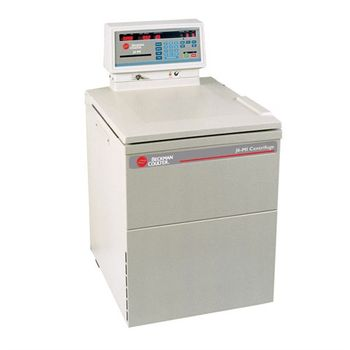
Beckman Coulter J6-MI
 Beckman Coulter · Model J6-MI
Worry-free performance for years of outstanding throughput - With its advanced induction drive, you'll never have to change brushes, because there are none. This innovative drive provides outstanding performance and long drive life. An accel/decel profile for your every application need - Choose from ten dual-ramp acceleration and deceleration settings that allow you to protect your delicate gradients from abrupt speed changes in the crucial range between 0 and 500 rpm. For maximum flexibility and control over accel/decel conditions, the acceleration profiles are independent of the deceleration profiles. Cool, quiet operation for a comfortable lab environment - The J6-MI generates less than 7,000 Btu/h and 59 dBA - fraction of the heat and sound levels of typical high-capacity centrifuges. You'll see increased productivity as laboratory personnel work with greater efficiency in a quiet, comfortable lab.
Key tips
- ·Run QC controls before trusting any repair - an analyzer that passes self-test can still report clinically wrong results.
- ·Rule out a reagent lot change before opening the instrument - it can look exactly like a hardware fault.
- ·Centrifuge rotors have a hard retirement age/cycle limit regardless of visible condition - don't eyeball it.
Typical Failure Modes
Compiled for this model from its own documentation and established engineering knowledge for this equipment class - not from a verified service record. Confirm against the manufacturer's service manual.
Will not start / error at start
HighSymptoms: Error code, run will not begin, or aborts shortly after start.
Root cause: Set speed exceeds the rotor maximum, an imbalanced load, the lid / door not locked, an unapproved rotor, or a drive / control fault.
Will not reach speed / excessive noise or vibration
MediumSymptoms: Slow spin-up, rumble, or vibration during a run.
Root cause: Load imbalance, worn drive / motor bearings, a worn drive coupling, or (older units) worn motor brushes.
Timer / speed inconsistency
MediumSymptoms: Run ends early / late, or RPM does not match the setting.
Root cause: Tacho / speed-sensor drift or a control-board fault.
Lid / door will not open or lock
MediumSymptoms: Lid-lock error, will not open after a run, or will not lock to start.
Root cause: Lid-lock solenoid / switch fault, or a run still winding down.
Rotor / bucket wear or corrosion
MediumSymptoms: Visible corrosion, cracks, or a bucket that will not swing; imbalance trips.
Root cause: Rotor / bucket ageing - a safety-critical wear item with a use-life limit.
Serviceable Parts & Consumables
Serviceable items for this model, compiled from its documentation and engineering knowledge for this equipment class. Service class and relative cost are estimates, not manufacturer figures; no part numbers are given. Confirm intervals and pricing against the manufacturer.
Drive / motor bearings & coupling
Class Major service partRel. cost $$$R&R Difficult
Lid-lock solenoid / switch
Class Major service partRel. cost $$R&R Moderate
Speed sensor / control board
Class Major service partRel. cost $$R&R Moderate
Motor brushes (older units)
Class Periodic replacementRel. cost $R&R Moderate
Rotor / bucket set & O-rings
Log rotor runs; retire per the manufacturer's rotor-life programme.
Class Major service partRel. cost $$$R&R Easy
| Part | Service class | Relative cost | R&R difficulty |
|---|---|---|---|
| Drive / motor bearings & coupling | Major service part | $$$ | Difficult |
| Lid-lock solenoid / switch | Major service part | $$ | Moderate |
| Speed sensor / control board | Major service part | $$ | Moderate |
| Motor brushes (older units) | Periodic replacement | $ | Moderate |
| Rotor / bucket set & O-rings Log rotor runs; retire per the manufacturer's rotor-life programme. | Major service part | $$$ | Easy |
Relative cost: $ lowest · $$$$ highest service-part cost for this equipment class. Not a price.
PM Checklist
Preventive-maintenance tasks typical of this equipment class. Perform to the manufacturer's procedure and your facility's policy - this is general reference, not a schedule for this specific unit.
- ·Daily QC controls run and reviewed
- ·Calibration verification per assay
- ·Routine cleaning and decontamination
- ·Scheduled reagent-path and pump-tubing maintenance
Troubleshooting Approach
A starting sequence for this model, compiled from its documentation and engineering knowledge for this equipment class. Follow the manufacturer's service documentation for the actual procedure.
Symptom: Diagnostic message / error number on the SPEED display
- Write down the error number or code (e.g. L7-, C1-, C2-, C3-, SEr).
- After the rotor has fully stopped, turn the power off (O) then back on (I) to reset; for some codes, also open and close the door before restarting.
- For a temperature message (C1- informational, C2-/C3-/C5- call service), press [CE] to clear an informational one.
- If "SEr" appears, do not press any keys - power off and on to exit service mode.
- Look the number up in the manual's Error Message Chart; escalate a repeatable microprocessor / mechanical code to Beckman Coulter Field Service.
Symptom: Door will not open (L7- or at end of run)
- Press down firmly on both sides of the door until the [DOOR] LED lights, then press [DOOR].
- If it still will not open, press down on the door and press [DOOR] again.
- Use the door-latch override procedure in the troubleshooting section to retrieve the sample after a power failure.
- If the door opens but the message stays, press [CE] to clear.
- Escalate a persistent latch fault to Beckman Coulter Field Service.
Symptom: Imbalance / vibration / icing (refrigerated)
- Re-balance the load with paired equal-mass tubes.
- For a door stuck shut by ice at very cold set points, press firmly around the door opening and step on the foot pedal again.
- Wipe moisture from the chamber, gasket and inner door before each cold run to minimise icing.
- Inspect the rotor and chamber for a broken tube.
- Verify speed and smooth running with a balanced load.
Technical Specs
- Height
- 1600 mm with door open
- Length
- 710 mm
- Weight
- 235 kg
- Maximum Speed
- 6000 rpm
- Width
- 710 mm
Typical Location
Where this class of equipment is typically deployed - general reference, not this unit's own placement record.
- Central / core laboratory
- Point-of-care testing stations
- Blood bank
- Microbiology lab
Documents & Manuals
Related calculators
From BioLab, for work done with this kind of equipment.
Troubleshoot this device with Bio
Describe a symptom or error code. Bio answers from this device's own documented error codes, failure modes, parts, and guides.
Ask Bio