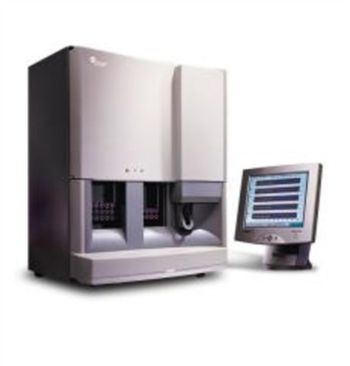
Beckman Coulter HMX A/L
 Beckman Coulter · Model HMX A/L
VCS technology for automated differential and semi-automated reticulocyte counts delivers consistently reliable results Advanced software features for automated test review and management Simple, fast and sensitive screening for morphologic white cell abnormalities High correlation of data between all VCS systems in your core and satellite labs Rapid result turnaround time with 75 samples-per-hour throughput Easy-to-use software with one-touch start up and shut down Continuous auto-loading for complete walkaway operation Error-free patient ID barcode reading at the point of aspiration for fail-safe sample management Closed vial sampling of various tube sizes improves operator safety.
Key tips
- ·When no category-specific guidance fits, default to the manufacturer's own service manual and the general troubleshooting method in the Engineer's Guide.
- ·Run an incoming and annual electrical safety test regardless of how niche the device is.
Typical Failure Modes
Compiled for this model from its own documentation and established engineering knowledge for this equipment class - not from a verified service record. Confirm against the manufacturer's service manual.
Aperture blockage / partial obstruction
HighSymptoms: Flagged or implausible CBC counts, voteouts, repeated aperture-clog alarms.
Root cause: Debris or a clot partially blocking a counting aperture.
Sample probe / piercer wear or misalignment
MediumSymptoms: Short samples, aspiration errors, bent piercer, cap-piercing failures.
Root cause: Worn or bent sample probe / closed-vial piercer.
Reagent / lyse delivery fault
MediumSymptoms: WBC or diff results shifted, high background, reagent-empty or pressure alarms.
Root cause: Reagent depleted or wrong lot, or a pinch-valve / tubing fault; note the LYSE III reagent-lot recall history.
Autoloader jam
MediumSymptoms: Tubes not advancing, carousel or transport error.
Root cause: Worn autoloader belt or a mis-loaded rack.
Vacuum / pressure out of range
MediumSymptoms: Multiple parameter errors, priming failures.
Root cause: Pump or regulator drift.
Serviceable Parts & Consumables
Serviceable items for this model, compiled from its documentation and engineering knowledge for this equipment class. Service class and relative cost are estimates, not manufacturer figures; no part numbers are given. Confirm intervals and pricing against the manufacturer.
Sample probe / closed-vial piercer
Class Periodic replacementRel. cost $$R&R Moderate
Peristaltic / pinch-valve pump tubing
Class Frequent wear itemRel. cost $R&R Moderate
Aperture bath assembly
Class Major service partRel. cost $$$R&R Difficult
Autoloader belt
Class Periodic replacementRel. cost $$R&R Moderate
System reagents / controls
Class ConsumableRel. cost $$R&R Easy
| Part | Service class | Relative cost | R&R difficulty |
|---|---|---|---|
| Sample probe / closed-vial piercer | Periodic replacement | $$ | Moderate |
| Peristaltic / pinch-valve pump tubing | Frequent wear item | $ | Moderate |
| Aperture bath assembly | Major service part | $$$ | Difficult |
| Autoloader belt | Periodic replacement | $$ | Moderate |
| System reagents / controls | Consumable | $$ | Easy |
Relative cost: $ lowest · $$$$ highest service-part cost for this equipment class. Not a price.
PM Checklist
Preventive-maintenance tasks typical of this equipment class. Perform to the manufacturer's procedure and your facility's policy - this is general reference, not a schedule for this specific unit.
- ·Follow the manufacturer's PM schedule
- ·Perform incoming and annual electrical safety testing per facility biomedical program
Troubleshooting Approach
A starting sequence for this model, compiled from its documentation and engineering knowledge for this equipment class. Follow the manufacturer's service documentation for the actual procedure.
Symptom: Aperture-clog alarm / flagged counts
- Run the instrument's aperture-clear / burn and flush cycles.
- Run a background count and confirm it is within limits.
- Run controls at all levels.
- If clogs recur, clean or replace the aperture bath.
- Confirm precision on a replicate sample before releasing results.
Symptom: Short samples / aspiration errors
- Inspect the sample probe / piercer for wear or a bend.
- Check tubing and pinch valves for leaks or collapse.
- Verify vacuum and pressure against the service spec.
- Replace the probe/piercer or tubing as found.
- Re-run controls.
Technical Specs
- Height
- 33 in
- Length
- 25 in
- Weight
- 210 lbs
- Width
- 25 in
Typical Location
Where this class of equipment is typically deployed - general reference, not this unit's own placement record.
- Varies by device - check the unit's own manual for facility placement guidance
Documents & Manuals
Safety & Recalls
Synced live from the FDA openFDA API.
- RECALL
The recall was initiated by Beckman Coulter because the COULTER LYSE III diff Lytic Reagent Lot number 101554F was released for distribution to customers between November 17 and December 1, 2010 prior to completion of QC testing.
- RECALL
The recall was initiated because Beckman Coulter has confirmed the Coulter MAXM, MAXM AL, HmX and HmX AL Analyzers omit the tilde (~) character when the tilde is used as part of the Sample 10 within a barcode label scanned by the primary mode barcode reader. There is a potential for Specimen or Patient misidentification to occur.
Troubleshoot this device with Bio
Describe a symptom or error code. Bio answers from this device's own documented error codes, failure modes, parts, and guides.
Ask Bio