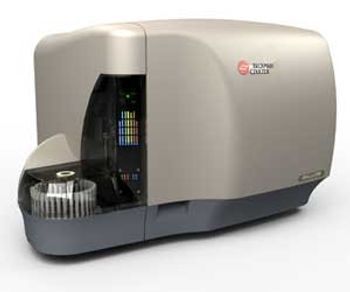
Beckman Coulter Gallios
 Beckman Coulter · Model Gallios
[u]For Research Use Only. Not for diagnostic procedures[/u] The Gallios Flow Cytometer Features Available in 3 configurations 6 color 2 Laser (5+1) 8 color 2 Laser (5+3) 10 color 3 Laser(5+3+2) Modular to fit your needs, today and tomorrow Innovative laser cartridges Picomotor driven beam steering optics. Laser control to conserve laser life. Allow for easy future integration of new lasers. Design for laser flexibility Plug and play filters allow rapid instrument reconfiguration between experiments. Filters are easily accessible and interchangeable with no tools required More power at the flow cell means greater resolution in your applications. Efficient delivery of light. Solid state lasers. Direct laser light delivery in air. Optimized beam steering optics. Increased power at flow cell Patented electronics design incorporates fast, accurate measurement of signals over a wide range of event rates. Fast pulse recovery. Minimize linearity errors. Sensitivity of dim particles. Adjusts for temperature variability. Minimize dead time. Accuracy at high event rates Instrument Dashboard. Cytometer indicators: Ready status Fluid level Sample flow Optical Design - Resolution and Sensitivity. To achieve maximum sensitivity and resolution, the generation, preservation and detection of light is critical.
Key tips
- ·Run QC controls before trusting any repair - an analyzer that passes self-test can still report clinically wrong results.
- ·Rule out a reagent lot change before opening the instrument - it can look exactly like a hardware fault.
- ·Centrifuge rotors have a hard retirement age/cycle limit regardless of visible condition - don't eyeball it.
Typical Failure Modes
Compiled for this model from its own documentation and established engineering knowledge for this equipment class - not from a verified service record. Confirm against the manufacturer's service manual.
Poor optical alignment / low signal / high CV
HighSymptoms: Bead CVs out of spec, scatter or fluorescence signal low or noisy, compensation drift.
Root cause: Flow-cell contamination or an air bubble, laser degradation / misalignment, or an optics / PMT fault.
Fluidics / sheath-pressure fault
MediumSymptoms: Unstable event rate, boost / prime failures, sheath or waste alarm, clogs.
Root cause: Sheath / waste tank issue, a peristaltic / vacuum fault, or a partially blocked sample line / flow cell.
Sample probe / SIP clog or crash
MediumSymptoms: No or low event rate, probe-position error, carryover.
Root cause: Clogged or bent sample probe, or a clot.
Laser fault
MediumSymptoms: A laser-line-specific parameter fails, laser-error message.
Root cause: Laser at end of life or a power-supply / interlock fault.
Workstation / software fault
LowSymptoms: Acquisition hangs, data will not export, instrument not recognised.
Root cause: Workstation PC or the acquisition software / link.
Serviceable Parts & Consumables
Serviceable items for this model, compiled from its documentation and engineering knowledge for this equipment class. Service class and relative cost are estimates, not manufacturer figures; no part numbers are given. Confirm intervals and pricing against the manufacturer.
Flow cell
Class Periodic replacementRel. cost $$$R&R Difficult
Sample probe / SIP
Class Periodic replacementRel. cost $$R&R Moderate
Peristaltic pump tubing
Class Frequent wear itemRel. cost $R&R Moderate
Sheath / waste filters
Class Frequent wear itemRel. cost $R&R Easy
Laser
Class Periodic replacementRel. cost $$$$R&R Difficult
| Part | Service class | Relative cost | R&R difficulty |
|---|---|---|---|
| Flow cell | Periodic replacement | $$$ | Difficult |
| Sample probe / SIP | Periodic replacement | $$ | Moderate |
| Peristaltic pump tubing | Frequent wear item | $ | Moderate |
| Sheath / waste filters | Frequent wear item | $ | Easy |
| Laser | Periodic replacement | $$$$ | Difficult |
Relative cost: $ lowest · $$$$ highest service-part cost for this equipment class. Not a price.
PM Checklist
Preventive-maintenance tasks typical of this equipment class. Perform to the manufacturer's procedure and your facility's policy - this is general reference, not a schedule for this specific unit.
- ·Daily QC controls run and reviewed
- ·Calibration verification per assay
- ·Routine cleaning and decontamination
- ·Scheduled reagent-path and pump-tubing maintenance
Troubleshooting Approach
A starting sequence for this model, compiled from its documentation and engineering knowledge for this equipment class. Follow the manufacturer's service documentation for the actual procedure.
Symptom: Poor alignment / low signal / high CV
- Run the daily startup / cleaning and a flow-check bead panel.
- Prime / de-bubble the flow cell and de-gas the sheath.
- Run an unclog / long-clean cycle.
- Verify each laser-line parameter against the beads.
- Escalate a confirmed laser or optics fault to the OEM.
Symptom: Fluidics or probe fault
- Check the sheath and waste tanks and connections.
- Inspect the sample probe for a bend or clog and clear it.
- Replace worn peristaltic pump tubing and the sheath filter.
- Run a boost / prime.
- Confirm a stable event rate on a control.
Typical Location
Where this class of equipment is typically deployed - general reference, not this unit's own placement record.
- Central / core laboratory
- Point-of-care testing stations
- Blood bank
- Microbiology lab
Documents & Manuals
No documents available for this device yet.
Related calculators
From BioLab, for work done with this kind of equipment.
Troubleshoot this device with Bio
Describe a symptom or error code. Bio answers from this device's own documented error codes, failure modes, parts, and guides.
Ask Bio