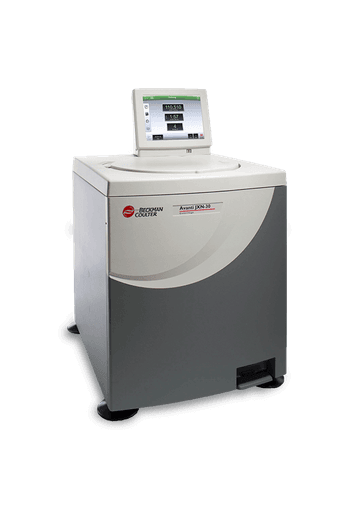
Beckman Coulter Avanti JXN-30 Series
 Beckman Coulter · Model Avanti JXN-30 Series
High-speed performance – reaches 30,000 RPM and 100,000+ x g for rapid, efficient sample processing Advanced networking – enables remote monitoring and data management for seamless lab integration Enhanced BioSafety – supports secure, contamination-free sample handling Reliable performance – designed for continuous operation in high-throughput research and clinical labs Ideal for biomedical engineers, clinical researchers, and lab professionals, the Avanti JXN-30 centrifuge provides cutting-edge speed, safety, and connectivity, making it an essential tool for modern high-performance laboratories. (Generated by AI)
Key tips
- ·Run QC controls before trusting any repair - an analyzer that passes self-test can still report clinically wrong results.
- ·Rule out a reagent lot change before opening the instrument - it can look exactly like a hardware fault.
- ·Centrifuge rotors have a hard retirement age/cycle limit regardless of visible condition - don't eyeball it.
Typical Failure Modes
Compiled for this model from its own documentation and established engineering knowledge for this equipment class - not from a verified service record. Confirm against the manufacturer's service manual.
Will not start / error at start
HighSymptoms: Error code, run will not begin, or aborts shortly after start.
Root cause: Set speed exceeds the rotor maximum, an imbalanced load, the lid / door not locked, an unapproved rotor, or a drive / control fault.
Will not reach speed / excessive noise or vibration
MediumSymptoms: Slow spin-up, rumble, or vibration during a run.
Root cause: Load imbalance, worn drive / motor bearings, a worn drive coupling, or (older units) worn motor brushes.
Timer / speed inconsistency
MediumSymptoms: Run ends early / late, or RPM does not match the setting.
Root cause: Tacho / speed-sensor drift or a control-board fault.
Lid / door will not open or lock
MediumSymptoms: Lid-lock error, will not open after a run, or will not lock to start.
Root cause: Lid-lock solenoid / switch fault, or a run still winding down.
Rotor / bucket wear or corrosion
MediumSymptoms: Visible corrosion, cracks, or a bucket that will not swing; imbalance trips.
Root cause: Rotor / bucket ageing - a safety-critical wear item with a use-life limit.
Serviceable Parts & Consumables
Serviceable items for this model, compiled from its documentation and engineering knowledge for this equipment class. Service class and relative cost are estimates, not manufacturer figures; no part numbers are given. Confirm intervals and pricing against the manufacturer.
Drive / motor bearings & coupling
Class Major service partRel. cost $$$R&R Difficult
Lid-lock solenoid / switch
Class Major service partRel. cost $$R&R Moderate
Speed sensor / control board
Class Major service partRel. cost $$R&R Moderate
Motor brushes (older units)
Class Periodic replacementRel. cost $R&R Moderate
Rotor / bucket set & O-rings
Log rotor runs; retire per the manufacturer's rotor-life programme.
Class Major service partRel. cost $$$R&R Easy
| Part | Service class | Relative cost | R&R difficulty |
|---|---|---|---|
| Drive / motor bearings & coupling | Major service part | $$$ | Difficult |
| Lid-lock solenoid / switch | Major service part | $$ | Moderate |
| Speed sensor / control board | Major service part | $$ | Moderate |
| Motor brushes (older units) | Periodic replacement | $ | Moderate |
| Rotor / bucket set & O-rings Log rotor runs; retire per the manufacturer's rotor-life programme. | Major service part | $$$ | Easy |
Relative cost: $ lowest · $$$$ highest service-part cost for this equipment class. Not a price.
PM Checklist
Preventive-maintenance tasks typical of this equipment class. Perform to the manufacturer's procedure and your facility's policy - this is general reference, not a schedule for this specific unit.
- ·Daily QC controls run and reviewed
- ·Calibration verification per assay
- ·Routine cleaning and decontamination
- ·Scheduled reagent-path and pump-tubing maintenance
Troubleshooting Approach
A starting sequence for this model, compiled from its documentation and engineering knowledge for this equipment class. Follow the manufacturer's service documentation for the actual procedure.
Symptom: Will not start or errors at start
- Confirm the set speed does not exceed the fitted rotor's maximum and the rotor is approved and seated.
- Rebalance the load - opposing positions evenly loaded and paired.
- Confirm the lid / door latches and the lock engages.
- Look the fault code up in the manual and follow the remedy.
- Functional-check speed and timer after any repair.
Symptom: Noisy / vibrates / will not reach speed
- Rebalance and re-run empty to confirm.
- Spin the rotor by hand and feel for bearing roughness.
- Inspect the drive coupling and (older units) the motor brushes.
- Replace the worn component.
- Verify speed with a tachometer and confirm smooth running.
Typical Location
Where this class of equipment is typically deployed - general reference, not this unit's own placement record.
- Central / core laboratory
- Point-of-care testing stations
- Blood bank
- Microbiology lab
Documents & Manuals
No documents available for this device yet.
Safety & Recalls
Synced live from the FDA openFDA API.
- RECALL
Beckman Coulter has become aware of an intermittent issue in which the optional flag Previous Sample Had Sperm was enabled but not displayed so that a carryover event could have been investigated.
- RECALL
The Strip Provider Modules (SPM) on some of the instruments had not been inspected during manufacture for correct seal placement and integrity.
- RECALL
Beckman Coulter has determined that there is a potential for under-reporting casts. This can occur if per high-power field (/HPF) units of measurement for casts are selected in the iQ200 software, but the abnormal threshold and/or grading format is set up based on reporting per low-power field (/LPF)* or *per microliter. This may occur during initial method validation or if settings are altered after the initial validation.
- RECALL
Beckman Coulter has determined that there is a potential for incorrect settings to be installed on North American iChemVELOCITY Urine Chemistry Analyzers. 1. The installation of International settings can result in the generation of erroneous, false low results for some of the analytes at some concentrations. 2. The installation of colors different from those stated in the Instructions for Use (Colorless, Straw, Yellow, Amber, Red, Blue) for output settings will result in incorrect reporting of colors. For example, if Green is the color choice for the output setting instead of Blue, Green will be reported.
- RECALL
A subset of Lot 7212154 A of the iChem VELOCITY Urine Chemistry strips has an incorrect pad placed in the location of the leukocytes pad. This will result in control CB failure for leukocytes and may generate false negative erroneous results for leukocytes.
- RECALL
iQ200 Series Urine Microscopy Analyzer may intermittently fail to read urine sample dilution barcode labels causing erroneous results that could delay treatment for health conditions such as hematuria.
- RECALL
Unpaired lots of AU lyophilized chemistry calibrator level 1 and 2 have been distributed. Calibrator level 1 and 2 must be paired when used for calibration and cannot be used in any other combination. If lot numbers are not correctly paired, calibration can be run using incorrect set points which may generate erroneous results. QC failures could occur if incorrect pairs of calibrators are used.
- RECALL
Beckman Coulter has determined that additional clarification for the Blast Suspect messages is necessary. In rare situations, the LH 750, LH 780, LH 500 and HmX Analyzers may not flag or detect blasts in some blood samples.
- RECALL
Beckman Coulter initiated a design change to update the Automate PC image to accommodate the operating system change to Windows 10.
- RECALL
Beckman Coulter is recalling the MicroScan LabPro Information Manager System because the software incorrectly allows the operator to manually edit the carbohydrate substrates when manually reading dried overnight gram negative panels with an ID Hold status.
- RECALL
Beckman coulter has received complaints regarding leaking and cracked C cups. When the cup cracks, coolant can leak onto the connectors of the Printed Circuit Boards (PCB) in the analyzer, resulting in a short-circuit causing the instrument to go into a stop mode.
- RECALL
Beckman Coulter is recalling the LH 750 and LH780 Hematology Systems because the use of the diluent lots may eventually result in a compromised Hgb cuvette.
- RECALL
The recall was initiated because Beckman Coulter has confirmed customer reports of secondary tubes being labeled with two different barcode labels on the AutoMate 2500 Family (previously referred to as OLA2500 Systems) units which can cause misidentification of a sample when software versions lower than version 4.1 is used.
- RECALL
The recall was initiated because Beckman has identified a problem with Integrated Circuit chips used in different boards throughout the analyzer.
- RECALL
The recall was initiated because Beckman Coulter has identified a problem with Integrated Circuit Chips used in different boards throughout the Beckman Coulter LH500/HmX/HmX Autoloader Hematology analyzer.
- RECALL
The recall was initiated by Beckman Coulter because the COULTER LYSE III diff Lytic Reagent Lot number 101554F was released for distribution to customers between November 17 and December 1, 2010 prior to completion of QC testing.
- RECALL
The recall was initiated after Beckman Coulter identified four (4) issues with the COULTER LH 500 Series System and the Unicel DxH 800 Coulter Cellular Analysis System: Issue 1: There is a potential for misidentification to occur when the system is configured in languages other than English or Chinese. The characters #,@,[,\,],`,{,|,}, or ~ are substituted or omitted in other languages. The issu
- RECALL
Issue 1: The system will substitute or omit the characters # @ [\] ' {I) when the system is configured in a language other than English or Chinese. Example: Using the character @, a substitution in the string '123@456' would result in '123#456' and an omission would result in '123456' Issue 2: The system will omit the character ~ regardless of language. Impact: There is a potential for Specimen
- RECALL
Beckman Coulter has become aware of a potential issue in which the Sample ID information embedded in the barcode affixed to a slide made by the Coulter GEN*S and LH SlideMaker does not match the text.
- RECALL
There is a potential for erroneous yet credible results for Body Fluids on the LH700 series hematology analyzers when a cassette label fails to read and the subsequent sample is cycled in Body Fluid mode.
- RECALL
There is a risk of sample misidentification when processing samples in the Manual aspiration mode.
- RECALL
Risk of injury to workers due to mechanical or electrical hazards.
- RECALL
Biohazard situation exists for users.
- RECALL
Incorrect Hemoglobin result can be reported with software version 2A and higher.
- RECALL
Device design allows for cross contamination issue to occur, possibly affecting assays and results reports.
- RECALL
Software vote out logic changed. Erroneous white blood cell counts.
Related calculators
From BioLab, for work done with this kind of equipment.
Troubleshoot this device with Bio
Describe a symptom or error code. Bio answers from this device's own documented error codes, failure modes, parts, and guides.
Ask Bio