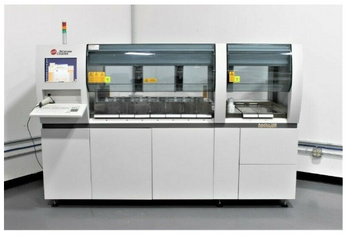
Beckman Coulter Automate 2550
 Beckman Coulter · Model Automate 2550
Measurement of each sample's volume prior to dispensing.- Decapping/cap disposal- Sample sorting and re-sorting- Automated measurement of sample diameter and height- Sample Aliquotting- Sample Barcode reading- Tube inspection unit (cap color analysis/cap coding detection)
Key tips
- ·Run QC controls before trusting any repair - an analyzer that passes self-test can still report clinically wrong results.
- ·Rule out a reagent lot change before opening the instrument - it can look exactly like a hardware fault.
- ·Centrifuge rotors have a hard retirement age/cycle limit regardless of visible condition - don't eyeball it.
Typical Failure Modes
Compiled for this model from its own documentation and established engineering knowledge for this equipment class - not from a verified service record. Confirm against the manufacturer's service manual.
Sample-transport / track fault
HighSymptoms: Carriers / pucks jam, stall, or mis-route; track-error message; throughput drops.
Root cause: Worn track belts / drive, a diverter / gate fault, or a carrier-sensor fault.
Robotic gripper / pick-place fault
MediumSymptoms: Tubes dropped or mis-placed, gripper-position error, aliquotting mis-aligned.
Root cause: Worn gripper / robot drive or an encoder / home-sensor fault.
Centrifuge module fault
MediumSymptoms: Inline centrifuge imbalance, lid-lock error, will not spin.
Root cause: Drive / bearing wear, a lid-lock fault, or an imbalance-sensor fault.
Decapper / recapper / aliquotter fault
MediumSymptoms: Caps not removed / applied, aliquot volumes off, station jams.
Root cause: Worn decapper jaws, aliquot-probe / syringe wear, or a station-drive fault.
Middleware / connectivity fault
HighSymptoms: Analysers or the LIS drop off the line, rules not applying, samples stuck in a queue.
Root cause: The automation middleware / server or a network link.
Serviceable Parts & Consumables
Serviceable items for this model, compiled from its documentation and engineering knowledge for this equipment class. Service class and relative cost are estimates, not manufacturer figures; no part numbers are given. Confirm intervals and pricing against the manufacturer.
Track belts / drive components
Class Periodic replacementRel. cost $$$R&R Difficult
Robotic gripper / drive assembly
Class Periodic replacementRel. cost $$$R&R Difficult
Centrifuge-module drive / lid-lock
Class Periodic replacementRel. cost $$$R&R Difficult
Decapper jaws / aliquot-probe & syringe
Class Periodic replacementRel. cost $$R&R Moderate
Carrier / position sensors
Class Periodic replacementRel. cost $$R&R Moderate
| Part | Service class | Relative cost | R&R difficulty |
|---|---|---|---|
| Track belts / drive components | Periodic replacement | $$$ | Difficult |
| Robotic gripper / drive assembly | Periodic replacement | $$$ | Difficult |
| Centrifuge-module drive / lid-lock | Periodic replacement | $$$ | Difficult |
| Decapper jaws / aliquot-probe & syringe | Periodic replacement | $$ | Moderate |
| Carrier / position sensors | Periodic replacement | $$ | Moderate |
Relative cost: $ lowest · $$$$ highest service-part cost for this equipment class. Not a price.
PM Checklist
Preventive-maintenance tasks typical of this equipment class. Perform to the manufacturer's procedure and your facility's policy - this is general reference, not a schedule for this specific unit.
- ·Daily QC controls run and reviewed
- ·Calibration verification per assay
- ·Routine cleaning and decontamination
- ·Scheduled reagent-path and pump-tubing maintenance
Error Codes
Extracted directly from this unit's own service manual.
No Parafilm FoundThe system alerts you.
Remove the Parafilm jam.
Troubleshooting Approach
A starting sequence for this model, compiled from its documentation and engineering knowledge for this equipment class. Follow the manufacturer's service documentation for the actual procedure.
Symptom: QC / calibration failure across a channel or the whole system
- Run fresh controls at all levels and note which analytes fail.
- Confirm reagents are in date, correctly loaded, mixed and not bubbled.
- Run the photometer / lamp-energy check and replace the lamp if energy is low.
- Clean the sample and reagent probes, the mixers and the wash / cuvette-wash stations.
- Recalibrate the affected assay / ISE module and re-run QC.
Symptom: Sample or reagent probe clog / crash / short aspiration
- Inspect the probe for a bend or blockage and clear it (wire / sonicate per the manual).
- Run the fluidics prime and the probe-wash cycle.
- Check for a clot or fibrin in the sample and the liquid-level sensing.
- Verify probe positioning / alignment.
- Replace the probe if aspiration is still short.
Symptom: ISE electrolyte results biased or noisy / ISE calibration fails
- Run the ISE calibration and check the slope / drift against spec.
- Replace an ISE electrode or the reference that is at end of life.
- Check the ISE pinch valves and tubing for wear or air.
- Confirm the ISE standard packs are in date.
- Re-run ISE QC before releasing electrolyte results.
Symptom: High cuvette blanks / position-dependent results
- Run the cuvette blank / photometric check.
- Clean or replace worn / scratched cuvettes or the reaction segment.
- Check the cuvette-wash station nozzles and drying.
- Confirm the water / DI supply quality.
- Recalibrate and re-run QC.
Typical Location
Where this class of equipment is typically deployed - general reference, not this unit's own placement record.
- Central / core laboratory
- Point-of-care testing stations
- Blood bank
- Microbiology lab
Documents & Manuals
Safety & Recalls
Synced live from the FDA openFDA API.
- RECALL
Customers have reported incidents where two sets of results report the same Specimen Identifier (Specimen ID) with different results, different Medical Record Number (MRN) and different patient identification (demographics).
- RECALL
Beckman Coulter has identified a case where a customer using the microltiterplate kit option without a sorting drive encountered a cross-contamination of samples when a connection time-out occurred between the system and Laboratory Information System (LIS) .
- RECALL
The Strip Provider Modules (SPM) on some of the instruments had not been inspected during manufacture for correct seal placement and integrity.
- RECALL
Beckman Coulter has determined that there is a potential for incorrect settings to be installed on North American iChemVELOCITY Urine Chemistry Analyzers. 1. The installation of International settings can result in the generation of erroneous, false low results for some of the analytes at some concentrations. 2. The installation of colors different from those stated in the Instructions for Use (Colorless, Straw, Yellow, Amber, Red, Blue) for output settings will result in incorrect reporting of colors. For example, if Green is the color choice for the output setting instead of Blue, Green will be reported.
- RECALL
Belts on the x-axis (and on the y-axis, to a lesser extent) manufactured from 2015 are showing premature failure, posing the remote risk of cross-contamination.
- RECALL
A misaligned pipette tip sensor poses the remote risk of cross-contamination when failing to cause a no-tip error, resulting in pipetting patient samples without pipette tips.
- RECALL
A subset of Lot 7212154 A of the iChem VELOCITY Urine Chemistry strips has an incorrect pad placed in the location of the leukocytes pad. This will result in control CB failure for leukocytes and may generate false negative erroneous results for leukocytes.
- RECALL
Beckman Coulter initiated a design change to update the Automate PC image to accommodate the operating system change to Windows 10.
- RECALL
The recall was initiated because Beckman Coulter has confirmed customer reports of secondary tubes being labeled with two different barcode labels on the AutoMate 2500 Family (previously referred to as OLA2500 Systems) units which can cause misidentification of a sample when software versions lower than version 4.1 is used.
- RECALL
The recall was initiated because Beckman Coulter has confirmed an issue with the AutoMate Sample Processing Systems. If during the recovery from Error 81201001, a stuck sample carrier with a tube is moved backwards to the loading position, sample tube/input tray information will become mismatched for samples being loaded onto the AutoMate.
Troubleshoot this device with Bio
Describe a symptom or error code. Bio answers from this device's own documented error codes, failure modes, parts, and guides.
Ask Bio