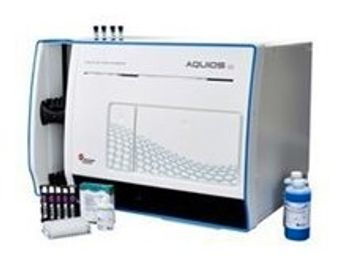
Beckman Coulter AQUIOS CL
 Beckman Coulter · Model AQUIOS CL
20 minutes to the first result following sample load (measured with Tetra-1 or Tetra-2+) 25 results per hour thereafter for up-to one full 96-well plate (measured with Tetra Combo) System users come up-to-speed in one day with computer-based training and an application specialist site visit Eliminate manual pipetting steps with a simplified system design Quickly check sample status for any run with the AQUIOS CL Intelligent Scheduler Fully-integrated sample prep Automated reagent monitoring and barcode scanning capability Automated system setup Continuous loading Automated quality control Full LIS connectivity More compact than traditional modular flow systems.
Key tips
- ·Run QC controls before trusting any repair - an analyzer that passes self-test can still report clinically wrong results.
- ·Rule out a reagent lot change before opening the instrument - it can look exactly like a hardware fault.
- ·Centrifuge rotors have a hard retirement age/cycle limit regardless of visible condition - don't eyeball it.
Typical Failure Modes
Compiled for this model from its own documentation and established engineering knowledge for this equipment class - not from a verified service record. Confirm against the manufacturer's service manual.
Poor optical alignment / low signal / high CV
HighSymptoms: Bead CVs out of spec, scatter or fluorescence signal low or noisy, compensation drift.
Root cause: Flow-cell contamination or an air bubble, laser degradation / misalignment, or an optics / PMT fault.
Fluidics / sheath-pressure fault
MediumSymptoms: Unstable event rate, boost / prime failures, sheath or waste alarm, clogs.
Root cause: Sheath / waste tank issue, a peristaltic / vacuum fault, or a partially blocked sample line / flow cell.
Sample probe / SIP clog or crash
MediumSymptoms: No or low event rate, probe-position error, carryover.
Root cause: Clogged or bent sample probe, or a clot.
Laser fault
MediumSymptoms: A laser-line-specific parameter fails, laser-error message.
Root cause: Laser at end of life or a power-supply / interlock fault.
Workstation / software fault
LowSymptoms: Acquisition hangs, data will not export, instrument not recognised.
Root cause: Workstation PC or the acquisition software / link.
Serviceable Parts & Consumables
Serviceable items for this model, compiled from its documentation and engineering knowledge for this equipment class. Service class and relative cost are estimates, not manufacturer figures; no part numbers are given. Confirm intervals and pricing against the manufacturer.
Flow cell
Class Periodic replacementRel. cost $$$R&R Difficult
Sample probe / SIP
Class Periodic replacementRel. cost $$R&R Moderate
Peristaltic pump tubing
Class Frequent wear itemRel. cost $R&R Moderate
Sheath / waste filters
Class Frequent wear itemRel. cost $R&R Easy
Laser
Class Periodic replacementRel. cost $$$$R&R Difficult
| Part | Service class | Relative cost | R&R difficulty |
|---|---|---|---|
| Flow cell | Periodic replacement | $$$ | Difficult |
| Sample probe / SIP | Periodic replacement | $$ | Moderate |
| Peristaltic pump tubing | Frequent wear item | $ | Moderate |
| Sheath / waste filters | Frequent wear item | $ | Easy |
| Laser | Periodic replacement | $$$$ | Difficult |
Relative cost: $ lowest · $$$$ highest service-part cost for this equipment class. Not a price.
PM Checklist
Preventive-maintenance tasks typical of this equipment class. Perform to the manufacturer's procedure and your facility's policy - this is general reference, not a schedule for this specific unit.
- ·Daily QC controls run and reviewed
- ·Calibration verification per assay
- ·Routine cleaning and decontamination
- ·Scheduled reagent-path and pump-tubing maintenance
Troubleshooting Approach
A starting sequence for this model, compiled from its documentation and engineering knowledge for this equipment class. Follow the manufacturer's service documentation for the actual procedure.
Symptom: Poor alignment / low signal / high CV
- Run the daily startup / cleaning and a flow-check bead panel.
- Prime / de-bubble the flow cell and de-gas the sheath.
- Run an unclog / long-clean cycle.
- Verify each laser-line parameter against the beads.
- Escalate a confirmed laser or optics fault to the OEM.
Symptom: Fluidics or probe fault
- Check the sheath and waste tanks and connections.
- Inspect the sample probe for a bend or clog and clear it.
- Replace worn peristaltic pump tubing and the sheath filter.
- Run a boost / prime.
- Confirm a stable event rate on a control.
Technical Specs
- Height
- 22 in (System)
- Length
- 22 in (System)
- Width
- 32 in (System)
Typical Location
Where this class of equipment is typically deployed - general reference, not this unit's own placement record.
- Central / core laboratory
- Point-of-care testing stations
- Blood bank
- Microbiology lab
Documents & Manuals
Safety & Recalls
Synced live from the FDA openFDA API.
- RECALL
The device may process the same sample with two different sample IDs and sample information while using the single tube loader, which has the potential for erroneous results due to the mis-identification.
- RECALL
The system may duplicate sample requests leading to sample misidentification when connected to a Laboratory Information System (LIS)
- RECALL
Beckman Coulter has identified that an incorrect setting using a proprietary software configuration tool can result in the Sample Prep Probe of the AQUIOS CL drawing aspirant from the wrong tube in a cassette which manifests in incorrect values being reported out of the laboratory for some patient samples.
- RECALL
Beckman Coulter has confirmed that the Export feature located in the Results area of the AQUIOS System software is not correctly exporting Tetra Combo CRD files.
- RECALL
Beckman Coulter is recalling the AQUIOS Lyse Reagent Kit because it may lead to an increased generation of notifications and flags when used on the AQUIOS CL when running the AQUIOS Tetra application. The issue could lead to an increase in the number of samples requiring review and re-runs with a potential delay to the reporting of results. Depending on the specimen age, a new blood specimen may be required.
- RECALL
Beckman Coulter is recalling the AQUIOS CL System because the use of the reagent carousel can lead to misalignment of the carousel and damage to the prep probe.
Related calculators
From BioLab, for work done with this kind of equipment.
Troubleshoot this device with Bio
Describe a symptom or error code. Bio answers from this device's own documented error codes, failure modes, parts, and guides.
Ask Bio