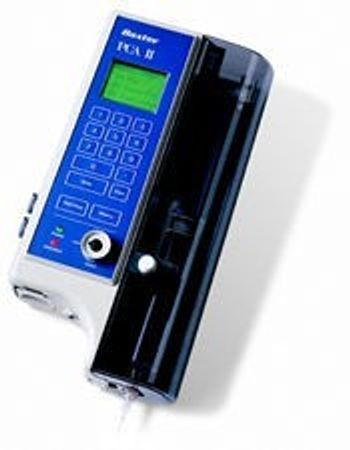
Baxter PCA II Pump
 Baxter International · Model PCA II Pump
Intuitive self-prompting programming for quick setup One-hour limit and limited parameter entry help ensure patient safety and guards against programming errors Internal safety checks help minimize the risk of tampering and errors Locking syringe cover and security codes minimize unauthorized operation Standard programming routine helps reduce procedural errors and minimizes training Built-in history logs successful injections, attempts, alarms, and other operating details (dosage history available in hard copy when connected to a printer) Large, back-lit display easily readable even at night Easily programmed infusion modes: PCA only, Basal plus PCA, Continuous Basal Program by milliliters or milligrams Select the syringe option to best suit your needs – prefilled syringes for convenience or standard syringes for cost savings Alternate power sources available – “D” size batteries/AC power kit.
Key tips
- ·Free-flow protection must be verified on every PM - a failed anti-free-flow clamp is a direct overdose risk.
- ·Test occlusion alarms in both directions - failing to alarm when it should is more dangerous than a false alarm.
- ·Battery run-time complaints are the most common real-world nuisance call - a full charge/discharge cycle test catches most of them.
Typical Failure Modes
Compiled for this model from its own documentation and established engineering knowledge for this equipment class - not from a verified service record. Confirm against the manufacturer's service manual.
Failure / error message stops delivery
HighSymptoms: The pump alarms and displays an error message / code and stops.
Root cause: A subsystem fault indexed in the service manual - motor / drive, a sensor, set-detection, or a board.
Occlusion alarm / pressure fault
MediumSymptoms: Repeated occlusion alarms, delivery stops, or an occlusion is missed.
Root cause: Kinked or clamped line, a closed roller clamp, a positional patient tube, pressure-sensor drift, or an improperly loaded set.
Air-in-line alarm
MediumSymptoms: Frequent air-in-line alarms, delivery stops.
Root cause: Air in the set, an improperly loaded set, or an ultrasonic air-detector fault.
Flow-rate accuracy drift
MediumSymptoms: Delivered volume outside tolerance on the annual test, especially at low rates.
Root cause: Worn pumping mechanism / plunger drive.
Battery will not hold charge
MediumSymptoms: Short run time, low-battery early after a full charge.
Root cause: Aged battery pack.
Door / plunger / sensor mechanical wear
LowSymptoms: Set will not load, door will not latch, plunger grip poor.
Root cause: Worn door latch, plunger jaws, or anti-free-flow mechanism.
Serviceable Parts & Consumables
Serviceable items for this model, compiled from its documentation and engineering knowledge for this equipment class. Service class and relative cost are estimates, not manufacturer figures; no part numbers are given. Confirm intervals and pricing against the manufacturer.
Battery pack
Class Periodic replacementRel. cost $$R&R Fairly easy
Pumping mechanism / rotor / plunger drive
Class Major service partRel. cost $$$R&R Difficult
Pressure / air-detector sensor assembly
Class Major service partRel. cost $$R&R Moderate
Door / latch / anti-free-flow assembly
Class Major service partRel. cost $$R&R Moderate
Drive motor / gearbox
Class Major service partRel. cost $$$R&R Difficult
| Part | Service class | Relative cost | R&R difficulty |
|---|---|---|---|
| Battery pack | Periodic replacement | $$ | Fairly easy |
| Pumping mechanism / rotor / plunger drive | Major service part | $$$ | Difficult |
| Pressure / air-detector sensor assembly | Major service part | $$ | Moderate |
| Door / latch / anti-free-flow assembly | Major service part | $$ | Moderate |
| Drive motor / gearbox | Major service part | $$$ | Difficult |
Relative cost: $ lowest · $$$$ highest service-part cost for this equipment class. Not a price.
PM Checklist
Preventive-maintenance tasks typical of this equipment class. Perform to the manufacturer's procedure and your facility's policy - this is general reference, not a schedule for this specific unit.
- ·Occlusion pressure and flow-rate accuracy verification
- ·Battery conditioning cycle
- ·Door latch and air-in-line sensor inspection
- ·Post-drop functional check before return to service
- ·Annual PM per manufacturer schedule
Error Codes
Extracted directly from this unit's own service manual.
EOI-E09Not used
El0Keypad button held down more than 2 minutes
El1PCA button held down more than 2 minutes
El2EOS on without 5 mL switch activated
El3Illegal open door occurred
El4Analog to digital converter busy flag time-out
El5Display controller busy flag time-out
El6Voltage error during LED test
El7Unable to get stable reading from decoder
El 8-E29Not used
E30No motor encoder counts after several motor pulses
E31Motor pulse width below minimum
E32Motor pulse width above maximum
E33Lead screw comparison error, +25%
E34Lead screw comparison error, -25%
E35Too many motor counts received, +3%
E36Too few motor counts received, -3%
E37Lead screw counts received when motor should be stopped
E38Motor counts received when motor should be stopped
E39Motor drive circuit failure
E40Motor disable circuit failure
E41-E49Not used
E50Clock comparison error
E51Bad data received from RTC chip
E52Real Time Clock chip is running too fast
E53Incorrect time data received from RTC chip
E54Unable to write data to RTC chip
E55-E59Not used
E60Regulated voltage over upper limit
E61Regulated voltage below lower limit
E62Charge ring detect failure
E63Charge insertion detection failure
E64No detectable power source
E65-69Not used
E70OPTION register data verification error
E71MPU set to test mode
E72CONFIG register data verification error
E73-E79Not Used
E80Stack overflow
E81Invalid Rx entry step
E82Keypad buffer overflow
E83Unused screen error
E84Interrupts illegally disabled
E85Software COP error
E86System volume out of range
E87System rate out of range
E88Total injected has exceeded maximum
E89Not used
E90Screen index error
E91History checksum failure; History data corrupt
E92Rx data cannot be retrieved
E93A critical variable has been corrupted
E94Rx data checksum failure
E95Hardware revision does not match with its complement
E96An error detection variable has been corrupted
E97Motor save variable has been corrupted
Troubleshooting Approach
A starting sequence for this model, compiled from its documentation and engineering knowledge for this equipment class. Follow the manufacturer's service documentation for the actual procedure.
Symptom: Alarm with an error message / code, delivery stopped
- Note the exact error message or code from the display.
- Look it up in the pump's technical service manual troubleshooting section.
- Run the biomed diagnostics / service utilities to exercise the named subsystem (motor / drive, a sensor, set-detection, a board).
- Follow the manual's parts-replacement procedure for that fault.
- Run the full scheduled-maintenance test set, including a flow-accuracy check, after any repair.
Symptom: Occlusion alarm / pressure fault (or a missed occlusion)
- Check the line for kinks, closed clamps and a closed roller clamp; check the patient site and cannula.
- Reload the administration set correctly, clearing all air.
- Confirm the set is an approved type for this pump.
- Run the pressure-sensor / force-sensor test in the service menu.
- Replace the set; refer the pump if the pressure sensor or pumping mechanism is indicated.
Symptom: Air-in-line alarm / free-flow or feed not delivering
- Prime the set fully and reload it; tap out micro-bubbles at the drip chamber.
- Confirm the set seats correctly against the air-in-line detector / rotor.
- Clean the ultrasonic air-detector window.
- Run the air-detector (or rotor / cassette) test in diagnostics.
- Replace a worn pumping mechanism / anti-free-flow assembly if flow accuracy or detection is out.
Symptom: Battery will not hold charge / short run time
- Fully charge, then run a battery run-down / capacity test in the service menu.
- Check the charging circuit and contacts.
- Replace the battery pack when capacity is below the service limit.
- Recalibrate the battery gauge if the pump supports it.
- Confirm run time meets spec after replacement.
Technical Specs
- Height
- 13 in
- Length
- 2.8 in
- Flow Rate Range
- 0.1 to 150 ml/h
- Weight
- 4.2 lbs with batteries
- Flow Accuracy
- 3 % average linear displacement
- Infusion Pump Type
- Patient-Controlled Analgesic (PCA)
- Width
- 6.3 in
Typical Location
Where this class of equipment is typically deployed - general reference, not this unit's own placement record.
- Patient care floors
- ICU
- OR
- Oncology / infusion centers
- Home health (portable pumps)
Documents & Manuals
Safety & Recalls
Synced live from the FDA openFDA API.
- RECALL
A software issue that may occur during a Volume/Time (VOT) multi-syringe infusion when a syringe reaches empty and is replaced while a Volume To Be Infused (VTBI) remains.
- RECALL
Baxter is issuing an Urgent Medical Device Correction for the Novum IQ large volume pump (LVP) due to the potential for underinfusion when transitioning from a flow rate to a higher flow rate that is more than double. (e.g., rate change or bolus). The level of underinfusion is variable based on the current infusion rate, the duration the pump has been running at this flow rate, and the magnitude of the rate change. The longer the duration the pump has been running at the current infusion rate and the larger the magnitude of the rate change, the larger the underinfusion that would be experienced. Additionally, Baxter has identified an increase in customer reports of over and underinfusion potentially due to set misloading. Failure to properly load the tubing into the pump channel may result in the pump infusing at a rate higher or lower than programmed. Consistent with the instructions
- RECALL
Baxter has identified a design issue which may cause the pump to detect the presence of a syringe flange when no syringe is loaded. When this issue occurs, the pumps 'user interface becomes stuck on the "Remove Syringe" screen when an infusion is complete, and the syringe is unloaded. A System Error 21502 (Flange Sensor Failure) may occur. Please note this issue only affects a subset of Novum IQ syringe pumps manufactured or repaired after July 4, 2023.
- RECALL
Variability in the performance of the tubing in the ARPS (Automatic Repositioning System) Pump Assembly which may lead to alarm situations during system self-test and therapy. This tubing is normally replaced during annual preventative maintenance. Alarm Situations: During System Self-Test: Alarm code B1215 (ARPS Self-Test failure); During Therapy: B1273 (ARPS Leak), B1215 (ARPS Pressure self-test), B1116 (Return Pressure self-test Failure), B1539 (Access Pod Reposition Failure), B1541 (Effluent Pod Reposition Failure), B1540 (Effluent Filter Pod Reposition Failure). If an alarm occurs, it may lead to delay or interruption of therapy. In the event that therapy is terminated without returning blood to the patient, blood loss may occur.
- RECALL
Baxter Healthcare Corporation is issuing a voluntary product recall for all unexpired lots of the 50mm 0.2 Micron Filter (Product Code: H93835) due to the potential for the filter membrane layer to be missing and for particulate matter to be present.
- RECALL
Advisory to alert users to assure that the hemofilter of the blood line is in the horizontal position to avoid kinking of the bloodline tubing to avoid hemolysis, and to show the compatible blood tubing sets to be used with the BM11/BM11A Blood Monitor Pump and BM25 System ultrafiltration hemodialysis system.
- RECALL
During an infusion in the 'Basal + PCA' or 'PCA only' modes, the SYNDEO pump may generate false Service Code 919 or Service Code 920, which will cause the pump to stop the infusion. Also, while attempting to turn on the device by pressing the On/Off key, the pump may not power up properly.
- RECALL
Leakage may occur at the inlet port
- RECALL
The I.V. filter sets contain a 1.2 micron filter instead of the labeled 0.22 micron filter.
Related calculators
From BioLab, for work done with this kind of equipment.
Troubleshoot this device with Bio
Describe a symptom or error code. Bio answers from this device's own documented error codes, failure modes, parts, and guides.
Ask Bio