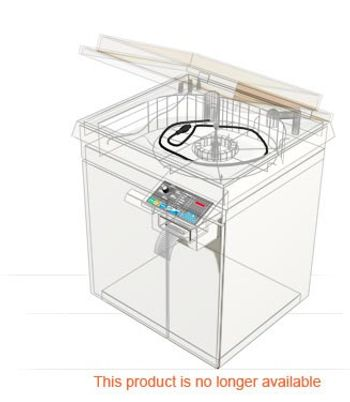
ASP Automatic Endoscope Reprocessor
 ASP · Model Automatic Endoscope Reprocessor
Complete perfusion occurs through 6 separate endoscope channel connectors. Advanced thermostat-controlled heater assures appropriate disinfectant temperature. Optional stand-alone water filtration system reduces pyrogens and provides bacteria-free rinse water; unique hollow fiber water filter technology extends filter life to minimize costs. Compatible with CIDEX OPS Solution for rapid, cost-effective, glutaraldehyde-free disinfection.
Key tips
- ·A failed leak test means the scope does not get reprocessed or used - send it for repair, full stop.
- ·A shortened reprocessing cycle is a real infection-control failure, not a minor deviation - follow AAMI ST91 exactly.
- ·Track light-source lamp-hours against the manufacturer's limit rather than running to failure.
Typical Failure Modes
Compiled for this model from its own documentation and established engineering knowledge for this equipment class - not from a verified service record. Confirm against the manufacturer's service manual.
Cycle fault / abort
HighSymptoms: Cycle stops with a fault code, scope not high-level disinfected, must be re-run.
Root cause: Water fill / drain fault, a leak-test failure, a channel-flow / pressure fault, or a chemistry-delivery fault.
Channel-flow / connector fault
MediumSymptoms: Low-flow or occlusion alarm on a scope channel, incomplete flushing.
Root cause: Wrong or worn hook-up connector, a blocked channel, or a flow-sensor fault.
Leak-test failure
HighSymptoms: The reprocessor's automated leak test fails.
Root cause: A genuine scope leak, or a worn leak-test connector / pump.
Chemistry / disinfectant concentration fault
MediumSymptoms: Low-concentration alarm, MEC test fails, dosing alarm.
Root cause: Empty or expired disinfectant, a dosing-pump fault, or a concentration-monitor fault.
Water-quality / filtration fault
MediumSymptoms: Water-quality alarm, poor rinse, filter-change overdue.
Root cause: Loaded pre-filter / final micron filter, or an RO / water-supply issue.
Serviceable Parts & Consumables
Serviceable items for this model, compiled from its documentation and engineering knowledge for this equipment class. Service class and relative cost are estimates, not manufacturer figures; no part numbers are given. Confirm intervals and pricing against the manufacturer.
Water filters (pre-filter & final micron)
Class Frequent wear itemRel. cost $$R&R Easy
Scope hook-up / channel connectors
Class Frequent wear itemRel. cost $$R&R Easy
Dosing / circulation pump
Class Periodic replacementRel. cost $$$R&R Difficult
Leak-test pump / connector
Class Periodic replacementRel. cost $$R&R Moderate
Door / chamber seal
Class Periodic replacementRel. cost $$R&R Moderate
| Part | Service class | Relative cost | R&R difficulty |
|---|---|---|---|
| Water filters (pre-filter & final micron) | Frequent wear item | $$ | Easy |
| Scope hook-up / channel connectors | Frequent wear item | $$ | Easy |
| Dosing / circulation pump | Periodic replacement | $$$ | Difficult |
| Leak-test pump / connector | Periodic replacement | $$ | Moderate |
| Door / chamber seal | Periodic replacement | $$ | Moderate |
Relative cost: $ lowest · $$$$ highest service-part cost for this equipment class. Not a price.
PM Checklist
Preventive-maintenance tasks typical of this equipment class. Perform to the manufacturer's procedure and your facility's policy - this is general reference, not a schedule for this specific unit.
- ·Leak testing before each reprocessing cycle
- ·Scope reprocessing per AAMI ST91
- ·Light source lamp-hour tracking
- ·Annual full PM
Troubleshooting Approach
A starting sequence for this model, compiled from its documentation and engineering knowledge for this equipment class. Follow the manufacturer's service documentation for the actual procedure.
Symptom: Cycle fault / abort
- Note the fault code and the phase it aborted in.
- Confirm the correct hook-up connectors for that scope model and that all channels are connected.
- Check the water supply, filters and drain.
- Run the MEC / concentration test.
- Follow the service manual for the specific code.
Symptom: Leak-test failure
- Repeat the manual / bench leak test on the scope to confirm a genuine leak.
- If the scope passes, inspect the reprocessor's leak-test connector and pump.
- Replace the leak-test connector.
- Re-run the automated leak test.
- Quarantine and send the scope for repair if it genuinely leaks.
Typical Location
Where this class of equipment is typically deployed - general reference, not this unit's own placement record.
- Endoscopy suite / GI lab
- Operating Room
- Bronchoscopy suite
Documents & Manuals
No documents available for this device yet.
Troubleshoot this device with Bio
Describe a symptom or error code. Bio answers from this device's own documented error codes, failure modes, parts, and guides.
Ask Bio