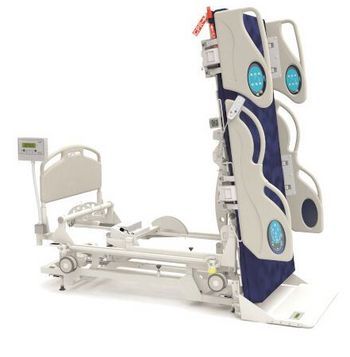
Arjo Total Lift Bed
 Arjo · Model Total Lift Bed
Complying with early mobility protocols Patented Foot Lifter Footboard Safety during movement while standing Patented weight bearing control system Flexible positioning In bed chair position.
Key tips
- ·Mounting and securement hardware takes real fatigue from vibration and road shock - inspect it as carefully as the device itself.
- ·Post-call battery and function checks catch transport-induced faults that a scheduled PM would miss for months.
Typical Failure Modes
Compiled for this model from its own documentation and established engineering knowledge for this equipment class - not from a verified service record. Confirm against the manufacturer's service manual.
Hand control not responding / no powered movement
HighSymptoms: Lift / lower or traverse does not respond to the hand control.
Root cause: Discharged or mis-inserted battery, an active emergency stop, an obstruction or overload, or a faulty hand control / cable.
Lift actuator / strap / mast fault
MediumSymptoms: Will not raise or lower, runs one direction only, noisy or slow, strap frays.
Root cause: Worn lift actuator / motor, or a frayed / twisted lifting strap or chain.
Battery will not hold charge
MediumSymptoms: Short run time, frequent low-battery, unit dies mid-transfer.
Root cause: Aged battery pack or a charger / charging-contact fault.
Traverse / rail-carriage fault (ceiling)
MediumSymptoms: Carriage will not move along the rail, or binds.
Root cause: Worn carriage wheels, a rail obstruction, or the traverse motor.
Overload / slack-strap / emergency-lowering fault
HighSymptoms: Lift stops with an overload indication, slack-strap cut-off active, or emergency lowering does not work.
Root cause: Load over the rated limit, the slack-strap sensor, or the emergency-lowering mechanism.
Serviceable Parts & Consumables
Serviceable items for this model, compiled from its documentation and engineering knowledge for this equipment class. Service class and relative cost are estimates, not manufacturer figures; no part numbers are given. Confirm intervals and pricing against the manufacturer.
Rechargeable battery pack
Class Periodic replacementRel. cost $$R&R Easy
Hand control
Class Periodic replacementRel. cost $$R&R Easy
Lifting strap / chain
Inspect before every use; retire on any fraying.
Class Periodic replacementRel. cost $$R&R Fairly easy
Lift actuator / motor assembly
Class Major service partRel. cost $$$R&R Difficult
Rail-carriage wheel set (ceiling)
Class Major service partRel. cost $$R&R Moderate
| Part | Service class | Relative cost | R&R difficulty |
|---|---|---|---|
| Rechargeable battery pack | Periodic replacement | $$ | Easy |
| Hand control | Periodic replacement | $$ | Easy |
| Lifting strap / chain Inspect before every use; retire on any fraying. | Periodic replacement | $$ | Fairly easy |
| Lift actuator / motor assembly | Major service part | $$$ | Difficult |
| Rail-carriage wheel set (ceiling) | Major service part | $$ | Moderate |
Relative cost: $ lowest · $$$$ highest service-part cost for this equipment class. Not a price.
PM Checklist
Preventive-maintenance tasks typical of this equipment class. Perform to the manufacturer's procedure and your facility's policy - this is general reference, not a schedule for this specific unit.
- ·Post-call function and battery check
- ·Mounting / securement inspection
- ·Annual full PM and vibration-tolerance check
Troubleshooting Approach
A starting sequence for this model, compiled from its documentation and engineering knowledge for this equipment class. Follow the manufacturer's service documentation for the actual procedure.
Symptom: Hand control not responding
- Confirm a charged, correctly inserted battery.
- Clear any obstruction and check the load is within the rated limit.
- Confirm the emergency stop is inactivated.
- Reseat the hand-control plug; try the up/down buttons on the unit if fitted.
- If the unit buttons work, replace the hand control; if not, use the emergency lowering and call qualified personnel.
Symptom: Will not raise or lower
- Check the strap / chain is not twisted, frayed or fouled at the drum.
- Listen for the lift actuator / motor.
- Confirm the slack-strap cut-off is not active (strap under tension).
- Replace a damaged strap immediately.
- Replace the actuator / motor if it will not run under command, then load-test to the rated limit.
Typical Location
Where this class of equipment is typically deployed - general reference, not this unit's own placement record.
- Ambulance / transport vehicles
- Emergency Department
- Inter-facility transport teams
Documents & Manuals
Safety & Recalls
Synced live from the FDA openFDA API.
- RECALL
There is a low but existing entrapment risk for a patient being treated on the Contoura 1000 and Contoura 1080 bariatric beds if they have a BMI < 40.
- RECALL
ArjoHuntleigh has received reports of unintended movement where the backrest and/or thigh sections of the bed have moved without anyone consciously pressing the control button. These incidents have occurred in High Dependency and Intensive Therapy environments where unintended movement of the patient may have serious consequences.
- RECALL
The Entroy Pool Lift boom may rapidly lower un-commanded to the bottom of its stroke, with a potential for injury to the resident or caregiver.
- RECALL
The manufacturer, BHM Medical, has received reports of structural failure of the mast during use.
- RECALL
The armrests of the lift chair may push up, allowing the patient to slip down and out of the seat. The resultant fall could result in serious or fatal patient injuries.
- RECALL
Scale could break and fall potentially causing injuries to someone who is on it. There is a potential for the mast scale load cell ssembly to fracture and allow the mast/boom to fall. Should a patient be in the lift at the time, the patient could fall and sustain injuries.
- RECALL
Repeated use of the ratchets that lock the position of the back and leg rest of the stretcher may damage the retention pin that prevents the latch from disengaging from the anchor system. This would allow the backrest to pivot freely down to the floor.
- RECALL
The hanger bar assembly may detach from the lift during use due to fatigue failure of the bolt.
- RECALL
There has been an increased number of tipping incidents and subsequent patient injuries.
- RECALL
The hanger bar may detach from the jib yoke, and the M8 bolt in the foot pedal assembly may come loose, resulting in the patient lift becoming unstable.
- RECALL
The tension pin was not installed in spreader bar pivot bolt to prevent the pivot bolt from migrating out of the spreader bar, allowing the spreader bar to detach from the lift.
Troubleshoot this device with Bio
Describe a symptom or error code. Bio answers from this device's own documented error codes, failure modes, parts, and guides.
Ask Bio