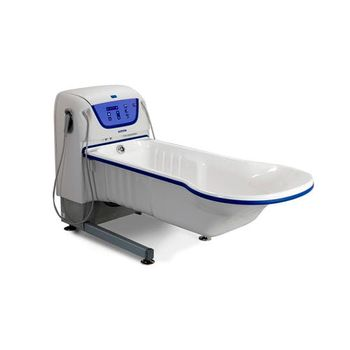
Arjo Bath Systems
 Arjo · Model Bath Systems
Arjo bathing systems are designed for flexibility. A complete system for safe management of the entire bathing process. Height adjustable, as well as highly adaptable. Features Control panel with electronic control functions operated by touchpad or push buttons. Electro-hydraulic lifting mechanism. Digital display showing bath water and fill and shower temperatures. Auto-fill automatically fills the tub. Pop-up drain incl. built-in overflow and flexible drain package for wall and floor connection. Options include functions like Sound & Vision, Hydromassage and Hydrosound.
Key tips
- ·Most "no output" stim-unit complaints are cable-side - check electrode/lead continuity before assuming a unit fault.
- ·Frame and strap wear on mechanical rehab equipment is a real fall/injury risk - don't defer it as cosmetic.
Typical Failure Modes
Compiled for this model from its own documentation and established engineering knowledge for this equipment class - not from a verified service record. Confirm against the manufacturer's service manual.
Motor / actuator / drive will not run or is weak
HighSymptoms: Traction force not applied, CPM carriage will not move or stalls, drive assist weak, motion one direction only.
Root cause: Worn drive motor / leadscrew / actuator, a hand-control fault, or a control-board fault.
Force / range / position inaccuracy
MediumSymptoms: Set traction force or CPM angle not reached, load cell drifts, carriage overshoots or stalls short.
Root cause: Load-cell / position-sensor drift, a potentiometer fault, or a limit-switch fault.
Hand control / patient-control fault
MediumSymptoms: Hand control unresponsive, the patient stop / reverse button does not work.
Root cause: Worn hand control or a damaged cable.
Frame / bearing / cable wear
MediumSymptoms: Rough or noisy travel, play in the carriage, frayed traction cord or rope.
Root cause: Worn bearings / slides or a frayed cable / cord.
Power / battery fault
LowSymptoms: Will not power on, short battery run time.
Root cause: Power supply / fuse or an aged battery.
Serviceable Parts & Consumables
Serviceable items for this model, compiled from its documentation and engineering knowledge for this equipment class. Service class and relative cost are estimates, not manufacturer figures; no part numbers are given. Confirm intervals and pricing against the manufacturer.
Drive motor / leadscrew / actuator
Class Major service partRel. cost $$$R&R Difficult
Load cell / position sensor / potentiometer
Class Major service partRel. cost $$R&R Moderate
Hand control
Class Periodic replacementRel. cost $$R&R Fairly easy
Bearings / slides / traction cord
Class Periodic replacementRel. cost $$R&R Moderate
Power supply / fuse / battery
Class Major service partRel. cost $R&R Moderate
| Part | Service class | Relative cost | R&R difficulty |
|---|---|---|---|
| Drive motor / leadscrew / actuator | Major service part | $$$ | Difficult |
| Load cell / position sensor / potentiometer | Major service part | $$ | Moderate |
| Hand control | Periodic replacement | $$ | Fairly easy |
| Bearings / slides / traction cord | Periodic replacement | $$ | Moderate |
| Power supply / fuse / battery | Major service part | $ | Moderate |
Relative cost: $ lowest · $$$$ highest service-part cost for this equipment class. Not a price.
PM Checklist
Preventive-maintenance tasks typical of this equipment class. Perform to the manufacturer's procedure and your facility's policy - this is general reference, not a schedule for this specific unit.
- ·Frame and strap wear inspection
- ·Electrode lead continuity check
- ·Annual electrical safety test
Troubleshooting Approach
A starting sequence for this model, compiled from its documentation and engineering knowledge for this equipment class. Follow the manufacturer's service documentation for the actual procedure.
Symptom: Motor / actuator will not run
- Confirm mains / battery and that any e-stop / patient stop is released.
- Try the hand control and, if fitted, the unit buttons to isolate the control.
- Listen for the drive motor and check the leadscrew is not jammed.
- Replace the hand control, motor or control board as isolated.
- Verify the achieved force / range against a reference after repair.
Symptom: Force or range not reached
- Run the calibration / homing routine.
- Check the load-cell / position sensor and the limit switches.
- Verify with a known weight (traction) or a goniometer (CPM).
- Replace the sensor if it drifts.
- Re-verify and confirm the patient stop works.
Typical Location
Where this class of equipment is typically deployed - general reference, not this unit's own placement record.
- Physical therapy / rehab gym
- Outpatient rehab clinic
- Sports medicine
Documents & Manuals
Safety & Recalls
Synced live from the FDA openFDA API.
- RECALL
The armrests of the lift chair may push up, allowing the patient to slip down and out of the seat. The resultant fall could result in serious or fatal patient injuries.
- RECALL
Repeated use of the ratchets that lock the position of the back and leg rest of the stretcher may damage the retention pin that prevents the latch from disengaging from the anchor system. This would allow the backrest to pivot freely down to the floor.
Troubleshoot this device with Bio
Describe a symptom or error code. Bio answers from this device's own documented error codes, failure modes, parts, and guides.
Ask Bio