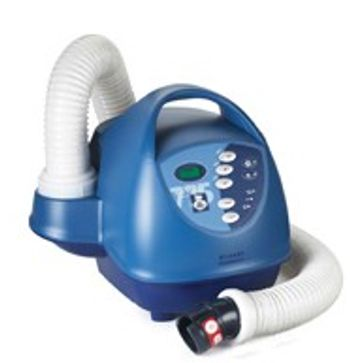
Arizant Bair Hugger Model 775
 Arizant · Model Bair Hugger Model 775
Adjustable airflow, precise temperature delivery and ease of use from a single, quiet warming unit Two airflow settings and hose-end temperature sensing ensure precise temperature delivery and compatibility with all Bair Hugger blanket styles - pediatric to adult Three temperature sensors and adjustable airflow provide safe, quick temperature response and greater heat transfer Tracks and reports forced-air warming therapy duration, over-temperature information, calibration, built-in hour meter and fault codes all via the front panel - no need to open the unit Compatible with Bair Hugger 241® blood/fluid warming set High-efficiency 0.2 µm air filter Safe, quick temperature response Adjustable airflow, precise temperature delivery, and ease of use from a single, quiet warming unit Compatible with all Bair Hugger Blanket Styles - pediatric to adult.
Key tips
- ·Never skip temperature-accuracy verification to save time - it's the one check that directly prevents burns.
- ·Hose/blanket connector wear is the most common real fault and the easiest to miss on a quick visual check.
Typical Failure Modes
Compiled for this model from its own documentation and established engineering knowledge for this equipment class - not from a verified service record. Confirm against the manufacturer's service manual.
Not delivering warm air / temperature fault
HighSymptoms: Air not warm, temperature alarm, over-temp shutdown, blows cold.
Root cause: Heater element, a temperature-sensor / thermal-cutout fault, or a control-board fault.
Low airflow / blower fault
MediumSymptoms: Weak airflow, blanket will not inflate, blower noisy.
Root cause: Worn blower, a blocked intake filter, or a kinked / disconnected hose.
Hose / adapter fault
LowSymptoms: Hose cracked, will not connect to the blanket, air leaks at the coupling.
Root cause: Worn hose or end fitting.
Filter overdue / dirty
LowSymptoms: Reduced airflow, longer warm-up.
Root cause: Clogged intake / HEPA filter.
Over-temperature safety fault
MediumSymptoms: Repeated over-temp alarms even with good airflow.
Root cause: Sensor or thermal-cutout fault.
Serviceable Parts & Consumables
Serviceable items for this model, compiled from its documentation and engineering knowledge for this equipment class. Service class and relative cost are estimates, not manufacturer figures; no part numbers are given. Confirm intervals and pricing against the manufacturer.
Heater element
Class Major service partRel. cost $$R&R Moderate
Blower / motor
Class Major service partRel. cost $$R&R Moderate
Temperature sensor / thermal cutout
Class Major service partRel. cost $$R&R Moderate
Intake / HEPA filter
Class Frequent wear itemRel. cost $R&R Easy
Delivery hose / adapter
Class Periodic replacementRel. cost $$R&R Easy
| Part | Service class | Relative cost | R&R difficulty |
|---|---|---|---|
| Heater element | Major service part | $$ | Moderate |
| Blower / motor | Major service part | $$ | Moderate |
| Temperature sensor / thermal cutout | Major service part | $$ | Moderate |
| Intake / HEPA filter | Frequent wear item | $ | Easy |
| Delivery hose / adapter | Periodic replacement | $$ | Easy |
Relative cost: $ lowest · $$$$ highest service-part cost for this equipment class. Not a price.
PM Checklist
Preventive-maintenance tasks typical of this equipment class. Perform to the manufacturer's procedure and your facility's policy - this is general reference, not a schedule for this specific unit.
- ·Hose / blanket connector inspection
- ·Temperature-accuracy verification
- ·Annual electrical safety test
Error Codes
Extracted directly from this unit's own service manual.
Fault Code 053Do not use automatic testers for service procedures; always test the temperature management unit manually. Failure to do so may cause Fault Code 053.
Over-Temperature ConditionWhen an over temperature condition exists, the following events occur: Over-temp indicator light flashes. Audible alarm sounds. Blower and heater turn off. Fault code appears in the alphanumeric display (see page 14). When the audible alarm sounds, press any button on the keypad to temporarily silence it. The temperature management unit must be unplugged before it can be restarted.
AltMode0The Hour Meter mode displays the cumulative amount of operating time (in Ambient, 32°C, 38°C, and 43°C modes) the temperature management unit has been in use. The time is displayed in whole hours only.
AltMode1The Calibration mode allows a technician to check and adjust the nozzle temperature. This should be done as part of routine maintenance and always after servicing the temperature management unit or replacing the hose. The nozzle temperature can be altered a maximum of ±3.0°C by adjusting the calibration offset value. In the Calibration mode, the temperature management unit operates in the Ambient
AltMode2The Fault Code Log mode sequentially displays the last 5 fault codes stored in system memory. Please refer to the Fault Code Table on page 14 for more information about a particular fault code.
Troubleshooting Approach
A starting sequence for this model, compiled from its documentation and engineering knowledge for this equipment class. Follow the manufacturer's service documentation for the actual procedure.
Symptom: Fluid / blood / blanket not reaching target temperature
- Confirm the correct programme / set for the fluid type and flow rate.
- Check both heater plates (or the water bath) warm evenly.
- Verify the output temperature against an independent reference at a representative flow.
- Replace the temperature sensor if it disagrees.
- Replace the heater plate / control assembly if output is still low.
Symptom: Over-temperature alarm / shutdown
- Let the unit cool and restart.
- Compare the displayed temperature to an independent reference.
- Check for an extreme flow-rate change during use (fluid warmers).
- Replace the temperature sensor / control board as isolated.
- Confirm stable control across the range before returning to service.
Symptom: Low airflow / blower fault (forced-air) or low water flow (water blanket)
- Replace the intake / HEPA filter (forced-air) or top up and de-air the reservoir (water).
- Check the hose for kinks or splits and confirm the correct blanket type.
- Inspect the blower / circulation pump and impeller.
- Replace the blower / pump if flow is still low.
- Confirm delivered air / water temperature and flow after repair.
Typical Location
Where this class of equipment is typically deployed - general reference, not this unit's own placement record.
- Operating Room
- PACU
- Emergency Department
- Labor & Delivery
- NICU
Documents & Manuals
Safety & Recalls
Synced live from the FDA openFDA API.
- RECALL
Arizant Healthcare Inc. is initiating a nationwide voluntary recall of 100/110-volt power cords (Arizant part number 502221 Model 90024) attached to its temperature management units and pressure infusion power pack (Bair Paws Temperature Management Units: Models 850 and 875 Bair Hugger Temperature Management Units: Models 500/OR, 505 (Human & Vet.), 750 (Human & Vet) and 775 Ranger Blood/Flui
- RECALL
Air channel seals on a limited number of Bair Hugger Model 555 Pediatric underbody blankets could separate when inflated with air from Bair Hugger warming unit. This separation would create a bulging area in the blanket's air channels, which could have a potential to shift the patient's position on the blanket.
Troubleshoot this device with Bio
Describe a symptom or error code. Bio answers from this device's own documented error codes, failure modes, parts, and guides.
Ask Bio