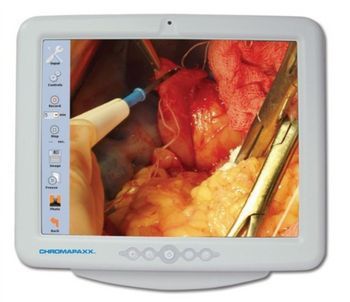
Ampronix ChromaPaxx 17C2D4G160HD
 Ampronix · Model ChromaPaxx 17C2D4G160HD
17 inch Touch Screen and digital recorder Record medical video/images via S-Video or Composite Patient database with video/image storage 50+ hours of SD Video recording Export videos (wmv) and images (jpeg) HDD anti-vibration mechanism Minimal noise fan design Anti-bacteria coating. Medical Certification Compliance (EN60601-1/UL60601-1) Surgical Grade Ingress Protection IP65 (front)/IPX1 Compliance.
Key tips
- ·Never defeat or bypass a return-electrode monitoring (REM) alarm to finish a case - it's a direct burn risk.
- ·Verify OR table battery backup - a table that loses power mid-procedure is a real, documented incident type.
- ·Track surgical light lamp-hours rather than waiting for failure - a sudden failure mid-case is avoidable.
Typical Failure Modes
Compiled for this model from its own documentation and established engineering knowledge for this equipment class - not from a verified service record. Confirm against the manufacturer's service manual.
No or poor recording / capture
HighSymptoms: Recording will not start, files corrupt, no input signal, poor image.
Root cause: Input-board / video-input fault, a cable / connector fault, or a codec / storage fault.
Storage / media fault
MediumSymptoms: "Disk full" or write errors, USB / DVD not recognised, exported files unreadable.
Root cause: Full or failing internal drive, or a worn optical / USB drive.
Network / PACS / export fault
MediumSymptoms: Studies will not send, worklist missing, share not reachable.
Root cause: Network configuration or the PACS / share connection.
Footswitch / trigger fault
LowSymptoms: Capture will not trigger from the pedal or camera button.
Root cause: Footswitch or trigger cable fault.
Fan / power fault
LowSymptoms: Overheats, shuts down, or will not power on.
Root cause: Cooling fan or power supply.
Serviceable Parts & Consumables
Serviceable items for this model, compiled from its documentation and engineering knowledge for this equipment class. Service class and relative cost are estimates, not manufacturer figures; no part numbers are given. Confirm intervals and pricing against the manufacturer.
Video input / capture board
Class Major service partRel. cost $$$R&R Difficult
Internal storage drive
Class Periodic replacementRel. cost $$R&R Moderate
Optical / USB drive
Class Periodic replacementRel. cost $R&R Fairly easy
Footswitch / trigger cable
Class Periodic replacementRel. cost $R&R Fairly easy
Cooling fan / power supply
Class Major service partRel. cost $R&R Moderate
| Part | Service class | Relative cost | R&R difficulty |
|---|---|---|---|
| Video input / capture board | Major service part | $$$ | Difficult |
| Internal storage drive | Periodic replacement | $$ | Moderate |
| Optical / USB drive | Periodic replacement | $ | Fairly easy |
| Footswitch / trigger cable | Periodic replacement | $ | Fairly easy |
| Cooling fan / power supply | Major service part | $ | Moderate |
Relative cost: $ lowest · $$$$ highest service-part cost for this equipment class. Not a price.
PM Checklist
Preventive-maintenance tasks typical of this equipment class. Perform to the manufacturer's procedure and your facility's policy - this is general reference, not a schedule for this specific unit.
- ·Pre-case functional check
- ·Electrosurgical return-electrode cable inspection
- ·Table hydraulic / mechanical inspection
- ·Annual electrical safety test and full PM
Troubleshooting Approach
A starting sequence for this model, compiled from its documentation and engineering knowledge for this equipment class. Follow the manufacturer's service documentation for the actual procedure.
Symptom: No or poor recording
- Confirm a valid input signal on each source (SDI / HDMI / DVI / composite).
- Swap the input cable and try another input.
- Check free storage space and test a short recording.
- Update / reset the codec settings per the manual.
- Replace the capture board if an input is confirmed dead.
Symptom: Storage or export fault
- Check free space and the internal drive health.
- Test export to USB and to the network share separately.
- Confirm the PACS / share settings and credentials.
- Replace a failing internal or optical drive.
- Verify an exported study opens on another workstation.
Typical Location
Where this class of equipment is typically deployed - general reference, not this unit's own placement record.
- Operating rooms
- Procedure rooms
- Interventional suites
Documents & Manuals
Troubleshoot this device with Bio
Describe a symptom or error code. Bio answers from this device's own documented error codes, failure modes, parts, and guides.
Ask Bio