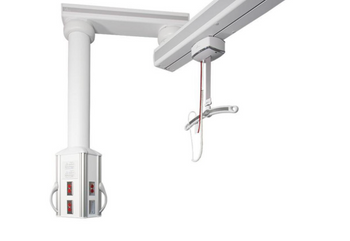
Amico GoLift In The OR
 Amico · Model GoLift In The OR
Ceiling Lift System The Amico GoLift is a ceiling lift system designed to transfer and position patients. The GoLift was created to be aesthetically pleasing yet incredibly efficient. In an effort to address infection prevention and control requirements, we incorporated smooth edges and round corners on the GoLift ceiling lift, carry bar, and capacitive touch hand control. This elimination of crevices minimizes the transmission of microorganisms and maximizes effective cleaning. The GoLift is activated with a single light touch to either the up or down arrow on the hand control. When looking at the anatomy of the GoLift, you will find an impressive set of all metal gears and state-of-the-art battery technology that allow the caregiver to safely and effortlessly transfer a patient weighing up to 700lbs (318 kg) on a single lift. For larger patients, you may combine two compact GoLift 700 systems to obtain a lifting capacity of 1000lbs (454 kg). In addition, our revolutionary trolley design allows for quick installation of the ceiling lift into and out of the track. The trolley also provides an instant mechanical and electrical connection while our modular track system gives you tremendous flexibility so that your workspace may be optimized to suit your needs for any working environment.
Key tips
- ·Mounting and securement hardware takes real fatigue from vibration and road shock - inspect it as carefully as the device itself.
- ·Post-call battery and function checks catch transport-induced faults that a scheduled PM would miss for months.
Typical Failure Modes
Compiled for this model from its own documentation and established engineering knowledge for this equipment class - not from a verified service record. Confirm against the manufacturer's service manual.
Hand control not responding / no powered movement
HighSymptoms: Lift / lower or traverse does not respond to the hand control.
Root cause: Discharged or mis-inserted battery, an active emergency stop, an obstruction or overload, or a faulty hand control / cable.
Lift actuator / strap / mast fault
MediumSymptoms: Will not raise or lower, runs one direction only, noisy or slow, strap frays.
Root cause: Worn lift actuator / motor, or a frayed / twisted lifting strap or chain.
Battery will not hold charge
MediumSymptoms: Short run time, frequent low-battery, unit dies mid-transfer.
Root cause: Aged battery pack or a charger / charging-contact fault.
Traverse / rail-carriage fault (ceiling)
MediumSymptoms: Carriage will not move along the rail, or binds.
Root cause: Worn carriage wheels, a rail obstruction, or the traverse motor.
Overload / slack-strap / emergency-lowering fault
HighSymptoms: Lift stops with an overload indication, slack-strap cut-off active, or emergency lowering does not work.
Root cause: Load over the rated limit, the slack-strap sensor, or the emergency-lowering mechanism.
Serviceable Parts & Consumables
Serviceable items for this model, compiled from its documentation and engineering knowledge for this equipment class. Service class and relative cost are estimates, not manufacturer figures; no part numbers are given. Confirm intervals and pricing against the manufacturer.
Rechargeable battery pack
Class Periodic replacementRel. cost $$R&R Easy
Hand control
Class Periodic replacementRel. cost $$R&R Easy
Lifting strap / chain
Inspect before every use; retire on any fraying.
Class Periodic replacementRel. cost $$R&R Fairly easy
Lift actuator / motor assembly
Class Major service partRel. cost $$$R&R Difficult
Rail-carriage wheel set (ceiling)
Class Major service partRel. cost $$R&R Moderate
| Part | Service class | Relative cost | R&R difficulty |
|---|---|---|---|
| Rechargeable battery pack | Periodic replacement | $$ | Easy |
| Hand control | Periodic replacement | $$ | Easy |
| Lifting strap / chain Inspect before every use; retire on any fraying. | Periodic replacement | $$ | Fairly easy |
| Lift actuator / motor assembly | Major service part | $$$ | Difficult |
| Rail-carriage wheel set (ceiling) | Major service part | $$ | Moderate |
Relative cost: $ lowest · $$$$ highest service-part cost for this equipment class. Not a price.
PM Checklist
Preventive-maintenance tasks typical of this equipment class. Perform to the manufacturer's procedure and your facility's policy - this is general reference, not a schedule for this specific unit.
- ·Post-call function and battery check
- ·Mounting / securement inspection
- ·Annual full PM and vibration-tolerance check
Troubleshooting Approach
A starting sequence for this model, compiled from its documentation and engineering knowledge for this equipment class. Follow the manufacturer's service documentation for the actual procedure.
Symptom: Hand control does not respond / no powered movement
- Confirm a charged, correctly inserted battery.
- Clear any obstruction and check the load is within the rated limit.
- Confirm the emergency stop button is not pushed in.
- Reseat the hand-control plug; try the up / down buttons on the control box if fitted.
- If the control-box buttons work, replace the hand control; if not, use the emergency lowering and refer the actuator / control box.
Symptom: Will not raise or lower / strap or actuator fault
- Check the strap / chain is not twisted, frayed or fouled at the drum - retire a frayed strap immediately.
- Listen for the lift actuator / motor under command.
- Confirm the slack-strap cut-off is not active (keep the strap under tension).
- Check the actuator supply at the control box.
- Replace the actuator / motor and load-test to the rated limit.
Symptom: Battery will not hold charge / dies mid-transfer
- Charge fully and check the charger / charging contacts.
- Run a battery test if the lift supports one.
- Replace the battery pack.
- Confirm several full lift cycles on a charge.
- Inspect the charge connector on the control box.
Symptom: Ceiling-lift carriage will not traverse / binds
- Check the rail for debris, a joint step or an end stop.
- Inspect the carriage wheels for wear or flat spots.
- Confirm the traverse motor runs (powered traverse).
- Lubricate the rail only per the manufacturer (many are dry-running).
- Replace the carriage wheel set.
Typical Location
Where this class of equipment is typically deployed - general reference, not this unit's own placement record.
- Ambulance / transport vehicles
- Emergency Department
- Inter-facility transport teams
Documents & Manuals
Troubleshoot this device with Bio
Describe a symptom or error code. Bio answers from this device's own documented error codes, failure modes, parts, and guides.
Ask Bio