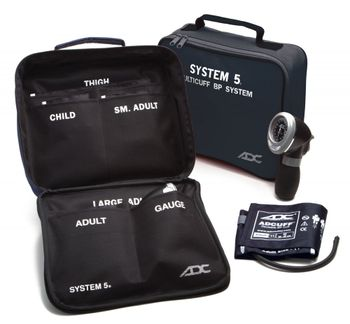
American Diagnostic Corporation System 5
 American Diagnostic Corporation · Model System 5
A multi-pocketed, heavy duty 600D nylon attaché style case that keeps each component securely in place, yet instantly accessible Dual zipper closure permits rapid access, and protects against the elements Measures a compact 10” x 9” x 4” when closed, weighs just 2 1/2 lbs. Compact enough to fit in most emergency bags or trauma boxes Reinforced carry handle allows for wall mounting in the open position Includes Child, Small Adult, Adult, Large Adult, and Thigh Adcuff™ nylon cuffs featuring the Size Guide™ marking system Quick release luer slip connector to permit rapid selection of the appropriate cuff Revolutionary Diagnostix™ #804 palm style manometer with precision Japanese engineered movement rated to 50,000 cycles Ambidextrous trigger release air valve Not made with natural rubber latex Assembled, inspected, and packaged in the U.S.A. from foreign components Meets or exceeds ANSI/AAMI/ISO 81060-1.
Key tips
- ·Mounting and securement hardware takes real fatigue from vibration and road shock - inspect it as carefully as the device itself.
- ·Post-call battery and function checks catch transport-induced faults that a scheduled PM would miss for months.
Typical Failure Modes
Compiled for this model from its own documentation and established engineering knowledge for this equipment class - not from a verified service record. Confirm against the manufacturer's service manual.
Aneroid gauge out of calibration
MediumSymptoms: Gauge disagrees with a reference manometer, or the needle does not rest in the zero band with no pressure.
Root cause: Normal drift / shock to the Bourdon-tube movement; the gauge is generally not field-adjustable.
Cuff / bladder will not hold pressure
MediumSymptoms: Slow inflation, pressure bleeds down too fast, cannot maintain a reading.
Root cause: Split or perished bladder, a cracked tube, or a loose / worn connector.
Inflation bulb / valve stiff or leaking
MediumSymptoms: Bulb hard to squeeze or perished, release valve will not give a smooth 2-3 mmHg/s deflation, or leaks down.
Root cause: Perished bulb rubber or a worn / gummed control (release) valve.
Gauge face / glass / bezel damage
LowSymptoms: Cracked lens, loose bezel, needle fouling the face.
Root cause: Drop or crush damage.
Serviceable Parts & Consumables
Serviceable items for this model, compiled from its documentation and engineering knowledge for this equipment class. Service class and relative cost are estimates, not manufacturer figures; no part numbers are given. Confirm intervals and pricing against the manufacturer.
Aneroid gauge (replacement)
Verify against a reference manometer; most movements are not field-adjustable.
Class Major service partRel. cost $R&R Easy
Cuff and bladder
Class Periodic replacementRel. cost $R&R Easy
Inflation bulb
Class Periodic replacementRel. cost $R&R Easy
Control / release valve
Class Periodic replacementRel. cost $R&R Fairly easy
Connecting tubing and connectors
Class Periodic replacementRel. cost $R&R Easy
| Part | Service class | Relative cost | R&R difficulty |
|---|---|---|---|
| Aneroid gauge (replacement) Verify against a reference manometer; most movements are not field-adjustable. | Major service part | $ | Easy |
| Cuff and bladder | Periodic replacement | $ | Easy |
| Inflation bulb | Periodic replacement | $ | Easy |
| Control / release valve | Periodic replacement | $ | Fairly easy |
| Connecting tubing and connectors | Periodic replacement | $ | Easy |
Relative cost: $ lowest · $$$$ highest service-part cost for this equipment class. Not a price.
PM Checklist
Preventive-maintenance tasks typical of this equipment class. Perform to the manufacturer's procedure and your facility's policy - this is general reference, not a schedule for this specific unit.
- ·Post-call function and battery check
- ·Mounting / securement inspection
- ·Annual full PM and vibration-tolerance check
Troubleshooting Approach
A starting sequence for this model, compiled from its documentation and engineering knowledge for this equipment class. Follow the manufacturer's service documentation for the actual procedure.
Symptom: Gauge reads inaccurately
- Connect the gauge to a calibrated reference manometer through a Y-piece with a closed volume.
- Check the zero: with no pressure the needle must rest within the zero band.
- Compare at several pressures across the range.
- Replace the gauge if it is outside tolerance (typically the movement is not field-adjustable).
- Log the calibration-check date.
Symptom: Cuff will not hold pressure / slow inflation
- Inspect the bladder, tubing and bulb for splits or perishing.
- Check the release valve seats and does not leak down too fast.
- Replace the bladder, bulb or valve as isolated, or the complete cuff.
- Re-test against a closed system for a slow, controllable release.
- Confirm the cuff size range suits the intended patients.
Technical Specs
- Sphyg Type:
- Multicuff
- Gauge:
- 804N
- Gauge Warranty:
- Lifetime
- Sphyg Accuracy:
- +/-3mmHg @ 50ºF(10ºC) - 104ºF(40ºC)
- Storage Temp:
- -4ºF (-20ºC) - 131ºF(55ºC)
- Valve Type:
- Integral
- Number of tubes:
- 1 Tube
- Cuff type:
- ADCUFF
- Cuff size:
- Multiple
- Cuff Range:
- 13-66cm
- Inflation Warranty:
- 3 Year
- Cuff color:
- Navy
- Zipper / Storage case:
- 883B
Typical Location
Where this class of equipment is typically deployed - general reference, not this unit's own placement record.
- Ambulance / transport vehicles
- Emergency Department
- Inter-facility transport teams
Documents & Manuals
Troubleshoot this device with Bio
Describe a symptom or error code. Bio answers from this device's own documented error codes, failure modes, parts, and guides.
Ask Bio