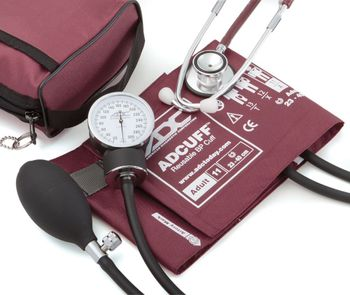
American Diagnostic Corporation Pro's Combo II DH
 American Diagnostic Corporation · Model Pro's Combo II DH
Combines ADC's ProsphygTM 768 with a ProscopeTM 670 and deluxe carry case Contemporary black enamel 300mmHg manometer Adcuff™ calibrated nylon cuff with proprietary Size Guide™ marking system prevents mis-cuffing Chrome-plated deflation valve Complete aneroid, matching case, and color-matched dualhead stethoscope Extra large, color-matched, dual pocket carry case, measures 9” x 5” x 2” Not made with natural rubber latex Assembled, inspected, and packaged in the U.S.A. from foreign components Meets or exceeds ANSI/AAMI/ISO 81060-1.
Key tips
- ·Biological-indicator verification applies to dental sterilizers exactly the same as hospital CSSD - no exception for smaller units.
- ·"Sounds different" is often the first real report of handpiece bearing wear, not an outright failure - investigate early rather than waiting.
Typical Failure Modes
Compiled for this model from its own documentation and established engineering knowledge for this equipment class - not from a verified service record. Confirm against the manufacturer's service manual.
Aneroid gauge out of calibration
MediumSymptoms: Gauge disagrees with a reference manometer, or the needle does not rest in the zero band with no pressure.
Root cause: Normal drift / shock to the Bourdon-tube movement; the gauge is generally not field-adjustable.
Cuff / bladder will not hold pressure
MediumSymptoms: Slow inflation, pressure bleeds down too fast, cannot maintain a reading.
Root cause: Split or perished bladder, a cracked tube, or a loose / worn connector.
Inflation bulb / valve stiff or leaking
MediumSymptoms: Bulb hard to squeeze or perished, release valve will not give a smooth 2-3 mmHg/s deflation, or leaks down.
Root cause: Perished bulb rubber or a worn / gummed control (release) valve.
Gauge face / glass / bezel damage
LowSymptoms: Cracked lens, loose bezel, needle fouling the face.
Root cause: Drop or crush damage.
Serviceable Parts & Consumables
Serviceable items for this model, compiled from its documentation and engineering knowledge for this equipment class. Service class and relative cost are estimates, not manufacturer figures; no part numbers are given. Confirm intervals and pricing against the manufacturer.
Aneroid gauge (replacement)
Verify against a reference manometer; most movements are not field-adjustable.
Class Major service partRel. cost $R&R Easy
Cuff and bladder
Class Periodic replacementRel. cost $R&R Easy
Inflation bulb
Class Periodic replacementRel. cost $R&R Easy
Control / release valve
Class Periodic replacementRel. cost $R&R Fairly easy
Connecting tubing and connectors
Class Periodic replacementRel. cost $R&R Easy
| Part | Service class | Relative cost | R&R difficulty |
|---|---|---|---|
| Aneroid gauge (replacement) Verify against a reference manometer; most movements are not field-adjustable. | Major service part | $ | Easy |
| Cuff and bladder | Periodic replacement | $ | Easy |
| Inflation bulb | Periodic replacement | $ | Easy |
| Control / release valve | Periodic replacement | $ | Fairly easy |
| Connecting tubing and connectors | Periodic replacement | $ | Easy |
Relative cost: $ lowest · $$$$ highest service-part cost for this equipment class. Not a price.
PM Checklist
Preventive-maintenance tasks typical of this equipment class. Perform to the manufacturer's procedure and your facility's policy - this is general reference, not a schedule for this specific unit.
- ·Daily handpiece lubrication and autoclave cycle verification
- ·Compressor moisture-trap draining
- ·Annual full PM
Troubleshooting Approach
A starting sequence for this model, compiled from its documentation and engineering knowledge for this equipment class. Follow the manufacturer's service documentation for the actual procedure.
Symptom: Gauge reads inaccurately
- Connect the gauge to a calibrated reference manometer through a Y-piece with a closed volume.
- Check the zero: with no pressure the needle must rest within the zero band.
- Compare at several pressures across the range.
- Replace the gauge if it is outside tolerance (typically the movement is not field-adjustable).
- Log the calibration-check date.
Symptom: Cuff will not hold pressure / slow inflation
- Inspect the bladder, tubing and bulb for splits or perishing.
- Check the release valve seats and does not leak down too fast.
- Replace the bladder, bulb or valve as isolated, or the complete cuff.
- Re-test against a closed system for a slow, controllable release.
- Confirm the cuff size range suits the intended patients.
Technical Specs
- Sphyg Type:
- Pro's Combo
- Gauge:
- 808
- Gauge Warranty:
- 20 Yr
- Sphyg Accuracy:
- +/-3mmHg @ 50ºF(10ºC) - 104ºF(40ºC)
- Storage Temp:
- -4ºF (-20ºC) - 131ºF(55ºC)
- Valve Type:
- Standard
- Number of tubes:
- 2 Tubes
- Cuff type:
- ADCUFF
- Cuff size:
- Adult
- Cuff Range:
- 23-40cm
- Inflation Warranty:
- 3 Year
- Cuff color:
- Burgundy
- Zipper / Storage case:
- 888BD
Typical Location
Where this class of equipment is typically deployed - general reference, not this unit's own placement record.
- Dental operatory
- Oral surgery suite
- CSSD (dental sterilizers)
Documents & Manuals
Troubleshoot this device with Bio
Describe a symptom or error code. Bio answers from this device's own documented error codes, failure modes, parts, and guides.
Ask Bio