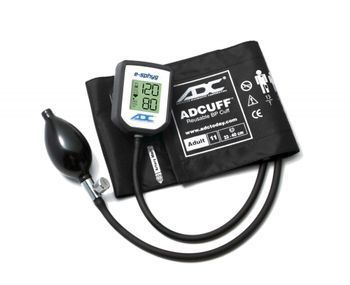
American Diagnostic Corporation E-sphyg
 American Diagnostic Corporation · Model E-sphyg
Virtually indestructible design can withstand repeated drops of 5 feet or more Splash resistant housing for use in harsh environments Extra large LCD digits are easy to read Backlit display for easy reading even in low light conditions Swivel cuff clip allows the manometer to be re-positioned for easy viewing Auto off function conserves battery strength Dual low battery warnings Recalibration reminder after 10,000 cycles (free lifetime recalibration) Systolic assist alerts practitioner to the onset of Korotkoff sounds – makes a great training aid Deflation rate display promotes proper technique in accordance with AHA guidelines Pulse rate display at completion of measurement New reading lock feature allows practitioner to lock in systolic and diastolic values during measurement Manometer works with virtually every cuff on the market Requires familiar and trusted manual auscultation to obtain blood pressure readings (use of stethoscope) 2 “AAA” batteries (included) May be ordered as a complete sphygmomanometer or gauge only for use with existing inflation systems Not made with natural rubber latex Lifetime calibration warranty Meets or exceeds ANSI/AAMI/ISO 86010-1, EN 1060-1, and EN 1060-3.
Key tips
- ·When no category-specific guidance fits, default to the manufacturer's own service manual and the general troubleshooting method in the Engineer's Guide.
- ·Run an incoming and annual electrical safety test regardless of how niche the device is.
Typical Failure Modes
Compiled for this model from its own documentation and established engineering knowledge for this equipment class - not from a verified service record. Confirm against the manufacturer's service manual.
Gauge out of calibration / CAL reminder
MediumSymptoms: Reads high or low vs a reference, or a "CAL" recalibration reminder appears after ~10,000-15,000 cycles.
Root cause: Semiconductor pressure sensor drift - the e-sphyg is not user-adjustable; return to ADC for recalibration.
"Err" heartbeat-detection error
LowSymptoms: "Err" shown, no systolic-assist prompts.
Root cause: Cuff deflated too rapidly - keep the deflation rate about 2-3 mmHg per second.
"E3" data error
LowSymptoms: "E3" on the display.
Root cause: Internal data fault - remove and reinsert the batteries; return the device if it recurs.
Cuff / bladder or valve leak
MediumSymptoms: Pressure will not hold, over-pressure or residual-pressure warning.
Root cause: Perforated bladder, cracked tubing, or a worn ADFLOW air-release valve.
Serviceable Parts & Consumables
Serviceable items for this model, compiled from its documentation and engineering knowledge for this equipment class. Service class and relative cost are estimates, not manufacturer figures; no part numbers are given. Confirm intervals and pricing against the manufacturer.
Digital manometer / sensor (ADC service only)
Do not dismantle; return to ADC for calibration.
Class Major service partRel. cost $$R&R Fairly easy
Cuff and bladder
Class Periodic replacementRel. cost $R&R Easy
ADFLOW air-release valve
Class Periodic replacementRel. cost $R&R Easy
Connecting tubing / luer connector
Class Periodic replacementRel. cost $R&R Easy
AAA alkaline batteries (x2)
Class Frequent wear itemRel. cost $R&R Easy
| Part | Service class | Relative cost | R&R difficulty |
|---|---|---|---|
| Digital manometer / sensor (ADC service only) Do not dismantle; return to ADC for calibration. | Major service part | $$ | Fairly easy |
| Cuff and bladder | Periodic replacement | $ | Easy |
| ADFLOW air-release valve | Periodic replacement | $ | Easy |
| Connecting tubing / luer connector | Periodic replacement | $ | Easy |
| AAA alkaline batteries (x2) | Frequent wear item | $ | Easy |
Relative cost: $ lowest · $$$$ highest service-part cost for this equipment class. Not a price.
PM Checklist
Preventive-maintenance tasks typical of this equipment class. Perform to the manufacturer's procedure and your facility's policy - this is general reference, not a schedule for this specific unit.
- ·Follow the manufacturer's PM schedule
- ·Perform incoming and annual electrical safety testing per facility biomedical program
Troubleshooting Approach
A starting sequence for this model, compiled from its documentation and engineering knowledge for this equipment class. Follow the manufacturer's service documentation for the actual procedure.
Symptom: Gauge suspected inaccurate
- Check the needle rests at zero (aneroid) or the display check matches the reference image (digital).
- Connect to a calibrated pressure standard with ADC's Y-test kit (part 991 / 991).
- Pressurise to ~299 mmHg and check at 299, 250, 150, 100 and 50 mmHg - should be within +/-3 mmHg.
- If out of tolerance or a CAL reminder is shown, return the gauge to ADC's Service Department.
- Record the calibration date.
Symptom: Cuff will not hold pressure
- Inflate the cuff to ~200 mmHg with the valve closed and watch the gauge.
- A steady fall means a leak - check the bladder, tubing, bulb valves and connectors.
- Replace the leaking part.
- Confirm the air-release valve opens and closes cleanly.
- Re-test the pressure hold.
Technical Specs
- Sphyg Type:
- Digital Aneroid
- Gauge:
- 8002
- Gauge Warranty:
- Lifetime
- Sphyg Accuracy:
- +/-3mmHg @ 50ºF(10ºC) - 104ºF(40ºC)
- Storage Temp:
- -4ºF (-20ºC) - 131ºF(55ºC)
- Valve Type:
- ADFLOW
- Number of tubes:
- 2 Tubes
- Cuff type:
- ADCUFF
- Cuff size:
- Adult
- Cuff Range:
- 23-40cm
- Inflation Warranty:
- 3 Year
- Cuff color:
- Black
- Zipper / Storage case:
- 880
Typical Location
Where this class of equipment is typically deployed - general reference, not this unit's own placement record.
- Varies by device - check the unit's own manual for facility placement guidance
Documents & Manuals
Troubleshoot this device with Bio
Describe a symptom or error code. Bio answers from this device's own documented error codes, failure modes, parts, and guides.
Ask Bio