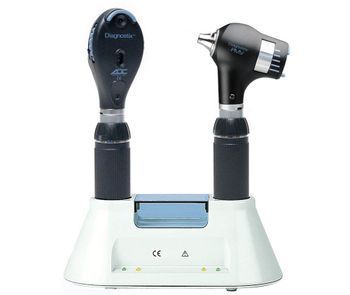
American Diagnostic Corporation Diagnostix 5510/5580
 American Diagnostic Corporation · Model Diagnostix 5510/5580
Choose a 3.5V Diagnostix Coax Plus Ophthalmoscope or Coax Ophthalmoscope Choose a 3.5V Diagnostix PMV Otoscope or Standard Otoscope Two Li-ion Adtronic rechargeable battery handles for improved performance. 50 hours continuous use between charges, 1,200 cycle life 3.5V Throat Illumination head available 3.5V Dermascope head available Choose from Halogen/Xenon or AdLED lighting technology Desk Charger holds up to two instrument handles and spare specula and comes complete with wall-mount bracket and hardware Two-year warranty on desk charger, instrument heads, and handles; lifetime warranty on AdLED lamp.
Key tips
- ·Verify laser output with a real power meter, not the unit's own display - the display can drift independently of true output.
- ·Take "the image looks a little off" reports seriously - optical alignment drift is usually gradual, not sudden.
Typical Failure Modes
Compiled for this model from its own documentation and established engineering knowledge for this equipment class - not from a verified service record. Confirm against the manufacturer's service manual.
Aneroid gauge out of calibration
MediumSymptoms: Reads high or low vs a reference, needle off zero at rest.
Root cause: Wear or a shock event to the movement.
Cuff bladder or tubing leak
MediumSymptoms: Pressure will not hold, slow steady drop on the gauge.
Root cause: Perforated bladder, cracked tubing, or a leaking connector.
Air-release valve fault
MediumSymptoms: Bulb will not build pressure, deflates too fast or sticks.
Root cause: Worn air-release valve or bulb one-way valve.
Bulb / connector wear
LowSymptoms: Cracked inflation bulb or a leaking connector.
Root cause: Age and handling.
Serviceable Parts & Consumables
Serviceable items for this model, compiled from its documentation and engineering knowledge for this equipment class. Service class and relative cost are estimates, not manufacturer figures; no part numbers are given. Confirm intervals and pricing against the manufacturer.
Aneroid gauge / movement
Class Major service partRel. cost $$R&R Fairly easy
Cuff and bladder
Class Periodic replacementRel. cost $R&R Easy
Air-release valve
Class Periodic replacementRel. cost $R&R Easy
Inflation bulb
Class Periodic replacementRel. cost $R&R Easy
Connecting tubing / connector
Class Periodic replacementRel. cost $R&R Easy
| Part | Service class | Relative cost | R&R difficulty |
|---|---|---|---|
| Aneroid gauge / movement | Major service part | $$ | Fairly easy |
| Cuff and bladder | Periodic replacement | $ | Easy |
| Air-release valve | Periodic replacement | $ | Easy |
| Inflation bulb | Periodic replacement | $ | Easy |
| Connecting tubing / connector | Periodic replacement | $ | Easy |
Relative cost: $ lowest · $$$$ highest service-part cost for this equipment class. Not a price.
PM Checklist
Preventive-maintenance tasks typical of this equipment class. Perform to the manufacturer's procedure and your facility's policy - this is general reference, not a schedule for this specific unit.
- ·Optical alignment / calibration check
- ·Lamp or laser output verification
- ·Annual full PM
Troubleshooting Approach
A starting sequence for this model, compiled from its documentation and engineering knowledge for this equipment class. Follow the manufacturer's service documentation for the actual procedure.
Symptom: Gauge suspected inaccurate
- Check the needle rests at zero.
- Tee to a calibrated reference manometer and compare at 60, 150 and 250 mmHg.
- If error exceeds +/-3 mmHg, replace the gauge / movement.
- Re-verify against the reference.
- Record the calibration date.
Symptom: Cuff will not hold pressure
- Inflate the cuff to ~200 mmHg with the valve closed and watch the gauge.
- A steady fall means a leak - check the bladder, tubing, bulb valve and connector.
- Replace the leaking part.
- Confirm the air-release valve seats cleanly.
- Re-test the pressure hold.
Typical Location
Where this class of equipment is typically deployed - general reference, not this unit's own placement record.
- Eye clinic / ophthalmology suite
- Operating Room (ophthalmic surgery)
Documents & Manuals
Troubleshoot this device with Bio
Describe a symptom or error code. Bio answers from this device's own documented error codes, failure modes, parts, and guides.
Ask Bio