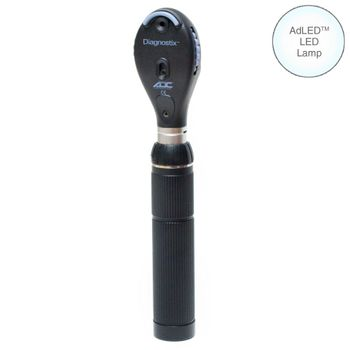
American Diagnostic Corporation Diagnostix 54122
 American Diagnostic Corporation · Model Diagnostix 54122
Coax Plus Ophthalmoscope Head (p/n 5442) features: High-performance aspherical condenser lens reduces corneal reflection Further reduction provided by utilizing distinct parallel observational and illuminating light beams (Gullstrand’s Equation) Ergonomic design and integral thumb rest improves stability and allows one-finger control of all functions Synthetic rubber brow rest facilitates use with practitioner eyeglasses Dust proof Magnified, illuminated aperture viewing window Universal bayonet mount for compatibility with other brands of 3.5V power supply handles Anti-theft locking feature is standard Choose from halogen/xenon or high-performance AdLED illumination Two-year warranty on instrument, lifetime warranty on AdLED lamp 89 viewing lenses from -44 to +45 in single step 28 aperture/filter combinations for improved diagnostic capability Secondary focusing wheel with zero retention for quick correction of ametropias, provides virtually unlimited fine focus or fast focus in lieu of the 89 viewing lenses The addition of a Karo (grid) aperture that allows for easier transfer of observations to standard Karo (graph) paper 6 apertures include: Slit – used to help determine levels of tumors and lesions Fixation – has graduated crosshairs for measuring eccentric fixation or locating lesions Large – standard aperture for a dilated pupil and general examination of the eye Small – provides excellent view of fundus through an undilated pupil Micro spot – allows quick entry into small, undilated pupils Half moon – provides a combination of depth perception and field of view 3 filters (plus neutral) include: Red free – excludes red rays from examination field for easy identification of veins, arteries, and nerve fibers Cobalt – used with fluorescent dye to view small lesions, abrasions, and foreign objects on the cornea Polarizing – virtually eliminates corneal reflection Battery Handle features: C-sized handle with 1400mAh Li-ion battery CNC machined from solid brass, the handle is chrome plated in black with a ribbed surface for a sure grip Adtronic electronic rheostatic light intensity control provides infinite continuous control and auto-off feature after two minutes Top half of handle unscrews to access wall plug (available in US or Euro fittings) Li-ion battery provides two to three hours continuous use with halogen/xenon lamp, 30 hours use with LED lamp when charged for 24 hours Up to 1,200 charge cycles Universal bayonet mount for compatibility with other brands of 3.5V instrument heads.
Key tips
- ·Verify laser output with a real power meter, not the unit's own display - the display can drift independently of true output.
- ·Take "the image looks a little off" reports seriously - optical alignment drift is usually gradual, not sudden.
Typical Failure Modes
Compiled for this model from its own documentation and established engineering knowledge for this equipment class - not from a verified service record. Confirm against the manufacturer's service manual.
Optical / illumination fault
MediumSymptoms: Dim, uneven or no illumination; poor or hazy view; slit / filters not working.
Root cause: Bulb / LED at end of life, a power-supply fault, or contaminated optics.
Alignment / positioning-stage fault
MediumSymptoms: Joystick or slide binds, will not hold position, chin-rest / head-rest drive faults.
Root cause: Worn stage bearings / slides or a positioning-drive fault.
Measurement / capture fault
MediumSymptoms: Reading errors (tonometer / autorefractor / lensmeter), no or poor image capture (fundus / OCT), calibration fails.
Root cause: Sensor / camera fault, a calibration issue, or contaminated measurement optics.
Printer / PC / connectivity fault
LowSymptoms: No printout, images / data will not save or transfer.
Root cause: Built-in printer, the PC, or the network / EMR interface.
Motorised table / chin-rest fault (where fitted)
LowSymptoms: Instrument table or chin-rest will not raise / lower.
Root cause: Table / chin-rest actuator or its switch.
Serviceable Parts & Consumables
Serviceable items for this model, compiled from its documentation and engineering knowledge for this equipment class. Service class and relative cost are estimates, not manufacturer figures; no part numbers are given. Confirm intervals and pricing against the manufacturer.
Illumination bulb / LED module
Class Frequent wear itemRel. cost $$R&R Fairly easy
Positioning-stage bearings / slides
Class Major service partRel. cost $$R&R Moderate
Measurement sensor / camera module
Class Major service partRel. cost $$$R&R Moderate
Built-in printer / paper
Class Periodic replacementRel. cost $R&R Fairly easy
Chin-rest / table actuator
Class Major service partRel. cost $$R&R Moderate
| Part | Service class | Relative cost | R&R difficulty |
|---|---|---|---|
| Illumination bulb / LED module | Frequent wear item | $$ | Fairly easy |
| Positioning-stage bearings / slides | Major service part | $$ | Moderate |
| Measurement sensor / camera module | Major service part | $$$ | Moderate |
| Built-in printer / paper | Periodic replacement | $ | Fairly easy |
| Chin-rest / table actuator | Major service part | $$ | Moderate |
Relative cost: $ lowest · $$$$ highest service-part cost for this equipment class. Not a price.
PM Checklist
Preventive-maintenance tasks typical of this equipment class. Perform to the manufacturer's procedure and your facility's policy - this is general reference, not a schedule for this specific unit.
- ·Optical alignment / calibration check
- ·Lamp or laser output verification
- ·Annual full PM
Troubleshooting Approach
A starting sequence for this model, compiled from its documentation and engineering knowledge for this equipment class. Follow the manufacturer's service documentation for the actual procedure.
Symptom: Dim, uneven or no illumination
- Replace the bulb / LED module with the correct type.
- Check the power supply and rheostat / brightness control.
- Clean the illumination and viewing optics per the manual.
- Confirm the slit, filters and apertures operate.
- Replace the power supply if output is still low.
Symptom: Measurement or capture error
- Run the instrument self-test / calibration.
- Clean the measurement window / objective.
- Verify against a model eye / test target where one exists.
- Confirm patient positioning and fixation.
- Refer the sensor / camera module if calibration will not hold.
Typical Location
Where this class of equipment is typically deployed - general reference, not this unit's own placement record.
- Eye clinic / ophthalmology suite
- Operating Room (ophthalmic surgery)
Documents & Manuals
No documents available for this device yet.
Troubleshoot this device with Bio
Describe a symptom or error code. Bio answers from this device's own documented error codes, failure modes, parts, and guides.
Ask Bio