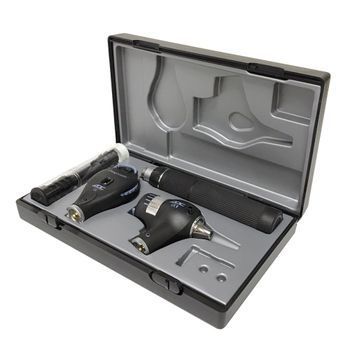
American Diagnostic Corporation Diagnostix 5410/5480
 American Diagnostic Corporation · Model Diagnostix 5410/5480
Choose a 3.5V Diagnostix Coax Plus Ophthalmoscope or Coax Ophthalmoscope Choose a 3.5V Diagnostix PMV Otoscope or Standard Otoscope Li-ion Adtronic plug-in rechargeable battery handle for improved performance 30 hours continuous use between charges. 1,200 cycle life Choice of hard or soft case holds instruments securely 3.5V Throat Illumination head available 3.5V Dermascope head available Choose from Halogen/Xenon or AdLED LED lighting technology Two-year warranty on instrument heads and handle, lifetime warranty on AdLED lamps.
Key tips
- ·Verify laser output with a real power meter, not the unit's own display - the display can drift independently of true output.
- ·Take "the image looks a little off" reports seriously - optical alignment drift is usually gradual, not sudden.
Typical Failure Modes
Compiled for this model from its own documentation and established engineering knowledge for this equipment class - not from a verified service record. Confirm against the manufacturer's service manual.
Optical / illumination fault
MediumSymptoms: Dim, uneven or no illumination; poor or hazy view; slit / filters not working.
Root cause: Bulb / LED at end of life, a power-supply fault, or contaminated optics.
Alignment / positioning-stage fault
MediumSymptoms: Joystick or slide binds, will not hold position, chin-rest / head-rest drive faults.
Root cause: Worn stage bearings / slides or a positioning-drive fault.
Measurement / capture fault
MediumSymptoms: Reading errors (tonometer / autorefractor / lensmeter), no or poor image capture (fundus / OCT), calibration fails.
Root cause: Sensor / camera fault, a calibration issue, or contaminated measurement optics.
Printer / PC / connectivity fault
LowSymptoms: No printout, images / data will not save or transfer.
Root cause: Built-in printer, the PC, or the network / EMR interface.
Motorised table / chin-rest fault (where fitted)
LowSymptoms: Instrument table or chin-rest will not raise / lower.
Root cause: Table / chin-rest actuator or its switch.
Serviceable Parts & Consumables
Serviceable items for this model, compiled from its documentation and engineering knowledge for this equipment class. Service class and relative cost are estimates, not manufacturer figures; no part numbers are given. Confirm intervals and pricing against the manufacturer.
Illumination bulb / LED module
Class Frequent wear itemRel. cost $$R&R Fairly easy
Positioning-stage bearings / slides
Class Major service partRel. cost $$R&R Moderate
Measurement sensor / camera module
Class Major service partRel. cost $$$R&R Moderate
Built-in printer / paper
Class Periodic replacementRel. cost $R&R Fairly easy
Chin-rest / table actuator
Class Major service partRel. cost $$R&R Moderate
| Part | Service class | Relative cost | R&R difficulty |
|---|---|---|---|
| Illumination bulb / LED module | Frequent wear item | $$ | Fairly easy |
| Positioning-stage bearings / slides | Major service part | $$ | Moderate |
| Measurement sensor / camera module | Major service part | $$$ | Moderate |
| Built-in printer / paper | Periodic replacement | $ | Fairly easy |
| Chin-rest / table actuator | Major service part | $$ | Moderate |
Relative cost: $ lowest · $$$$ highest service-part cost for this equipment class. Not a price.
PM Checklist
Preventive-maintenance tasks typical of this equipment class. Perform to the manufacturer's procedure and your facility's policy - this is general reference, not a schedule for this specific unit.
- ·Optical alignment / calibration check
- ·Lamp or laser output verification
- ·Annual full PM
Troubleshooting Approach
A starting sequence for this model, compiled from its documentation and engineering knowledge for this equipment class. Follow the manufacturer's service documentation for the actual procedure.
Symptom: Will not power on or unexpected shutdown
- Confirm the outlet, mains lead and fuse; try another outlet.
- Try on battery, then on mains only, to isolate the supply.
- Look for a power indicator or a self-test / POST code.
- Replace the fuse / battery / power supply as isolated.
- Run the self-test after any repair.
Symptom: Fails self-test or the scheduled performance / calibration check
- Note the exact failure message or code.
- Power-cycle and repeat the self-test.
- Verify against a reference / simulator / phantom where one applies.
- Recalibrate per the service manual.
- Refer the affected board / sensor for service if it will not hold calibration.
Symptom: Battery will not hold charge / short run time
- Fully charge, then run a capacity test if the device supports one.
- Check the charging circuit and the contacts.
- Replace the battery pack when capacity is below the service limit.
- Recalibrate the battery gauge if supported.
- Confirm run time meets spec after replacement.
Symptom: Display / control-panel or connectivity fault
- Power-cycle the device fully.
- Check the display / backlight and its cable, or the network / data cable.
- Recalibrate the touchscreen if the touch is offset.
- Confirm settings (network address, printer, interface) and send a test.
- Replace the display / control board or refer the interface as isolated.
Typical Location
Where this class of equipment is typically deployed - general reference, not this unit's own placement record.
- Eye clinic / ophthalmology suite
- Operating Room (ophthalmic surgery)
Documents & Manuals
Troubleshoot this device with Bio
Describe a symptom or error code. Bio answers from this device's own documented error codes, failure modes, parts, and guides.
Ask Bio