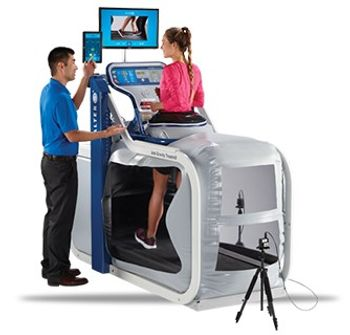
AlterG M320
 AlterG · Model M320
Allows patients to rehabilitate with less pain while reducing the risk of further injury, which may enable patients to heal faster. Provides physical therapists a precise way to track patient progress, keeping patients engaged and motivated during rehab. Helps clinics, therapists and trainers set themselves apart by offering the most advanced physical therapy technology available. Acts as both a rehab device and wellness tool that gets patients excited to continue using it for training beyond short term rehab. Safely improve patients’ mobility, and as a result, increase independence during day-to-day activities and improve wellness. Provide a fall-safe environment, giving elderly patients the confidence to walk further, faster, and with a more normal gait. Reduce patient discomfort and risk of injury, as well as hesitancy during walking.
Key tips
- ·Most "no output" stim-unit complaints are cable-side - check electrode/lead continuity before assuming a unit fault.
- ·Frame and strap wear on mechanical rehab equipment is a real fall/injury risk - don't defer it as cosmetic.
Typical Failure Modes
Compiled for this model from its own documentation and established engineering knowledge for this equipment class - not from a verified service record. Confirm against the manufacturer's service manual.
Motor / actuator / drive will not run or is weak
HighSymptoms: Traction force not applied, CPM carriage will not move or stalls, drive assist weak, motion one direction only.
Root cause: Worn drive motor / leadscrew / actuator, a hand-control fault, or a control-board fault.
Force / range / position inaccuracy
MediumSymptoms: Set traction force or CPM angle not reached, load cell drifts, carriage overshoots or stalls short.
Root cause: Load-cell / position-sensor drift, a potentiometer fault, or a limit-switch fault.
Hand control / patient-control fault
MediumSymptoms: Hand control unresponsive, the patient stop / reverse button does not work.
Root cause: Worn hand control or a damaged cable.
Frame / bearing / cable wear
MediumSymptoms: Rough or noisy travel, play in the carriage, frayed traction cord or rope.
Root cause: Worn bearings / slides or a frayed cable / cord.
Power / battery fault
LowSymptoms: Will not power on, short battery run time.
Root cause: Power supply / fuse or an aged battery.
Serviceable Parts & Consumables
Serviceable items for this model, compiled from its documentation and engineering knowledge for this equipment class. Service class and relative cost are estimates, not manufacturer figures; no part numbers are given. Confirm intervals and pricing against the manufacturer.
Drive motor / leadscrew / actuator
Class Major service partRel. cost $$$R&R Difficult
Load cell / position sensor / potentiometer
Class Major service partRel. cost $$R&R Moderate
Hand control
Class Periodic replacementRel. cost $$R&R Fairly easy
Bearings / slides / traction cord
Class Periodic replacementRel. cost $$R&R Moderate
Power supply / fuse / battery
Class Major service partRel. cost $R&R Moderate
| Part | Service class | Relative cost | R&R difficulty |
|---|---|---|---|
| Drive motor / leadscrew / actuator | Major service part | $$$ | Difficult |
| Load cell / position sensor / potentiometer | Major service part | $$ | Moderate |
| Hand control | Periodic replacement | $$ | Fairly easy |
| Bearings / slides / traction cord | Periodic replacement | $$ | Moderate |
| Power supply / fuse / battery | Major service part | $ | Moderate |
Relative cost: $ lowest · $$$$ highest service-part cost for this equipment class. Not a price.
PM Checklist
Preventive-maintenance tasks typical of this equipment class. Perform to the manufacturer's procedure and your facility's policy - this is general reference, not a schedule for this specific unit.
- ·Frame and strap wear inspection
- ·Electrode lead continuity check
- ·Annual electrical safety test
Error Codes
Extracted directly from this unit's own service manual.
EThe safety magnet has been displaced. Place the safety magnet in proper location and press START.
Place the safety magnet in proper location and press START.
LThe cockpit has not been locked prior to START.
Ensure the cockpit is fully locked in position and press START.
OPROver pressure error. The pressure is higher than requested for a particular degree of unweighting. Outflow from the pressure control valve may be blocked or the valve may not be operating correctly.
Press START. If the error persists call AlterG Customer Support.
UPRUnder pressure error. The system is unable to reach the requested pressure for a particular degree of unweighting. There may be a leak, the subject may be too heavy, or the output of the blower may be blocked.
Check system for leaks. Press START. If error persists call AlterG Customer Support.
SCOThe scale offset value is out of range. The weighing scales or electronics may be damaged. The system may have been turned on with someone standing on the treadmill.
Remove the subject from the system. Raise the cockpit and cycle the power switch off-on. Wait 30 seconds before attempting to use the system again. If error persists call AlterG Customer Support.
PRSThe pressure offset value is out of range. The pressure sensor may need replacement.
Remove the subject from the system. Raise the cockpit and cycle the power switch off-on. Wait 30 seconds before attempting to use the system again. If error persists call AlterG Customer Support.
CE#Indicates an error during the calibration process. The subject may be moving too much, there may be an air leak or the system may have been turned on with someone standing on the treadmill.
Check for leaks. Instruct patient to stand still. Press START. If error persists, remove the subject from the system. Raise the cockpit and cycle the power switch off-on. Wait 30 seconds before attempting to use the system again. If error persists call AlterG Customer Support.
L5Treadmill motor control board, speed sensor or treadmill motor may be bad.
Call AlterG Customer Support
POThe treadmill elevation motor may need replacing, the elevation function may need to be re-calibrated or the elevation potentiometer may be bad.
Call AlterG Customer Support
Troubleshooting Approach
A starting sequence for this model, compiled from its documentation and engineering knowledge for this equipment class. Follow the manufacturer's service documentation for the actual procedure.
Symptom: No or low output on a modality / channel
- Fit a fresh applicator / handpiece / electrodes for that modality.
- Substitute a known-good lead / cable.
- Test therapeutic-ultrasound output into a water bath (visible cavitation / warmth) and run the applicator-contact / BNR self-test.
- Try the modality on another unit if available.
- Escalate a confirmed output-stage fault to the OEM.
Symptom: Patient feels nothing / open-circuit on an e-stim channel
- Fit fresh self-adhesive electrodes on well-prepped skin.
- Swap the lead wires.
- Confirm the current ramps and there is no open-electrode alarm.
- Test the channel into a resistive load per the manual.
- Refer the output stage if a good lead set still gives nothing.
Symptom: Unresponsive or erratic touchscreen / parameters will not set
- Power-cycle the unit.
- Recalibrate / re-seat the touchscreen if the touch is offset.
- Check the mains fuse and power supply.
- Confirm the cooling fan runs and the vents are clear.
- Replace the touchscreen or power supply as isolated.
Typical Location
Where this class of equipment is typically deployed - general reference, not this unit's own placement record.
- Physical therapy / rehab gym
- Outpatient rehab clinic
- Sports medicine
Documents & Manuals
Troubleshoot this device with Bio
Describe a symptom or error code. Bio answers from this device's own documented error codes, failure modes, parts, and guides.
Ask Bio