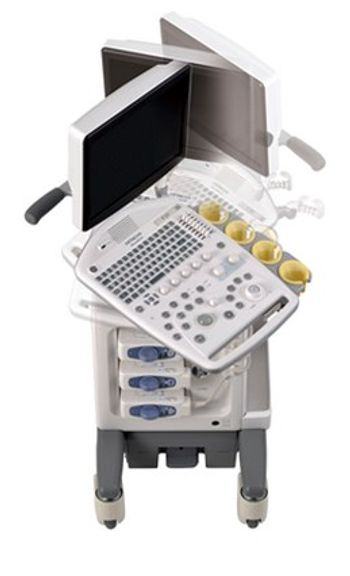
Aloka ProSound F37
 Aloka · Model ProSound F37
The most advanced broadband beam-forming technology combined with high speed image processing that allows for higher definition ultrasound imaging than ever before. Provides high quality imaging using an expanded range of harmonic signals. This technology results in excellent image resolution and sensitivity and improved penetration. Clearly displays differences in tissues, reducing speckle noise while maintaining the frame rate. It can also display outlines more clearly by selectively emphasizing boundaries. The ultrasound beam is transmitted and received in real time and in the multiple directions resulting in a reduction of speckle noise, suppression of artifacts, and improvement of contrast resolution allowing lesions to be clearly observed At the touch of a button the B-mode image is instantly optimized to the user’s preference. This technology continually monitors the user’s typical settings to optimally adjust the image when pressed resulting in less manual adjustments and more efficient examinations. The new high-efficiency probes are very lightweight and designed to be high in energy conversion to transmit high-quality ultrasound beams without raising the temperature on the probe surface. The image quality contributes to reduction of examination time Patient-friendly examinations enabled by the small size of the probe Basic measurement results can be transferred onto the report Unique probe holder for endocavity probes.
Key tips
- ·Never bypass a radiation interlock to "just get the image" - this is one of the few true zero-tolerance rules in BMET work.
- ·Trend image-quality phantom results over time - drift shows up before an outright failure does.
- ·Portable/mobile units take real physical abuse from transport - check wheel locks and cable strain reliefs more often than fixed units.
Typical Failure Modes
Compiled for this model from its own documentation and established engineering knowledge for this equipment class - not from a verified service record. Confirm against the manufacturer's service manual.
Poor 2D image quality / channel dropout
HighSymptoms: Noisy or non-uniform image, missing sector, artefacts across multiple probes.
Root cause: Front-end / beamformer board fault, or a transducer-connector (probe port) fault.
Transducer not recognised / probe-port fault
MediumSymptoms: A probe is not detected on one port but works on another.
Root cause: Worn probe-port connector or a scan-connector board fault.
Will not power on / boot fault
HighSymptoms: Dead system, no boot, or intermittent shutdowns.
Root cause: Power supply / DC converter, the battery, or a system-board fault.
Battery will not hold charge (portable)
MediumSymptoms: Short run time, will not charge, powers off unexpectedly.
Root cause: Aged battery pack.
Touchscreen / control-panel or display fault
MediumSymptoms: Unresponsive controls, distorted or blank display.
Root cause: Touchscreen, control-panel board, or the display.
Overheating / cooling fault
LowSymptoms: Thermal shutdown, loud fan.
Root cause: Failed fan or blocked air path.
Serviceable Parts & Consumables
Serviceable items for this model, compiled from its documentation and engineering knowledge for this equipment class. Service class and relative cost are estimates, not manufacturer figures; no part numbers are given. Confirm intervals and pricing against the manufacturer.
Front-end / beamformer board
Class Major service partRel. cost $$$$R&R Difficult
Probe-port / scan-connector board
Class Major service partRel. cost $$$R&R Difficult
Power supply / DC converter
Class Major service partRel. cost $$$R&R Difficult
Battery pack
Class Periodic replacementRel. cost $$R&R Easy
Touchscreen / control-panel board
Class Major service partRel. cost $$$R&R Moderate
Cooling fan
Class Major service partRel. cost $R&R Moderate
| Part | Service class | Relative cost | R&R difficulty |
|---|---|---|---|
| Front-end / beamformer board | Major service part | $$$$ | Difficult |
| Probe-port / scan-connector board | Major service part | $$$ | Difficult |
| Power supply / DC converter | Major service part | $$$ | Difficult |
| Battery pack | Periodic replacement | $$ | Easy |
| Touchscreen / control-panel board | Major service part | $$$ | Moderate |
| Cooling fan | Major service part | $ | Moderate |
Relative cost: $ lowest · $$$$ highest service-part cost for this equipment class. Not a price.
PM Checklist
Preventive-maintenance tasks typical of this equipment class. Perform to the manufacturer's procedure and your facility's policy - this is general reference, not a schedule for this specific unit.
- ·Daily QC per modality: image-quality phantom test
- ·Tube and detector inspection
- ·Annual state-required radiation safety survey
- ·Vendor-scheduled preventive maintenance
Error Codes
Extracted directly from this unit's own service manual.
program error: 00000001SYSTEM ERROR program error: 00000001
preset data errorSYSTEM ERROR preset data error :
Invalid Patient Diagnosis Information FiSYSTEM ERROR Invalid Patient Diagnosis Information File May I delete study information after the last New Patient ?
If the "Yes" button is selected in the displayed dialog box, the patient database for temporary storage is initialized, and the error message is not displayed the next time the machine is started. Initializing this database deletes last patient information data.
ERROR: Measurement processingSYSTEM ERROR ERROR: Measurement processing PDB : pdbER_CALL (********H)******************************.cpp(****) or SYSTEM ERROR ERROR: Measurement processing is finished. CMF : cmfER_DB_ACCESS (********H)*****************************.cpp(****)
A read error likely occurred because the patient database (for master, for temporary storage) on the machine hard disk drive is corrupted, or the structure is not appropriate for the current software version. If the PRESET button is lit, see "Volume 2: Chapter 3, Service information" – "System reset", and initialize the patient database. Initializing this database deletes all patient information data and image data stored on the machine. If the PRESET button is not lit, contact our technical support.
NO PROBEWhen the probe not connected The machine starts but ultrasound images are not displayed. Some characters and graphics are displayed on the LCD monitor, and only the operation panel switch allocated the EXT function (default is F11) and the probe selection switch are enabled. A "NO PROBE" message is displayed at the top right of the screen.
Invalid probe connectedWhen an unsupported probe has been connected or the probe cannot be correctly recognized The machine starts, but a "Invalid probe connected" message is displayed, and ultrasound images are not displayed. Some characters and graphics are displayed on the LCD monitor, and only the operation panel switch allocated the EXT function (default is F11) and the probe selection switch are enabled. A "NO PRO
Troubleshooting Approach
A starting sequence for this model, compiled from its documentation and engineering knowledge for this equipment class. Follow the manufacturer's service documentation for the actual procedure.
Symptom: Poor image / probe not recognised
- Try the probe on a second port and a known-good probe on the suspect port.
- Wipe off all gel and inspect the probe lens; try on a phantom.
- Inspect the probe-port connectors for bent pins or debris.
- Run any built-in front-end diagnostics.
- Replace the probe-port board or front-end board as isolated.
Symptom: Will not power on / short battery life
- Confirm mains / charger operation and try with the battery removed.
- Check the power supply / DC-converter output.
- Fully charge and time the battery run.
- Replace the battery pack if run time is short.
- Refer the power supply or system board as isolated.
Typical Location
Where this class of equipment is typically deployed - general reference, not this unit's own placement record.
- Radiology / Imaging department
- Emergency Department (portable units)
- Operating Room (C-arms)
- Cath lab
- Bedside ICU (portable X-ray)
Documents & Manuals
Troubleshoot this device with Bio
Describe a symptom or error code. Bio answers from this device's own documented error codes, failure modes, parts, and guides.
Ask Bio