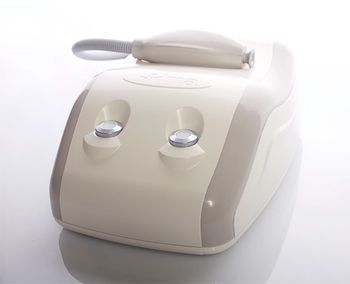
Alma Lasers Reboost
 Alma Lasers · Model Reboost
Stress, pollution, UV radiation and an unbalanced diet can all have a negative impact on our skin. As we age, our skin becomes dull, wrinkles begin to appear and the texture of our skin can become coarse and uneven. Proper skin care is essential for maintaining the vitality and glow of healthy, youthful skin. Alma Beauty, a sub-brand of medical technology leader Alma Lasers, has developed an advanced skin rejuvenation solution that treats skin imperfections with instant results. ALMA BEAUTY REBOOST. ALMA BEAUTY REBOOST uses the power of acoustic oscillations to enhance the effectiveness of the entire skin treatment session- from cleansing and exfoliation to the application and penetration of therapeutic dermatological ingredients. REBOOST emits acoustic waves of mechanical pressure on the skin. These create a push and pull effect, exfoliating the skin by removing dead skin cells and excess sebum. The acoustic vibrations also cause gaseous bubbles within the skins barrier, or the stratum corneum, to rapidly expand and collapse. This disorganizes the lipid bi-layer, creating crevices and pores between 25-75 micrometers in diameter, and increases the fluidity of the lipids in the stratum corneum. More fluidity in sub-epidermal tissue allows topical ingredients to penetrate the skin more deeply and effectively. Both hydrophobic and hydrophilic compounds are effectively delivered to the target tissue depth and remain active for up to 30 minutes after application, for maximally effective skin repair and aesthetic enhancement. Multiple clinical studies and extensive laboratory testing has proven the ability of REBOOST technology to deliver active ingredients deep beyond the skin barrier and has shown positive change in skin appearance following each treatment. The REBOOST treatment is easy to administer, is safe for all skin types and can be performed all year round. Patients experience no discomfort or downtime and enjoy immediate, dramatic results.
Key tips
- ·Verify true laser output with an external power meter, not the console readout - the display drifts independently of real delivered energy.
- ·Never bypass a door interlock, key switch, or footswitch safety to finish a treatment - laser safety interlocks are not optional.
- ·Most low-output complaints trace to the delivery fiber or handpiece, not the laser source - inspect and swap those first.
- ·Intermittent mid-treatment shutdowns are usually cooling-related - check coolant level and flow before suspecting the diode or lamp.
Typical Failure Modes
Compiled for this model from its own documentation and established engineering knowledge for this equipment class - not from a verified service record. Confirm against the manufacturer's service manual.
No or low laser output
HighSymptoms: Weak or no output at the delivery device, treatment ineffective, power not reaching the set value.
Root cause: Laser module / lamp / diode-bar ageing, a damaged delivery fibre / handpiece / applicator, or a driver / power-supply fault.
Cooling / thermal shutdown
HighSymptoms: Unit shuts down after a period, over-temperature or low-flow alarm.
Root cause: Chiller / TEC fault, low or contaminated coolant, a failed pump, or blocked airflow.
Delivery fibre / handpiece / applicator fault
MediumSymptoms: Burn marks at the tip, high loss, intermittent output, applicator not recognised.
Root cause: Damaged or contaminated fibre / applicator / connector.
Skin-cooling / contact-cooling fault (aesthetic)
MediumSymptoms: Skin cooling not delivered, cooling / cryogen alarm.
Root cause: Contact-cooling / cryogen supply, a valve, or the tip.
Footswitch / interlock / key fault
MediumSymptoms: Laser will not fire, key / interlock / footswitch error.
Root cause: Footswitch, door interlock, or key-switch fault.
Serviceable Parts & Consumables
Serviceable items for this model, compiled from its documentation and engineering knowledge for this equipment class. Service class and relative cost are estimates, not manufacturer figures; no part numbers are given. Confirm intervals and pricing against the manufacturer.
Laser module / lamp / diode bar
Power re-calibration required after replacement.
Class Periodic replacementRel. cost $$$$R&R Expert-level
Delivery fibre / handpiece / applicator
Class Frequent wear itemRel. cost $$$R&R Fairly easy
Chiller / TEC components & coolant filter
Class Periodic replacementRel. cost $$$R&R Difficult
Contact-cooling tip / cryogen valve (aesthetic)
Class Periodic replacementRel. cost $$R&R Moderate
Footswitch
Class Periodic replacementRel. cost $$R&R Fairly easy
| Part | Service class | Relative cost | R&R difficulty |
|---|---|---|---|
| Laser module / lamp / diode bar Power re-calibration required after replacement. | Periodic replacement | $$$$ | Expert-level |
| Delivery fibre / handpiece / applicator | Frequent wear item | $$$ | Fairly easy |
| Chiller / TEC components & coolant filter | Periodic replacement | $$$ | Difficult |
| Contact-cooling tip / cryogen valve (aesthetic) | Periodic replacement | $$ | Moderate |
| Footswitch | Periodic replacement | $$ | Fairly easy |
Relative cost: $ lowest · $$$$ highest service-part cost for this equipment class. Not a price.
PM Checklist
Preventive-maintenance tasks typical of this equipment class. Perform to the manufacturer's procedure and your facility's policy - this is general reference, not a schedule for this specific unit.
- ·Laser output power verification against a calibrated external power meter
- ·Cooling-system check: coolant level, flow rate, and filter / heat-exchanger condition
- ·Delivery-system inspection: handpiece, delivery fiber or articulated arm, and output optics
- ·Interlock, key-switch, emergency-stop, and footswitch function test
- ·Beam-alignment and optical-path check per the service manual
- ·Annual full PM and electrical safety test
Troubleshooting Approach
A starting sequence for this model, compiled from its documentation and engineering knowledge for this equipment class. Follow the manufacturer's service documentation for the actual procedure.
Symptom: No or low output
- Measure output at the delivery device with a laser power meter against the setting.
- Fit a known-good delivery fibre / handpiece / applicator.
- Confirm the cooling system runs and coolant is at level and clean.
- Check the key, interlock and footswitch are satisfied.
- Escalate a confirmed laser-module or driver fault to the OEM; recalibrate power after any module work.
Symptom: Thermal shutdown
- Confirm the cooling fans / pump run and airflow is clear.
- Check the coolant level and replace the coolant filter.
- Let the unit cool and restart.
- Clean the air filters / vents.
- Monitor for recurrence during a treatment.
Typical Location
Where this class of equipment is typically deployed - general reference, not this unit's own placement record.
- Operating rooms and surgical procedure suites
- Dermatology and medical-aesthetic clinics
- ENT, gynecology, and specialty procedure rooms
- Outpatient surgical centers
Documents & Manuals
Troubleshoot this device with Bio
Describe a symptom or error code. Bio answers from this device's own documented error codes, failure modes, parts, and guides.
Ask Bio